Google AI
The Times Australia
Business and Money

Job creation isn't always a good thing. Hobart's new stadium can only make Tasmania's housing crisis worse

  • Written by John Quiggin, Professor, School of Economics, The University of Queensland
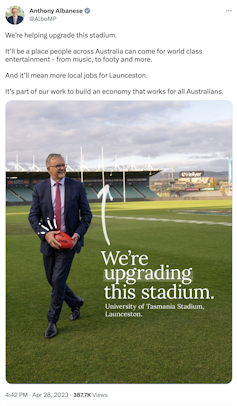
Anthony Albanese's Twitter account spruiks the federal funding for Tasmania.

The Albanese government’s announcement it will provide $240 million for a new stadium in Hobart has not had the favourable reception it might have hoped.

Those concerned with the proper operation of the federal system can point out that this kind of funding is the concern of state and local governments.
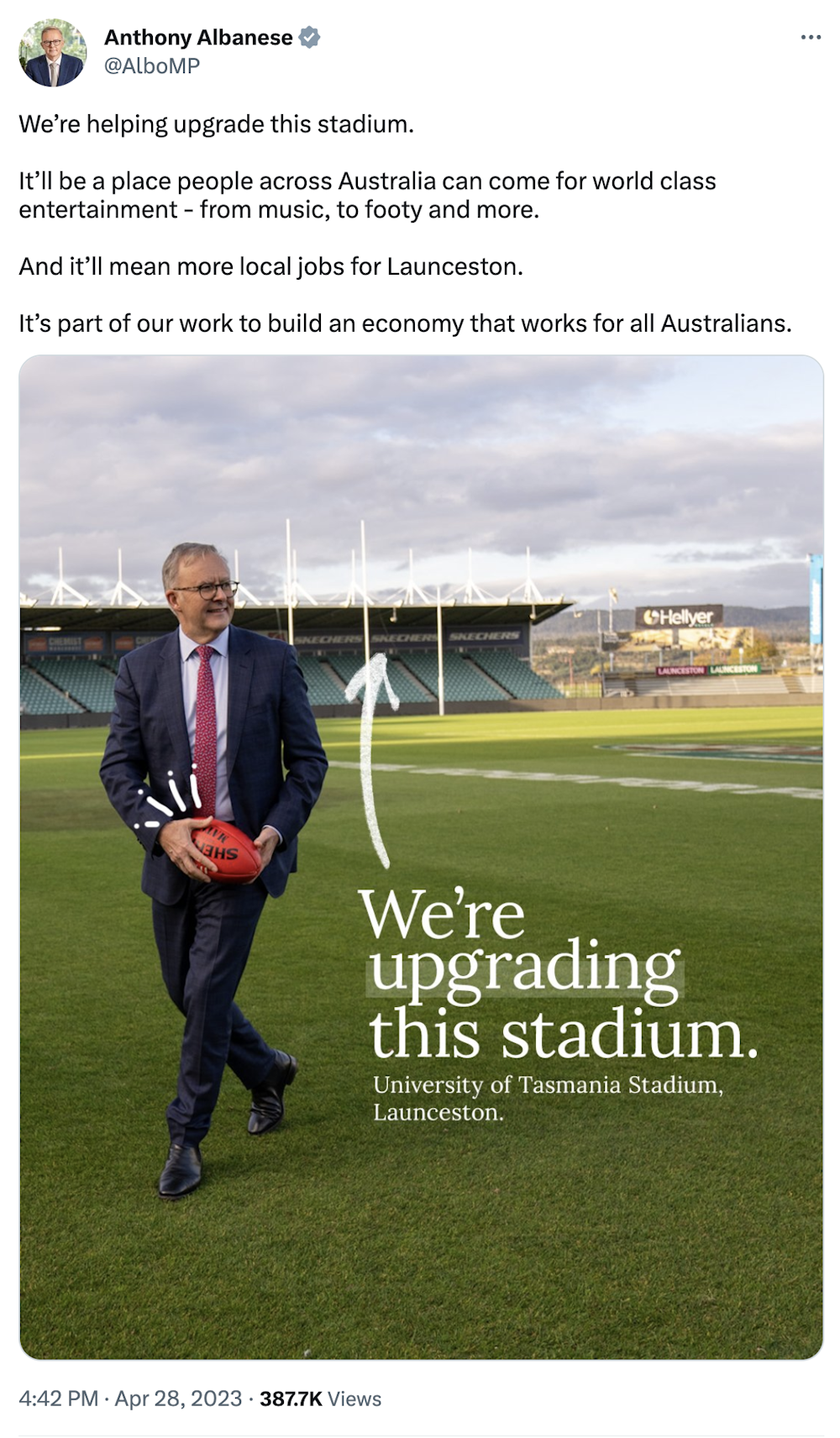
Anthony Albanese's Twitter account spruiks the federal funding for Tasmania.
Twitter, CC BY[1] Concerns about process are reinforced by the sorry history of “sports rorts[2]”. Both Labor and Liberal federal governments have funded sports facilities to curry political favour. To be fair, it is hard to see this project as targeted at a particular seat, but presumably the aim was to win support in Tasmania as a whole. Even compared with the dubious economics of sporting events such as the Formula 1 Grand Prix and the Olympic Games, stadium developments stand out as boondoggles. Extensive research in the US is summarised by the conclusion[3] that over the past 30 years, building sports stadiums has been a profitable undertaking for large sports teams, at the expense of the general public. While there are some short-term benefits, the inescapable truth is the economic benefit of these projects for local communities is minimal. Indeed, they can be an obstacle to real development. Read more: Devils in the detail: an economist argues the case for a Tasmanian AFL team – and new stadium[4] Making the business case The economic case for the Hobart Stadium is startlingly thin. The only clear-cut benefit attributable to the project is that the new Tasmanian AFL team will play its home games there, replacing the small number of AFL rounds played at Hobart’s existing stadium, Bellerive Oval. In 2022, eight AFL men’s games[5] were played in Tasmania – four at Bellerive, four at UTAS Stadium in Launceston. A local AFL team will play 11 home games. The North Melbourne Kangaroos warm up before their Round 15 match against the Adelaide Crows at Blundstone Arena, also known as Bellerive Oval. Linda Higginson/AAP The state government’s business case estimates that 5,000 interstate visitors will attend seven matches a year. It seems safe to assume some will fly in and out on the same day, and that few will stay more than two nights. If we allow an average of one night per visitor, that’s 35,000 bed nights, or an increase of about 0.3% in current visitor nights for Tasmania (about 11 million a year[6] in 2022). Against that must be offset the Tasmanians who will travel to Melbourne and elsewhere for away games. What about housing? All of this is par for the course for projects of this kind. The big problem for both state and federal governments is that it comes at a time of a housing crisis. The federal government’s press release[7] contains some vague references to housing developments associated with the project. But this is little more than the sort of PR spin we’d expect from, for example, the proponents of a new coal mine. The numbers here are quite startling. The centrepiece of federal Labor’s election platform was a $10 billion fund for housing[8], providing $500 million year to support social housing. (Labor’s bill is currently held up in the Senate, with the Coalition opposed, and the Greens demanding stronger action.) Read more: Labor's proposed $10 billion social housing fund isn't big as it seems, but it could work[9] If this $500 million were allocated proportionally by population, Tasmania would get about $10 million a year. The Commonwealth’s $240 million contribution to the stadium would cover this expenditure until nearly 2050. The total public outlay on the Hobart stadium (with $375 million from the Tasmanian government) would cover most of this century. At a time of extreme fiscal stringency, such a massive outlay on a luxury project is very hard to justify. What about job creation? No serious benefit-cost analysis of this project has been made. Instead, supporters have relied on announcing the number of jobs it will create – 4,200 jobs during construction[10] and 950 jobs when operational. Such numbers are questionable. To make them bigger, governments typically count on the “multiplier effect” of work created for suppliers of various kinds. This is a long-standing tradition taken to new heights by the Albanese government. The announcement of the AUKUS submarine project, for example, was all about the jobs[11] it would create. Read more: $18 million a job? The AUKUS subs plan will cost Australia way more than that[12] But wait a moment. At the same time as trumpeting the creation of jobs for construction workers, the government is seeking to solve Australia’s “skills shortage” arising from historically low unemployment. Tasmania’s unemployment rate is 3.8%, marginally above the average for Australia, but lower than at any time since the economic crisis of the 1970s. This low rate represents a situation of full employment, where numbers of unemployed workers and job vacancies are roughly equal. In such circumstances, creating a job means luring a worker away from another. If the new job is on a major construction project, that means one less worker available to build housing. As I argue in my book, Economics in Two Lessons[13] (Princeton University Press, 2019), the true costs of wasteful public expenditure are opportunity costs – the alternatives that are foregone. Multiplier effects make opportunity costs even larger. The project diverts the workers employed directly, and takes all kinds of resources that could otherwise be used for socially useful purposes. This diversion of necessary resources is the truly pernicious aspect of publicly subsidising projects like the AFL stadium. Tasmania, like the rest of Australia, does not need government action to create any more jobs, particularly in construction. It needs to ensure skilled workers are employed where they can be most valuable. References^ CC BY (creativecommons.org)^ sports rorts (theconversation.com)^ summarised by the conclusion (econreview.berkeley.edu)^ Devils in the detail: an economist argues the case for a Tasmanian AFL team – and new stadium (theconversation.com)^ eight AFL men’s games (www.afltas.com.au)^ 11 million a year (www.tourismtasmania.com.au)^ press release (www.pm.gov.au)^ $10 billion fund for housing (theconversation.com)^ Labor's proposed $10 billion social housing fund isn't big as it seems, but it could work (theconversation.com)^ 4,200 jobs during construction (theconversation.com)^ all about the jobs (theconversation.com)^ $18 million a job? The AUKUS subs plan will cost Australia way more than that (theconversation.com)^ Economics in Two Lessons (press.princeton.edu)Authors: John Quiggin, Professor, School of Economics, The University of Queensland

Read more https://theconversation.com/job-creation-isnt-always-a-good-thing-hobarts-new-stadium-can-only-make-tasmanias-housing-crisis-worse-204806

Business Times

Your AI is only as smart as your search

Enterprises are pouring billions into artificial intelligence, and many are not seeing the return they expected. The reason...

Where Australians Are Making Their Money Right Now

Australia’s economy in 2026 is sending mixed signals. On one hand, households are under pressure. Interest rates remain ...

In the age of AI, why do Australian company boards have so few te…

The global economy is undergoing major transformation as artificial intelligence (AI) filters into almost every industry ...

The Times Features

The Decentralized DJ: How Play House is Rewriting the M…

The traditional music industry model is currently facing its most significant challenge since the ...

What Australians Use YouTube For

In Australia, YouTube is no longer just a video platform—it is infrastructure. It entertains, e...

Independent MPs warn NDIS funding cuts risk leaving vul…

Federal Independent MPs have called on the Albanese Government to provide greater transparency...

While Fuel Has Our Attention, There Are Many More Issue…

Australia is once again fixated on fuel. Petrol prices rise, headlines follow, political pressu...

Recent outbreaks highlight the risks of bacterial menin…

Outbreaks of bacterial meningococcal disease in England[1] and recent cases in students in New Z...

Nationals leader Matt Canavan promotes work from home t…

Nationals leader Matt Canavan has urged the embrace of work-from-home opportunities as a way to ...

Nearly Half of Disadvantaged Australian Schools Run Lib…

A new national snapshot from Dymocks Children’s Charities reveals outdated books, no librarians ...

Why a Skin Check Should Be Part of Your Gather Round Pl…

There’s a certain rhythm to AFL Gather Round - long days outdoors, packed stands, and a city that ...

Kinder Joy Hosts a Free Night in the Museum Dinosaur Ad…

This April, Kinder Joy invites families to step into a thrilling after-hours dinosaur adventure ...