Our research shows higher carbon emissions increase costs for Australian businesses
- Written by: Adam G. Arian, Lecturer (Accounting & Finance), Australian Catholic University
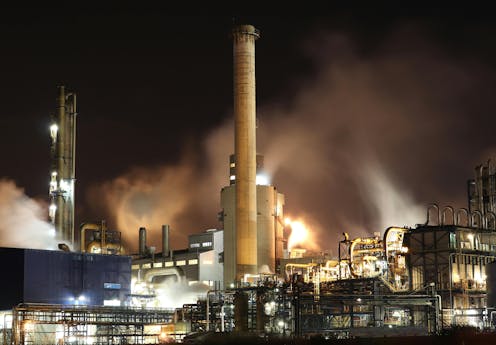
Imagine every ton of carbon dioxide a company emits is slowly inflating its costs — not just in terms of potential fines or fees but in the capital it needs to grow and operate.
This isn’t just an environmental issue, it’s a stark reality many companies experience today.
Our new research[1], looking at more than a thousand Australian-listed companies from 2007 to 2020 reveals higher carbon emissions significantly increase the costs to business.
Similar analysis has been done in Europe[2] and North America[3] where environmental regulations are tough and longstanding. But ours is the first analysis of its type in Australia where regulations are less stringent.
Emissions linked to costs
Our research, using panel regression analysis[4] - a statistical method often used in social science, demography and econometrics - shows companies with higher emissions are seen as riskier investments.
Due to confidentiality agreements about financial data, we are unable to disclose company names. But the trend was consistent across utilities, energy, industrial and other sectors.
This risk isn’t about stock market ups and downs; it’s about how individual companies stand out from others due to their environmental practices.
In finance, this type of risk is known as “idiosyncratic risk[5]”. It refers to the dangers a company faces on its own, separate from the broader market, often driven by specific actions like how much carbon it emits.
Higher risk translates into higher costs when these companies try to raise money. Whether it’s taking out a loan or selling shares, the market demands greater returns to compensate for the higher risk, driving up costs.
Essentially, the more a company pollutes[6] the more expensive it becomes for it to fund growth and operations.
The markets are watching
Today’s markets are increasingly vigilant about environmental impacts.
Investors and lenders make decisions based on how companies manage their carbon emissions. For every extra ton of emissions, a company’s expansion costs can jump by 18.5% due to higher operational and compliance risks.
Higher expansion costs can cut into profits and damage a company’s financial health. A big carbon footprint risks putting off environmentally conscious investors and consumers, reducing market value.
Reducing footprints isn’t just about corporate goodwill, it’s a critical financial strategy. It lowers the perceived risk and, subsequently, costs.
Energy efficient companies have a smaller environmental impact and greater investment appeal.
Managing risks and finances
The implications of our research extends beyond individual companies.
It provides evidence for more rigorous reporting of corporate carbon emissions. Clear and consistent disclosure of these figures is good for transparency and improves company valuations[8].
For regulators and policymakers, these findings boost the case for stronger environmental legislation demanding rigorous emission disclosures and reductions.
Our findings are in line with the government’s proposed environmental regulations[9], to enforce stricter emission disclosures and reduction targets.
These measures are also designed to promote more favorable financial conditions in the capital markets, making Australian companies more competitive globally.
Everyone benefits
As pressure for sustainable operations increases, managing emissions is emerging as not just an environmental responsibility but as a savvy business move.
Companies with low-carbon practices have a competitive edge[10] in market perception and real financial terms.
This isn’t just about combating climate change. Understanding and managing carbon emissions is about securing a financially viable future in an increasingly green economy. It helps[11] the planet and the wallet.
Our analysis provides a critical insight into why businesses need to design strategies aimed at sustainability and business success is inextricably linked to effective carbon management.
By making environmental responsibility a financial strategy[12], companies can ensure their future is greener and financially sound[13].
References
- ^ new research (www.sciencedirect.com)
- ^ Europe (www.sciencedirect.com)
- ^ North America (www.stern.nyu.edu)
- ^ panel regression analysis (en.wikipedia.org)
- ^ idiosyncratic risk (doi.org)
- ^ the more a company pollutes (doi.org)
- ^ Anna Nekrashevich/Pexels (www.pexels.com)
- ^ and improves company valuations (doi.org)
- ^ government’s proposed environmental regulations (treasury.gov.au)
- ^ competitive edge (doi.org)
- ^ helps (doi.org)
- ^ a financial strategy (doi.org)
- ^ financially sound (doi.org)
Authors: Adam G. Arian, Lecturer (Accounting & Finance), Australian Catholic University