Self-employed Australians' hours have fallen 32% since coronavirus hit – double the impact on all employees
- Written by: Matthew Gray, Director, ANU Centre for Social Research and Methods, Australian National University
Australia Bureau of Statistics data has confirmed the massive economic hit from the COVID-19 pandemic, with total hours worked across the economy officially falling 9%[1] between early March and early April 2020.
Read more: Were it not for JobKeeper, unemployment would be 11.7%, up from 5.2% in one month. Here's how the numbers pan out[2]
Our analysis, using data from the quarterly ANUpoll[3], suggests the self-employed have been hit harder, with average weekly hours dropping by almost a third between February and April 2020. More than eight out of 10 self-employed Australians say their profits have taken a significant hit.
Decline in hours worked for the self employed
The ANUpoll is an important economic and social barometer in Australia because it is a longitudinal survey – polling the same group of people multiple times throughout the year. This enables a more accurate snapshot of how individuals are being affected.
The data we are releasing today[4] was collected from 3,155 Australians between April 14 and April 27.
It shows the 32% drop in hours worked by the self-employed (from 35.2 to 23.8 hours) was about double that of all employees, whose hours declined by 16% (from 35.5 to 29.7 hours).
The following infographic illustrates the degree of decline for all the self-employed in the poll (about 240 people). The blue dots above the red line show those working more hours in April; those below the line show those working less. Note the number at or near zero.
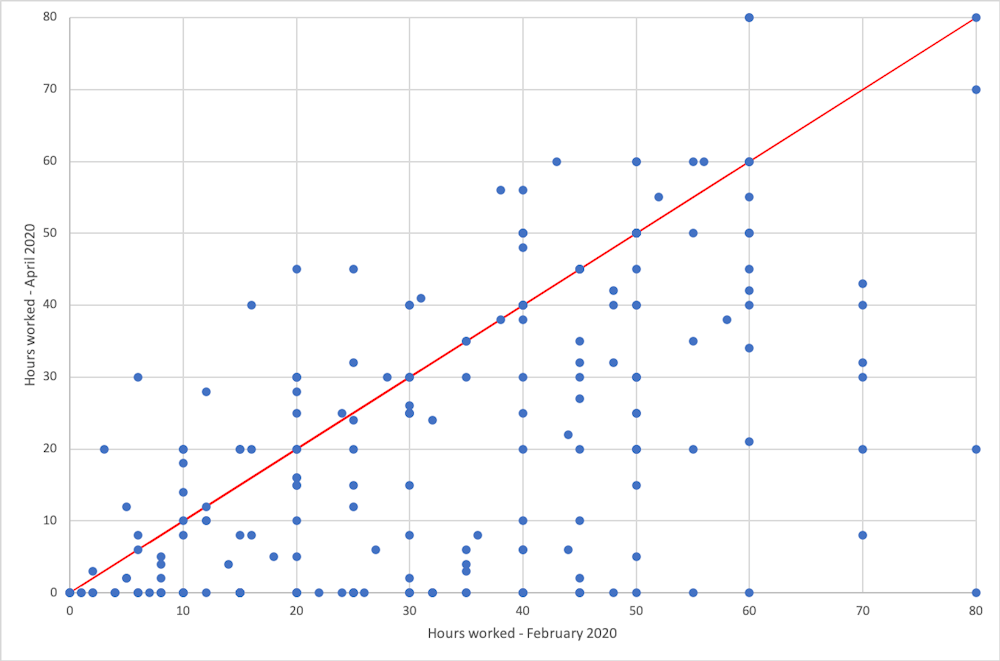 Comparing weekly hours worked by the self-employed in February to April 2020.
ANU Centre for Social Research and Methods, Author provided
Comparing weekly hours worked by the self-employed in February to April 2020.
ANU Centre for Social Research and Methods, Author provided
Almost a third said their business would be unviable if financial trends continued for two months. If trends persisted for six months, 40% doubted they could survive.
Read more: COVID crisis has produced many negatives but some positives too, including confidence in governments: ANU study[5]
The impact on savings and wellbeing
The proportion of self-employed saying they were finding it difficult or very difficult to survive on their current income increased from 29% to 36%.
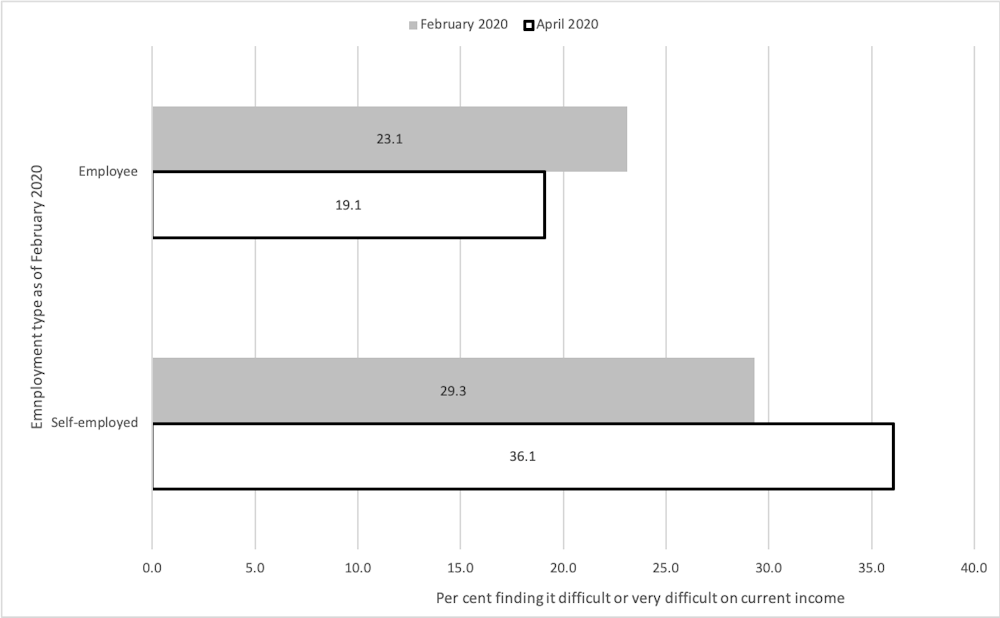 Proportion of people finding it difficult or very difficult on their current income, by employment type.
ANU Centre for Social Research and Methods
Proportion of people finding it difficult or very difficult on their current income, by employment type.
ANU Centre for Social Research and Methods
This contrasts with an aggregate improvement among employees, most likely due to higher payments for those on lower incomes, such as the A$750 given to social security recipients.
21% of self-employed respondents said they had accessed retirement savings or superannuation early, compared with 7% of employees.
Among those thinking their business was unviable, 69% reported feeling anxious and worried, compared with 59% of those thinking their business was viable. Life satisfaction was also lower (5.6 out 10 compared to 7.0).
What does this mean for the self-employed in 2020?
Current policies includes a large amount of targeted assistance for the self-employed. Without that assistance, the outcomes summarised above would be far worse.
Read more: What'll happen when the money's snatched back? Our looming coronavirus support cliff[6]
As physical distancing restrictions are eased, it will be important to continue to monitor how the self-employed are faring to ensure the level of government support is sufficient and well-targeted.
References
- ^ falling 9% (theconversation.com)
- ^ Were it not for JobKeeper, unemployment would be 11.7%, up from 5.2% in one month. Here's how the numbers pan out (theconversation.com)
- ^ ANUpoll (csrm.cass.anu.edu.au)
- ^ data we are releasing today (csrm.cass.anu.edu.au)
- ^ COVID crisis has produced many negatives but some positives too, including confidence in governments: ANU study (theconversation.com)
- ^ What'll happen when the money's snatched back? Our looming coronavirus support cliff (theconversation.com)
Authors: Matthew Gray, Director, ANU Centre for Social Research and Methods, Australian National University