When to buy Christmas gifts online to get them in time? The answer is now
- Written by: Flavio Romero Macau, Senior Lecturer in Supply Chain Management and Global Logistics, Edith Cowan University
Santa Claus is the ultimate global logistics worker, magically delivering gifts all over the world in a single night.
The rest of us have to rely on more mundane delivery systems to get gifts under the Christmas tree and into stockings – and this year those systems are under huge pressure.
So if you’re ordering gifts online, how late can you leave it to guarantee they arrive in time?
Our advice is to lock in your orders in the next few days. Anything ordered from late November may not arrive before 2021.
Even if you’re planning on traditional bricks-and-mortar Christmas shopping, do it sooner rather than later. The supply chains that usually keep shops stocked during December could fall behind.
Leave it too late and you may find your most wanted item out of stock.
Read more: Whatever the hardships of COVID-19, let's be thankful it wasn't COVID-99[1]
Parcel pressures
Delivery services have been under strain for most of 2020 due to the dramatic increase in online shopping driven by the COVID-19 pandemic.
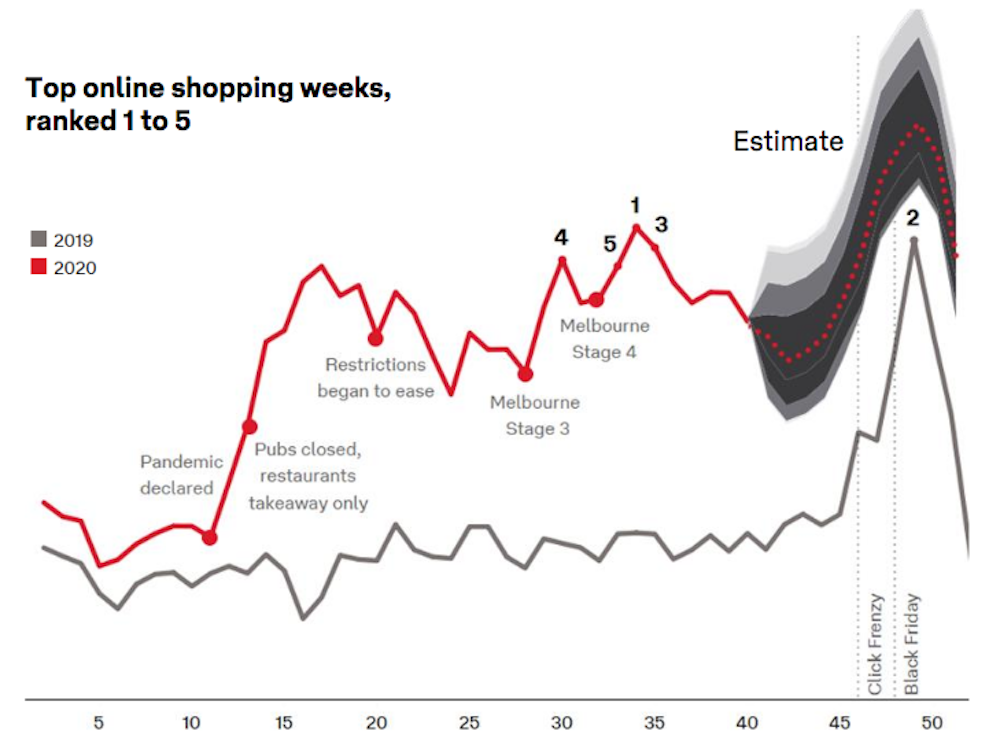
In the US online shopping is up more than 30%[2] year on year. The UK is similar, and set to increase[3] as the country goes into another lockdown. In Australia it’s up more than 75%[4] to last year.
With online sales in September already more than 7% higher than the 2019 Christmas peak, Australia Post is projecting a huge increase in the month prior to Christmas.
Number of online purchases, Australia, 2019-2020
 Australia Post[5]
What this means, of course, is many more parcels to deliver – more than eight times the monthly average if 2019 is anything to go by[6]. Delivery services will find it hard - if not impossible - to cope.
As noted by James Thomson, chief strategy officer with US company Buy Box Experts (a service provider to Amazon sellers) the weakest link in the delivery chain is “last-mile delivery capacity[7]”.
With consumers moving so many more shopping dollars online, all of those sites need last-mile delivery through UPS, FedEx, USPS, etc […] While these carriers are building capacity, they likely will not build anywhere near enough, resulting in late shipments and disappointed customers.
If that’s the case in the US, it’s even more true in Australia. In 2019 Australia Post delivered 41.5% of parcels to premises[8]. While it and other postal services (such as the UK’s Royal Mail[9]) hire thousands more casual workers from as early as September to cope with the load, there are still only so many sorting facilities and delivery vehicles.
Read more:
You've got (less) mail: COVID-19 hands Australia Post a golden opportunity to end daily letter delivery[10]
Overseas delays
To these local delivery delays, add delays for goods coming from overseas.
Many regions are experiencing renewed COVID-19 restrictions, reducing manufacturing and distribution capacities. These disruptions, going back over the whole year, will mean shortages.
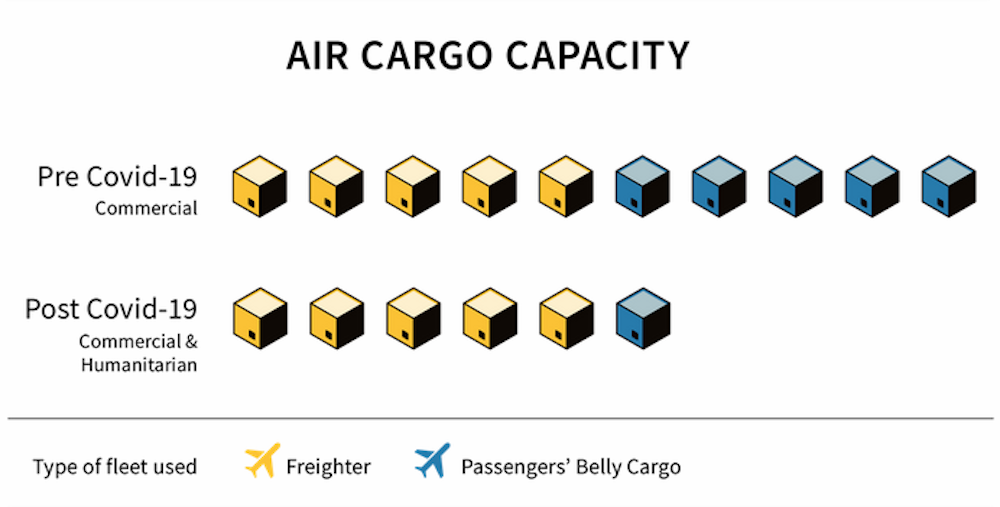
Also, many items “shipped” from places such as China have historically come by air – not just in dedicated cargo planes but also commercial passenger planes. Prior to the COVID-19 pandemic half of all air cargo was transported in passenger planes. The International Civil Aviation Organisation estimates passenger aircraft “belly cargo capacity” has fallen 80%[11].
Australia Post[5]
What this means, of course, is many more parcels to deliver – more than eight times the monthly average if 2019 is anything to go by[6]. Delivery services will find it hard - if not impossible - to cope.
As noted by James Thomson, chief strategy officer with US company Buy Box Experts (a service provider to Amazon sellers) the weakest link in the delivery chain is “last-mile delivery capacity[7]”.
With consumers moving so many more shopping dollars online, all of those sites need last-mile delivery through UPS, FedEx, USPS, etc […] While these carriers are building capacity, they likely will not build anywhere near enough, resulting in late shipments and disappointed customers.
If that’s the case in the US, it’s even more true in Australia. In 2019 Australia Post delivered 41.5% of parcels to premises[8]. While it and other postal services (such as the UK’s Royal Mail[9]) hire thousands more casual workers from as early as September to cope with the load, there are still only so many sorting facilities and delivery vehicles.
Read more:
You've got (less) mail: COVID-19 hands Australia Post a golden opportunity to end daily letter delivery[10]
Overseas delays
To these local delivery delays, add delays for goods coming from overseas.
Many regions are experiencing renewed COVID-19 restrictions, reducing manufacturing and distribution capacities. These disruptions, going back over the whole year, will mean shortages.
Also, many items “shipped” from places such as China have historically come by air – not just in dedicated cargo planes but also commercial passenger planes. Prior to the COVID-19 pandemic half of all air cargo was transported in passenger planes. The International Civil Aviation Organisation estimates passenger aircraft “belly cargo capacity” has fallen 80%[11].
 International Civil Aviation Organisation[12]
While freighter capacity has increased, as of late October global air cargo capacity was still 20% lower[13] than a year ago.
December is usually the busiest period for air travel, with these extra passenger flights helping to deliver higher cargo volumes. That’s not going to be the case this year. So expect any deliveries relying on air transport to take longer.
Currently Australia Post advises allowing for more than 25 days[14] for international deliveries.
Post haste
These stresses on international supply chains will also affect stocks in local retail shops.
Even in the best of times supply chains are pushed to their limits towards the end of the year. If they are not healthy to start with, Christmas can be the last straw. Inventory for products as different as bicycles, video games and dumbbells are already way down.
The signs are there – out-of-stock messages, caveats on expected dispatch times, and long delays in promised delivery times.
So you want the full Christmas experience with a tree full of presents, order or buy now to avoid disappointment.
This is not a year to procrastinate, or wait until the last moment to get the best deal. In 2020 first come will be first served.
International Civil Aviation Organisation[12]
While freighter capacity has increased, as of late October global air cargo capacity was still 20% lower[13] than a year ago.
December is usually the busiest period for air travel, with these extra passenger flights helping to deliver higher cargo volumes. That’s not going to be the case this year. So expect any deliveries relying on air transport to take longer.
Currently Australia Post advises allowing for more than 25 days[14] for international deliveries.
Post haste
These stresses on international supply chains will also affect stocks in local retail shops.
Even in the best of times supply chains are pushed to their limits towards the end of the year. If they are not healthy to start with, Christmas can be the last straw. Inventory for products as different as bicycles, video games and dumbbells are already way down.
The signs are there – out-of-stock messages, caveats on expected dispatch times, and long delays in promised delivery times.
So you want the full Christmas experience with a tree full of presents, order or buy now to avoid disappointment.
This is not a year to procrastinate, or wait until the last moment to get the best deal. In 2020 first come will be first served.
References
- ^ Whatever the hardships of COVID-19, let's be thankful it wasn't COVID-99 (theconversation.com)
- ^ more than 30% (www.emarketer.com)
- ^ and set to increase (www.retailgazette.co.uk)
- ^ more than 75% (auspost.com.au)
- ^ Australia Post (auspost.com.au)
- ^ 2019 is anything to go by (auspost.com.au)
- ^ last-mile delivery capacity (www.ascm.org)
- ^ 41.5% of parcels to premises (auspost.com.au)
- ^ Royal Mail (jobs.royalmailgroup.com)
- ^ You've got (less) mail: COVID-19 hands Australia Post a golden opportunity to end daily letter delivery (theconversation.com)
- ^ has fallen 80% (etradeforall.org)
- ^ International Civil Aviation Organisation (etradeforall.org)
- ^ still 20% lower (www.accenture.com)
- ^ allowing for more than 25 days (auspost.com.au)
Authors: Flavio Romero Macau, Senior Lecturer in Supply Chain Management and Global Logistics, Edith Cowan University