



ANZUS without NZ? Why the new security pact between Australia, the UK and US might not be all it seems
- Written by: Alexander Gillespie, Professor of Law, University of Waikato
We live, to borrow a phrase, in interesting times. The pandemic aside, relations between the superpowers are tense. The sudden arrival of the new AUKUS security agreement between Australia, the US and UK simply adds to the general sense of unease internationally.
The relationship between America and China had already deteriorated under the presidency of Donald Trump and has not improved[1] under Joe Biden. New satellite evidence[2] suggests China might be building between 100 and 200 silos for a new generation[3] of nuclear intercontinental missiles.
At the same time, the US relationship with North Korea continues[4] to smoulder, with both North and South Korea conducting missile tests[5] designed to intimidate.
And, of course, Biden has just presided over the foreign policy disaster[6] of withdrawal from Afghanistan. His administration needs something new with a positive spin.
Enter AUKUS, more or less out of the blue. So far, it is just a statement[7] launched by the member countries’ leaders. It has not yet been released as a formal treaty.
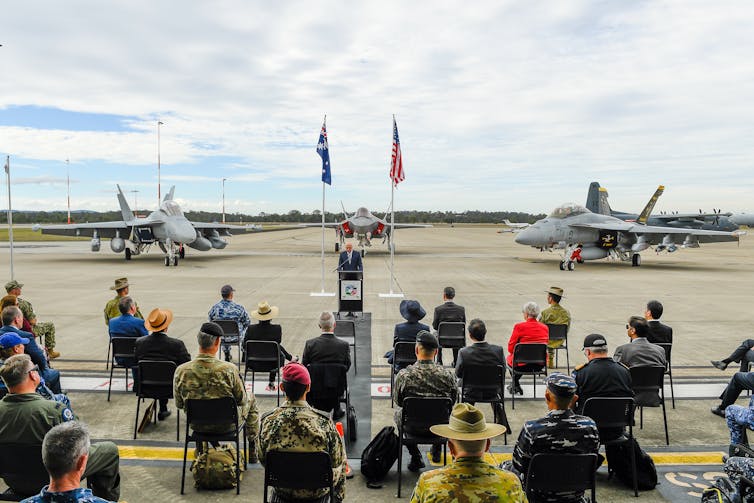 Pivot to China: the ceremony to mark the start of joint Australian-US military exercise Talisman Sabre in Brisbane, July 2021.
AAP
Pivot to China: the ceremony to mark the start of joint Australian-US military exercise Talisman Sabre in Brisbane, July 2021.
AAP
The Indo-Pacific pivot
The new agreement speaks of “maritime democracies” and “ideals and shared commitment to the international rules-based order” with the objective to “deepen diplomatic, security and defence co-operation in the Indo-Pacific region”.
“Indo-Pacific region” is code for defence against China, with the partnership promising greater sharing and integration of defence technologies, cyber capabilities and “additional undersea capabilities”. Under the agreement, Australia also stands to gain[8] nuclear-powered submarines.
Read more: Australia to build nuclear submarines in a new partnership with the US and UK[9]
To demonstrate the depth of the relationship, the agreement highlights how “for more than 70 years, Australia, the United Kingdom and the United States have worked together, along with other important allies and partners”.
At which point New Zealand could have expected a drum roll, too, having only just marked the 70th anniversary[10] of the ANZUS agreement. That didn’t happen, and New Zealand was conspicuously absent from the choreographed announcement hosted by the White House.
Having remained committed to the Five Eyes[11] security agreement and having put boots on the ground in Afghanistan for the duration, “NZ” appears to have been taken out of ANZUS and replaced with “UK”.
Don’t mention the nukes
The obvious first question is whether New Zealand was asked to join the new arrangement. While Prime Minister Jacinda Ardern has welcomed[12] the new partnership, she has confirmed[13]: “We weren’t approached, nor would I expect us to be.”
That is perhaps surprising. Despite problematic comments[14] by New Zealand’s trade minister about Australia’s dealings with China, and the foreign minister’s statement that she “felt uncomfortable” with the expanding remit of the Five Eyes, reassurances by Ardern[15] about New Zealand’s commitment should have calmed concerns.
Read more: Why nuclear submarines are a smart military move for Australia — and could deter China further[16]
One has to assume, therefore, that even if New Zealand had been asked to join, it might have chosen to opt out anyway. There are three possible explanations for this.
The first involves the probable provision to Australia of nuclear-powered military submarines. Any mention of nuclear matters makes New Zealand nervous. But Australia has been at pains to reiterate its commitment to “leadership on global non-proliferation”.
Similar commitments or work-arounds could probably have been made for New Zealand within the AUKUS agreement, too, but that is now moot.
The dragon in the room
The second reason New Zealand may have declined is because the new agreement is perceived as little more than an expensive purchasing agreement for the Australian navy, wrapped up as something else.
This may be partly true. But the rewards of the relationship as stated in the initial announcement go beyond submarines and look enticing. In particular, anything that offers cutting-edge technologies and enhances the interoperability of New Zealand’s defence force with its allies would not be lightly declined.
Read more: ANZUS at 70: Together for decades, US, Australia, New Zealand now face different challenges from China[17]
The third explanation could lie in an assumption that this is not a new security arrangement. Evidence for this can be seen in the fact that New Zealand is not the only ally missing from the new arrangement.
Canada, the other Five Eyes member, is also not at the party. Nor are France, Germany, India and Japan. If this really was a quantum shift in strategic alliances, the group would have been wider — and more formal than a new partnership announced at a press conference.
Nonetheless, the fact that New Zealand’s supposedly extra-special relationship with Britain, Australia and America hasn’t made it part of the in-crowd will raise eyebrows. Especially while no one likes to mention the elephant – or should that be dragon? – in the room: New Zealand’s relationship with China.
References
- ^ not improved (www.nytimes.com)
- ^ satellite evidence (www.ft.com)
- ^ new generation (thediplomat.com)
- ^ continues (www.bbc.com)
- ^ conducting missile tests (www.reuters.com)
- ^ foreign policy disaster (edition.cnn.com)
- ^ statement (www.whitehouse.gov)
- ^ stands to gain (www.nzherald.co.nz)
- ^ Australia to build nuclear submarines in a new partnership with the US and UK (theconversation.com)
- ^ 70th anniversary (theconversation.com)
- ^ Five Eyes (www.gcsb.govt.nz)
- ^ welcomed (www.newshub.co.nz)
- ^ confirmed (www.theguardian.com)
- ^ problematic comments (www.stuff.co.nz)
- ^ reassurances by Ardern (www.newshub.co.nz)
- ^ Why nuclear submarines are a smart military move for Australia — and could deter China further (theconversation.com)
- ^ ANZUS at 70: Together for decades, US, Australia, New Zealand now face different challenges from China (theconversation.com)










