
Why Jacinda Ardern’s ‘clumsy’ leadership response to Delta could still be the right approach
- Written by: Suze Wilson, Senior Lecturer, Executive Development, Massey University
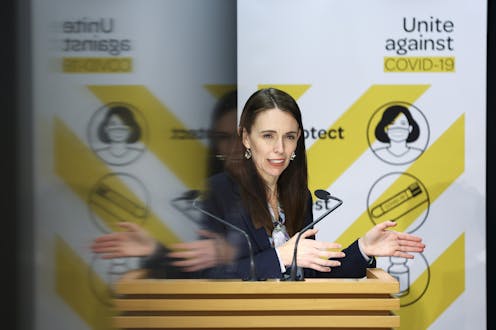
Leading people through the pandemic is clearly no easy task. But does the criticism[1] currently directed at New Zealand Prime Minister Jacinda Ardern reveal a major misstep on her part, or something deeper about the nature of leadership itself?
Ardern has previously won widespread praise[2] for her COVID-19 response and crisis communication, topping Fortune magazine’s “world’s greatest leaders[3]” list in 2021.
Focused on minimising harm to both lives and livelihoods, her pandemic leadership[4] has comprised three main strands: reliance on expert advice, mobilising collective effort and cushioning the pandemic’s disruptive effects.
These built the trust needed to secure high levels of voluntary compliance for measures designed to limit the spread of the virus.
Then came the Delta outbreak in mid-August, which sees Auckland still under lockdown measures nearly eight weeks later. Despite the efforts of many, elimination proved elusive – a daunting reality that Ardern and her cabinet colleagues appear to have accepted.
A strategic shift
This shift by Ardern, who engages deeply[5] with the scientific evidence, has confused and angered[6] many, even those who normally support her.
With vaccination rates climbing, in early October, Ardern announced the beginning of a “gradual transition[7]” away from the established “zero COVID” strategy in favour of suppression of inevitable outbreaks.
Read more: Three reasons why Jacinda Ardern's coronavirus response has been a masterclass in crisis leadership[8]
This included a three-step “roadmap” to guide Auckland “carefully” towards reduced restrictions. What criteria will be used to trigger movement through those steps, however, have not been specified.
Both the strategic shift and the roadmap’s ambiguity have become the source of heated debate. But beyond merely choosing sides, how can we make sense of Ardern’s leadership at this point?
Wicked and adaptive problems
The pandemic presents a particular type of problem for political leaders, described as “wicked[9]” or “adaptive[10]” by leadership experts Keith Grint and Ronald Heifetz, respectively.
Basically, wicked or adaptive problems have complex and contentious causes, generating equally complex and contentious responses.
Their “wickedness” isn’t fundamentally a question of morality, although they do typically entail making values-based choices. Rather, it refers to how difficult they are to contend with. Poverty, the housing crisis and climate change are other good examples of these kinds of problems.
Wicked/adaptive problems don’t have clear boundaries, nor are they static. They have multiple dynamic dimensions. Their effects typically spill out into many parts of our lives and organisations, creating confusion, harmful consequences and disruption to established routines.
“Clumsy” leadership
To make matters worse, there simply aren’t tried and trusted solutions that can resolve or dissolve such problems. Instead, they require leaders to accustom people to uncomfortable and disruptive changes to established ways of thinking and acting.
Unsurprisingly, many leaders avoid facing up to such difficulties, requiring as it does the cobbling together of a range of imperfect responses to ever-changing circumstances. It requires constant engagement, mobilising people to help craft a way forward.
Read more: Anniversary of a landslide: new research reveals what really swung New Zealand's 2020 'COVID election'[11]
Leaders can’t and don’t have all the answers to such problems. Whatever answers they do have likely need to keep changing as things unfold. The best possible scenario is what Grint calls a “clumsy” solution – a patchwork of adaptive initiatives that blunt the problem’s worst effects.
Only genuinely transformative change can truly overcome these wicked or adaptive problems in the long run.
Conflict and criticism are inevitable
In the meantime, “clumsy” leadership will typically trigger conflict between leaders and citizens (or employees in a work setting), and among those people too. There will be blame, recrimination, avoidance, denial, grief, “what ifs” and “if onlys”, as people struggle to deal with the changes needed.
Indeed, all these very normal responses have characterised much of the commentary about the Ardern government’s decision to change tack.
That criticism, however, doesn’t mean she has failed in her leadership responsibilities. Instead, she has required the population to face up to an adaptive challenge. It’s unavoidably contentious and painful.
Read more: Phased border reopening, faster vaccination, be ready for Delta: Jacinda Ardern lays out NZ's COVID roadmap[12]
For all that we can debate whether different decisions could or should have been made, the difficulties involved in facing the new reality are unavoidable.
To help people navigate this, Ardern is seeking to “regulate distress”, as Heifetz recommends. She has repeatedly assured people a cautious approach remains in place and has appeared not to have been distracted by the criticism.
Instead, she has stayed focused on mobilising the individual and collective effort to follow the rules and get vaccinated.
Read more: The COVID-zero strategy may be past its use-by date, but New Zealand still has a vaccination advantage[13]
Least-worst options
Wicked/adaptive problems are not amenable to resolution by way of quick, easy or elegant answers. They aren’t fixed by recourse to command and control, although some top-down decisions are needed.
They entail ambiguity and uncertainty, a constant piecing together of efforts to outflank, mitigate or adapt, giving rise to inevitably imperfect or “clumsy” solutions.
Asking people to adjust to efforts to achieve the least-worst outcome possible from a range of unpalatable options may not be the easiest path to political popularity. But it is arguably what responsible leaders do.
References
- ^ criticism (www.rnz.co.nz)
- ^ praise (www.washingtonpost.com)
- ^ world’s greatest leaders (fortune.com)
- ^ pandemic leadership (journals.sagepub.com)
- ^ engages deeply (www.stuff.co.nz)
- ^ confused and angered (thespinoff.co.nz)
- ^ gradual transition (www.beehive.govt.nz)
- ^ Three reasons why Jacinda Ardern's coronavirus response has been a masterclass in crisis leadership (theconversation.com)
- ^ wicked (wickedproblems.fm)
- ^ adaptive (hbr.org)
- ^ Anniversary of a landslide: new research reveals what really swung New Zealand's 2020 'COVID election' (theconversation.com)
- ^ Phased border reopening, faster vaccination, be ready for Delta: Jacinda Ardern lays out NZ's COVID roadmap (theconversation.com)
- ^ The COVID-zero strategy may be past its use-by date, but New Zealand still has a vaccination advantage (theconversation.com)