Can New Zealand apply the political lessons of COVID-19 in the year ahead?
- Written by: The Conversation
An end-of-year political poll[1] appeared recently and virtually no one paid it any attention. After a year of high-stakes health, economic and electoral events, it was a sign New Zealanders are on the other side of something.
It was a reminder, too, that politics is the exception rather than the norm for most people. With the 2020 election behind us, and Prime Minister Jacinda Ardern’s government rapidly adjusting to the pleasures of life with a parliamentary majority[2], for most of us other things — summer, Christmas, the horrendous cost[3] of buying or renting a house — now take priority.
But before 2020 fades entirely from view, it’s as well to reflect on one or two aspects of the extraordinary year that was.
As might be expected in a nation that covets the status of underdog, New Zealanders took some pride in having out-performed[4] many other countries on matters COVID-related. From that performance a couple of important lessons can be drawn.
The first is that the country can, when needs must, rise to complex challenges. Not perfectly, to be sure — we were never all in this together[5]. But 2020 made it clear that, when required, the formal and the volitional rules that shape our behaviour and govern our social interactions can bend and adapt for the better.
The second is that, in the main, our institutions work. We have our fair share of liars and manipulators on social and in other forms of media, but our scientific, cultural, political and administrative institutions worked when we needed them to.
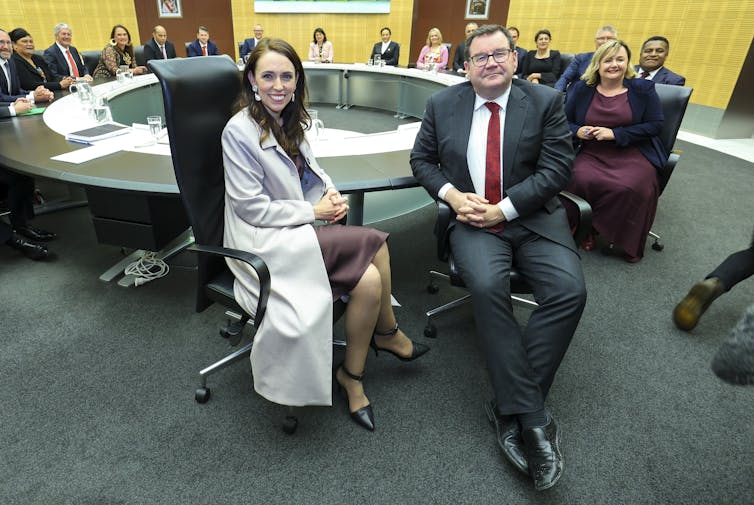 What’s next? Prime Minister Jacinda Ardern and Deputy Prime Minister Grant Robertson at their first post-election cabinet meeting. GettyImages
Time to apply those COVID lessons
The challenge now is to to apply this collective capacity to other issues — the climate crisis[6], inequality[7] of all kinds, the disgrace of racism — before we all snap back into conventional shape.
On this count there is no case for self-congratulation. Rather, there are worrying indications we are slouching back to a form of politics many hoped we had left behind.
The fizz and energy of early-pandemic thinking about different ways of being and doing is being replaced by the existential pull of the desire for “normality” (a pre-virus state of affairs that worked for some but not all) as we begin to emerge, emotionally and often economically wrung out, from COVID.
Read more: By declaring a climate emergency Jacinda Ardern needs to inspire hope, not fear[8]
Jacinda Ardern is arguably the perfect politician for such circumstances. Often characterised as a 21st century politician, she is also very much a politician of the last century: a centrist who plays to deeply entrenched shibboleths around taxation and home ownership that indulge the interests of an older generation of property owners (and voters).
At the same time, more and more New Zealanders are finding themselves locked out of the “Kiwi dream”. Witness the fact that home ownership has dropped to its lowest level[9] since 1951.
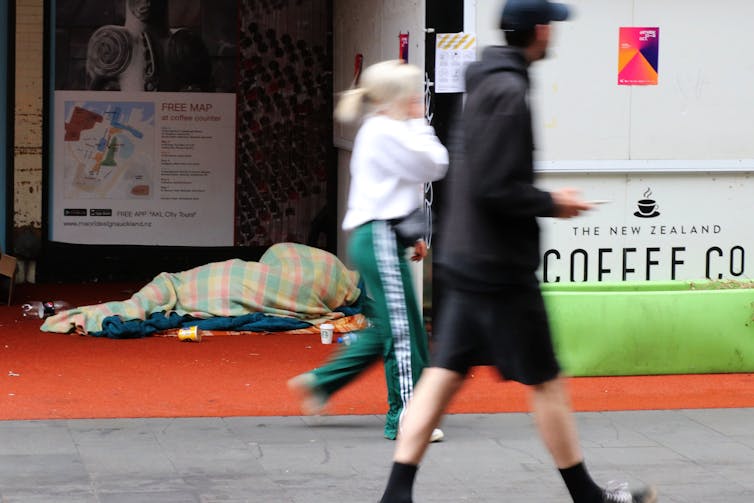 The Kiwi dream? Pedestrians walk past a rough sleeper in central Auckland on election day, October 17 2020. GettyImages
Ardern’s historic choice
Ardern has an acute sense of the location of the political centre. The risk is that in the interests of keeping together the electoral coalition of Labourites and disaffected former National Party voters that delivered her stunning electoral victory[10], she maintains the policy fundamentals put in place by the reforming Labour and National governments of the 1980s and 90s.
If that happens, the national narrative regarding home ownership will not be the only thing looking pretty tatty come 2023. The notions of Aotearoa being a great place to raise kids[11] and where everyone gets a fair go will increasingly also look like myths.
But Ardern might choose differently. She has the political influence[12] and smarts to permanently shift the way New Zealanders think about, engage in and experience the effects of politics for the better.
Read more: With house prices soaring again the government must get ahead of the market and become a 'customer of first resort'[13]
She also has the perfect opportunity to do this. Having been fed a thin gruel of individual responsibility for the past 35 years or so, most of us were reminded by the pandemic that altruism is important, context matters and “meritocracy” is often something certain people are born into and others aren’t.
Ardern has shown she can lead in crises — now we need her to show she can also harness what we learned during this tumultuous year and help rebuild the country many of us carry in our heads, but which in reality is rather less than that for too many New Zealanders.
For now, most of us can look forward to a summer without significant restrictions on our movement. That is no small thing, especially given what is happening elsewhere[14]. But come 2021, and we move slowly into a post-pandemic world, we need the vision, political leadership and moral fortitude to ensure this country really is a team of five million[15].
References
- ^ end-of-year political poll (www.colmarbrunton.co.nz)
- ^ parliamentary majority (www.rnz.co.nz)
- ^ horrendous cost (www.rnz.co.nz)
- ^ out-performed (www.scoop.co.nz)
- ^ we were never all in this together (www.newsroom.co.nz)
- ^ climate crisis (www.theguardian.com)
- ^ inequality (www.theguardian.com)
- ^ By declaring a climate emergency Jacinda Ardern needs to inspire hope, not fear (theconversation.com)
- ^ lowest level (www.stuff.co.nz)
- ^ stunning electoral victory (www.stuff.co.nz)
- ^ great place to raise kids (www.stats.govt.nz)
- ^ political influence (www.forbes.com)
- ^ With house prices soaring again the government must get ahead of the market and become a 'customer of first resort' (theconversation.com)
- ^ happening elsewhere (www.nytimes.com)
- ^ a team of five million (www.nytimes.com)