


Could the Biden administration pressure Australia to adopt more humane refugee policies?
- Written by: Claire Higgins, Senior Research Fellow, Kaldor Centre for International Refugee Law, UNSW
As a presidential candidate, Joe Biden promised[1] the US would demonstrate “global leadership on refugees”. Once elected, he pledged[2] to vastly increase refugee resettlement in the US.
If history is any guide, the new president’s forward-thinking approach could help drive Australia’s commitments to refugee protection, as well.
Over the past four decades, the United States and Australia have contributed to international refugee resettlement through planned annual admission programs.
The annual US Refugee Admissions Program (USRAP) has traditionally operated on a much larger scale than any other country, with tens of thousands of places per year. Since 1980, the program has enabled more than 3 million[3] people to find safety and build new lives in the US.
Under former President Donald Trump, however, the program was cut to historic lows of just 15,000[4] places for the year beginning in October 2020.
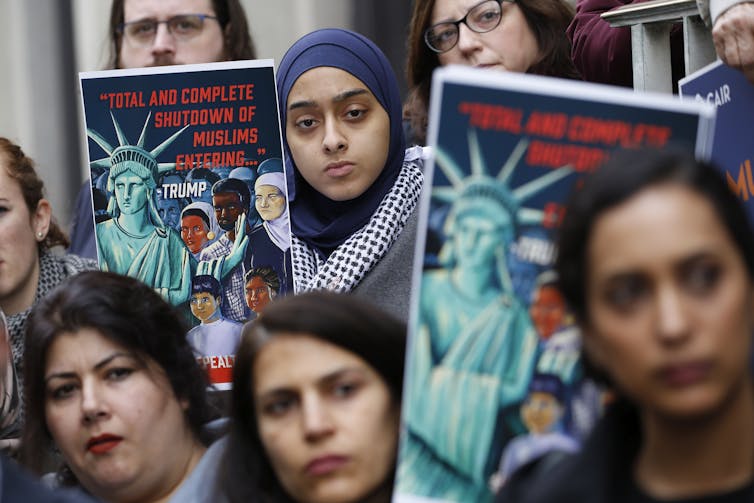 A rally against Trump’s refugee policy in October. Steve Helber/AP
Less dramatically, Australia’s quota for the admission of refugees and others in humanitarian need was similarly reduced from 18,750[5] in 2019-20 to 13,750[6] in 2020-21, a cut attributed[7] to travel restrictions imposed due to COVID-19.
Biden pledging to increase US refugee intake
Revitalising the US refugee program is one of the many tasks facing the newly installed Biden administration, in addition to revising[8] US asylum policy for those seeking protection at the borders.
Biden has committed to an annual refugee intake of up to 125,000 people, echoing the goals of the Obama administration in its final year[9], when it set an intake of up to 110,000 refugees.
At that time, resettlement was valued as a “foreign policy priority[10]” for the US, with President Barack Obama joining UN Secretary-General Ban Ki-Moon in hosting a Leaders’ Summit on Refugees[11] in 2016 to address record levels of global displacement, including from Syria.
The Australian government participated in that initiative and pledged[12] to increase its annual humanitarian intake to 19,000 by 2018. The summit demonstrated how leadership by the US can have direct impact and influence on the actions of other states.
Read more: With our borders shut, this is the ideal time to overhaul our asylum seeker policies[13]
Australia has similarly tried to boost its reputation
By increasing the US resettlement numbers now, Biden is looking to rebuild America’s image abroad.
This is a tried and tested tool, evident[14] in the Ford and Carter administration’s large-scale admission of Vietnamese refugees in the aftermath of the disastrous war in Vietnam.
Previous Australian governments have also sought to improve the country’s image through the rosy glow of resettlement contributions.
In September 2015, for example, just five days after The New York Times published a scathing assessment[15] of Australia’s offshore detention system, the Abbott government announced Australia would resettle an additional 12,000 Iraqi and Syrian refugees.
Abbott claimed[16] Australia was demonstrating good international citizenry.
However, the optics did not prevent the UN High Commissioner for Human Rights from decrying[17] a week later the lack of transparency around offshore detention in Australia and the inability of asylum seekers to access medical care and independent legal advice.
Most recently, the Australian government this month cited[18] the country’s “generous” humanitarian program in its formal response to UN concerns[19] about the treatment of asylum seekers here.
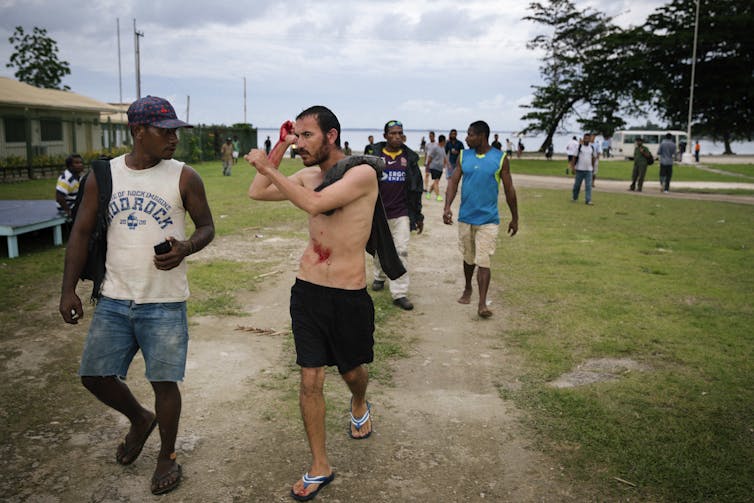 Refugees housed on Manus Island have long faced dangerous and unhealthy conditions. Matthew Abbott/PR Handout Image/GetUp
US and Australia policies have long echoed one another
Whether the Biden administration could influence Australia’s treatment of asylum seekers is hard to gauge.
The US has been a model for Australia’s harsh asylum policies over the years. The US Coast Guard, for instance, was interdicting[20] asylum seeker boats under the Reagan administration, years before the Howard government adopted the practice in 2001.
And in the early 1990s, the Bush and Clinton administrations authorised the detention[21] of Haitian refugees at the Guantanamo Bay naval base — a practice later adopted by Australia on Manus Island and Nauru.
Read more: Yes, the US border policy is harsh – but Australia's treatment of refugee children has also been deplorable[22]
And at times, Australia has influenced the US. In a phone call with Trump following his inauguration in January 2017, then-Prime Minister Malcolm Turnbull expressed support for Trump’s promotion of hard-line immigration control, and claimed[23] that Australia had “inform[ed] your approach”. Turnbull said,
We have, as you know, taken a very strong line on national security and border protection here […] We are very much of the same mind.
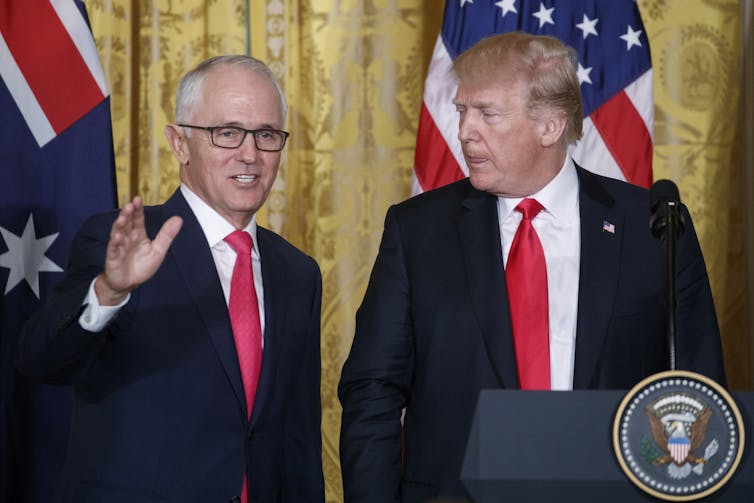 In their phone call, Trump said he liked Australia’s tough approach to refugees. Shawn Thew/EPA
Could the Biden administration lean on Canberra now?
If Biden follows through on his pledge[24] to reinstate America’s “historic role in protecting the vulnerable”, he may prove to be a very different kind of leader.
The Obama era could provide some clues to the Biden approach. In 2015, the head of the Department of State’s refugee bureau encouraged[25] Australia to
be with us again in really being leaders in humanitarian response to migrants and refugees in the region.
The Obama administration urged[26] the Australian government to change its hard-line insistence on detaining asylum seekers offshore.
Unsuccessful in this effort, the Obama administration did what it could, signing a resettlement deal[27] with the Turnbull government in 2016 to get refugees off Manus and Nauru and grant them entry to the United States.
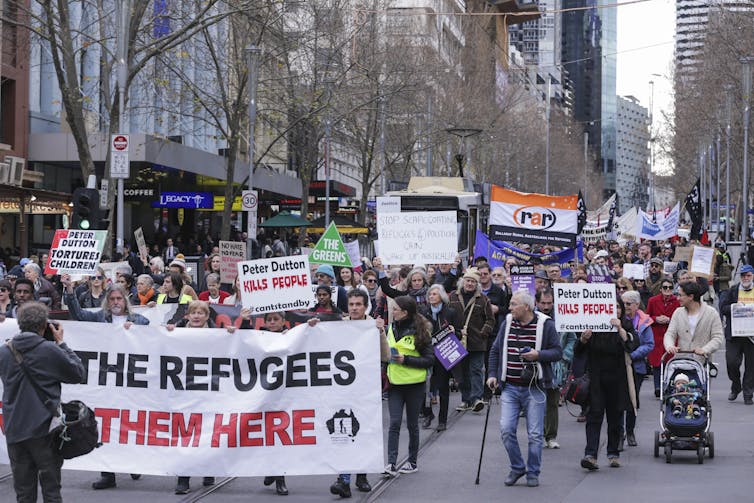 Protests in support of relocating refugees from Manus and Nauru have been a familiar sight on Australian streets. Wayne Taylor/AAP
The deal was loudly criticised but reluctantly upheld[28] by the Trump administration (even though Trump struggled to understand what he called Australia’s “thing with boats”).
Importantly, the deal was reportedly predicated on Australia “doing more[29]” for refugees elsewhere in the world. Signs of this effort were evident in Australia’s increased refugee admission quotas of recent years.
Read more: Hotels are no 'luxury' place to detain people seeking asylum in Australia[30]
If the Biden administration leans on Canberra in a similar way, we may see Australia return to a higher resettlement quota.
Perhaps we will also see humane solutions for those who came by boat seeking Australia’s protection and are still being detained in hotels and remote detention facilities — including young children[31].
There are glimmers of hope. In recent days, for instance, the Australia government released dozens[32] of refugees and asylum seekers from detention.
However, these men have been given short-term visas, which means they will continue to face an uncertain future — a product of current government policy that affects many thousands[33] of refugees living in Australia today.
It is clear that leadership by the US, Australia’s major ally, is needed now more than ever.
References
- ^ promised (joebiden.com)
- ^ pledged (www.jrsusa.org)
- ^ 3 million (journals.sagepub.com)
- ^ 15,000 (www.state.gov)
- ^ 18,750 (www.refugeecouncil.org.au)
- ^ 13,750 (www.kaldorcentre.unsw.edu.au)
- ^ attributed (www.refugeecouncil.org.au)
- ^ revising (www.undispatch.com)
- ^ Obama administration in its final year (obamawhitehouse.archives.gov)
- ^ foreign policy priority (obamawhitehouse.archives.gov)
- ^ Leaders’ Summit on Refugees (2009-2017.state.gov)
- ^ pledged (www.malcolmturnbull.com.au)
- ^ With our borders shut, this is the ideal time to overhaul our asylum seeker policies (theconversation.com)
- ^ evident (academic.oup.com)
- ^ assessment (www.nytimes.com)
- ^ claimed (www.lowyinstitute.org)
- ^ decrying (www.ohchr.org)
- ^ cited (www.ohchr.org)
- ^ UN concerns (documents-dds-ny.un.org)
- ^ interdicting (www.nytimes.com)
- ^ authorised the detention (theconversation.com)
- ^ Yes, the US border policy is harsh – but Australia's treatment of refugee children has also been deplorable (theconversation.com)
- ^ claimed (www.washingtonpost.com)
- ^ pledge (www.jrsusa.org)
- ^ encouraged (2009-2017.state.gov)
- ^ urged (time.com)
- ^ signing a resettlement deal (www.theguardian.com)
- ^ reluctantly upheld (www.washingtonpost.com)
- ^ doing more (www.abc.net.au)
- ^ Hotels are no 'luxury' place to detain people seeking asylum in Australia (theconversation.com)
- ^ young children (ama.com.au)
- ^ dozens (www.abc.net.au)
- ^ thousands (temporary.kaldorcentre.net)










