
Australia must continue to press for humane treatment of journalist Cheng Lei after her arrest in China
- Written by: Elena Collinson, Senior Project and Research Officer, Australia-China Relations Institute, University of Technology Sydney
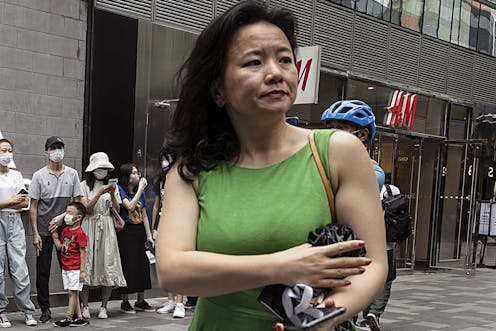
Australia-China relations, which have been spiralling downward for some time, continue to sink. The latest blow comes in the form of the formal arrest of Australian journalist and former business anchor for Chinese state media outlet China Global Television Network (CGTN), Cheng Lei.
Cheng was first detained by Chinese state authorities on August 13 last year.
Chinese officials have offered scant explanation for her arrest, with the Australian government simply stating[1] it had been advised Cheng had been arrested “on suspicion of illegally supplying state secrets overseas”.
Foreign Minister Marise Payne told[2] ABC radio that Australia was currently “not privy to [the] evidence” supporting Beijing’s move. She said[3] Australia was “seeking further advice in relation to the charges”.
The arrest is itself not tantamount to a formal charge, but is indicative of Beijing’s intent to plough ahead with a full-scale criminal investigation into the matter. Should a formal charge be laid, the prospect of acquittal is slim.
Read more: Journalists have become diplomatic pawns in China's relations with the West, setting a worrying precedent[4]
A challenge mounted through China’s courts would also likely yield an unhappy outcome. While China’s courts, on paper, are bound to “follow legal provisions to independently exercise the power of adjudication[5]”, the very nature of China’s domestic system means there is no institutional guarantee for this.
This was made explicit in 2017, when China’s Chief Justice Zhou Qiang said[6]:
[China’s courts] must firmly resist the western idea of ‘constitutional democracy’, ‘separation of powers’ and ‘judicial independence’. These are erroneous western notions that threaten the leadership of the ruling Communist Party and defame the Chinese socialist path on the rule of law.
As Colin Hawes, associate professor of law at University of Technology Sydney points out[7]:
In criminal cases, despite recent reforms to protect accused defendants, the system is heavily weighted in favour of the prosecution.
It would be difficult to argue that the detention and formal arrest of Cheng Lei is divorced from the tensions that have crept into nearly every aspect of the Australia-China relationship.
Asked[8] in August last year whether he thought “Cheng Lei is a pawn in a worsening relationship between China and Australia”, then-Trade Minister Simon Birmingham replied it would not be particularly helpful “to try and draw that link”.
However, the timing of Cheng’s arrest and the seeming parallels of her case with those of fellow Australian citizen Yang Hengjun[9] and Canadian citizens Michael Kovrig and Michael Spavor[10], seem to point to an alarming trend of Beijing using individuals to communicate political dissatisfaction.
Read more: Australia has a great chance to engage in trade diplomacy with China, and it must take it[11]
Even allowing for circumstances in which there may be substantive merit to the case brought against Cheng, it is evident Beijing has secured another card in its political game with Australia.
It would not be beyond the realm of possibility that Beijing would seize on this particular matter to exert pressure on Australia with respect to decisions that are contrary to Chinese state interests. For example, it could be used to try to force concessions, or simply dissuade Australia from future unfavourable actions.
While the Australian government has pledged to continue to advocate for Cheng - and rightly so - there are limits to what it can do. But continuing, at the very least, to press strongly for basic standards of justice, procedural fairness and humane treatment to be met in accordance with international norms is paramount.
Read more: Australian government must act urgently on detention of journalist Cheng Lei in China[12]
References
- ^ stating (www.foreignminister.gov.au)
- ^ told (www.abc.net.au)
- ^ said (www.foreignminister.gov.au)
- ^ Journalists have become diplomatic pawns in China's relations with the West, setting a worrying precedent (theconversation.com)
- ^ follow legal provisions to independently exercise the power of adjudication (www.chinalawtranslate.com)
- ^ said (globalvoices.org)
- ^ points out (www.australiachinarelations.org)
- ^ Asked (www.trademinister.gov.au)
- ^ Yang Hengjun (theconversation.com)
- ^ Michael Kovrig and Michael Spavor (www.bbc.com)
- ^ Australia has a great chance to engage in trade diplomacy with China, and it must take it (theconversation.com)
- ^ Australian government must act urgently on detention of journalist Cheng Lei in China (theconversation.com)