

Anthony Albanese's plan to boost protections for Australians in insecure work
- Written by: Michelle Grattan, Professorial Fellow, University of Canberra
Anthony Albanese will risk a backlash from employers when he releases an industrial relations policy promising a Labor government would substantially increase the legal rights and protections for Australians in insecure work.
Wednesday’s policy unveiling will ensure industrial relations is a major political battleground in coming months, with the opposition already declaring it will vote against the government’s workplace legislation now before parliament.
In his speech, issued ahead of its delivery in Brisbane, Albanese pledges Labor would legislate to make “job security” a key objective of the Fair Work Act, and to give “gig” economy workers more protection and benefits, in pay and conditions.
The policy promises “a crack down on cowboy labour hire firms”, to guarantee workers placed through them received the same pay as directly-employed workers performing the same job.
While Labor anticipates aspects of the policy will be unpopular with employers, it argues the IR settings are skewed unfairly against workers in insecure jobs.
Albanese accuses the government of using the pandemic “as a cover to cut pay and make work even less secure”.
Labor would scrap the Australian Building and Construction Commission – the so-called cop-on-the-beat in the construction industry which has been a political football for years.
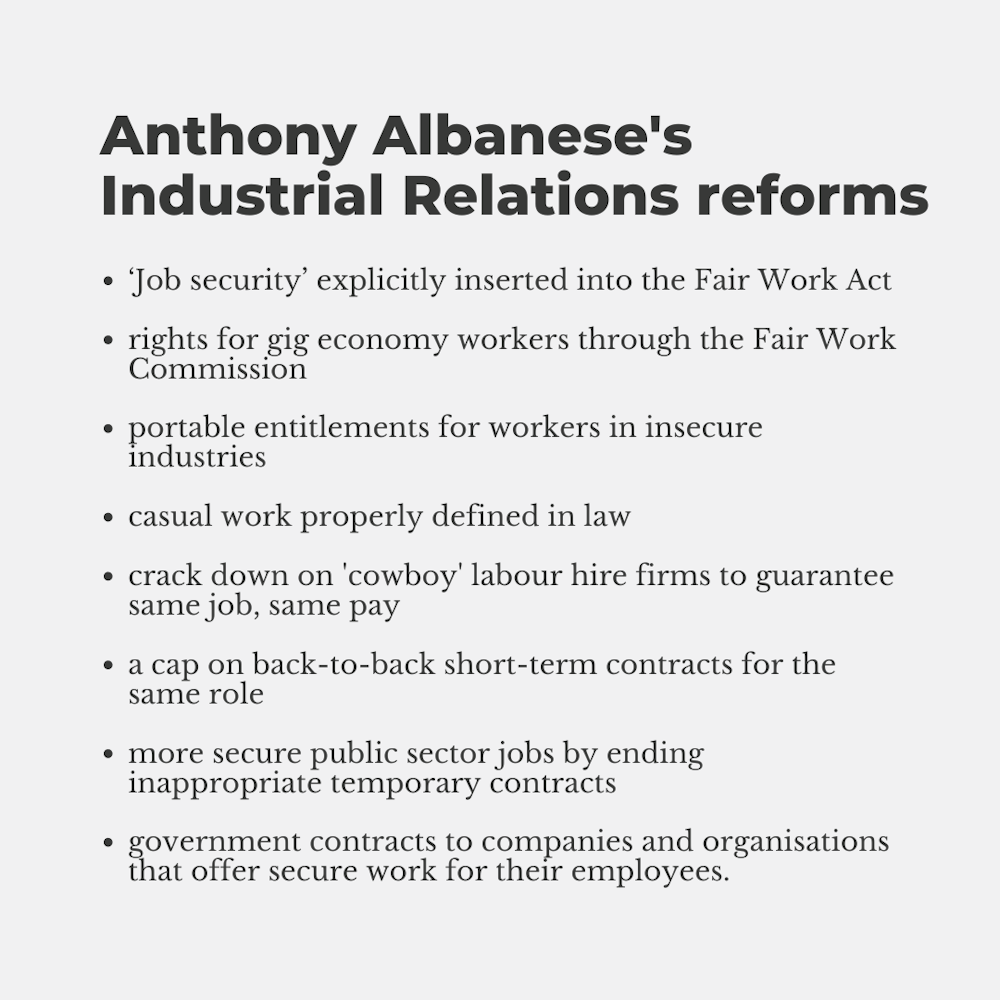 It would also do away with the Registered Organisations Commission, which Albanese describes as discredited and politicised. Albanese says that changing the Fair Work Act would require the Fair Work Commission “to bring a sharp focus to jobs security when making decisions”. Also, Labor would “legislate to ensure more Australian workers have access to employee protections and entitlements currently denied to them by the narrow, outdated definition of an ‘employee’”. The powers of the Fair Work Commission would be extended “to include employee-like forms of work”, so it could make orders for minimum standards for those in the gig economy. “Labor will ensure that the independent umpire has the capacity to inquire into all forms of work and determine what rights and obligations should apply.” Albanese promises a national approach on the portability of entitlements. A Labor government would work with states and territories, unions and industry “to develop portable entitlements for annual leave, sick leave and long service leave” for those in insecure work. It would legislate for a “fair test” to determine the definition of a casual worker. A limit would be put on the number of consecutive fixed term contracts an employer could offer for the same role. While acknowledging a valid place for such contracts, Albanese says “what’s not right is when employees are put on an endless treadmill of fixed-term contracts by employers who want to avoid giving them permanent status”. The limits for the same role would be 24 months or no more than two consecutive contracts, whichever came first. “Once that limit is reached, the employer will be required to offer a permanent position – either part time or full time.” Labor would “call time” on the “relentless outsourcing” in the public service. And more secure employment would be provided in the public service “where temporary forms of work are being used inappropriately”. Government procurement policy would be used to uphold Labor’s work values “by supporting bids from companies and organisations that are themselves providers of good, secure jobs”. Albanese says there has been a “creeping expansion of insecure work. Indeed, fewer Australians can access the basic entitlements and protections earlier generations took for granted. "Nearly a third of Australian workers are in arrangements with unpredictable, fluctuating pay and hours. They endure few or no protections such as sick and holiday leave, or superannuation benefits.” The opposition leader invokes the spirit of the Hawke and Keating governments’ approach to industrial relations. “The best governments in our history have understood the need for a compact between capital and labour to advance their mutual interests. "The Labor governments of Bob Hawke and Paul Keating are a prime example. Collaboration between workers, employers and the government of the day delivered genuine enterprise bargaining and the conditions that created 30 years of continuous economic growth.” Albanese says a government he led would “always respect the central importance of successful businesses as job creators”. He accuses Scott Morrison of being “all smirk and mirrors” on industrial relations, saying the Prime Minister wanted to scrap the Better Off Overall Test while hoping “people won’t notice it’s a plan to leave workers worse off”. The government’s legislation contains “the worst workplace changes” since John Howard’s WorkChoices, Albanese says.