
How to actually get something done
- Written by: Chris Wallace, Associate Professor, 50/50 By 2030 Foundation, Faculty of Business Government & Law, University of Canberra
This week’s March 4 Justice protests saw tens of thousands of people take to the streets[1]. It gave Australians – outraged by gendered violence connected to Parliament House and beyond – a satisfying sense of agency. It also made headlines around the world[2].
Now comes the hard part: how to actually get something done. Here, there are political realities to face.
Silencing the opposition
The parliamentary proceedings held immediately after the Monday protests underline this problem.
Morrison and his Minister for Women Marise Payne had already drawn the protesters’ ire by refusing to attend[3] the Canberra rally. Morrison compounded this with a clumsy description[4] of the protests as a “triumph for democracy” because “not far from here, such marches, even now, are being met with bullets”.
Then, during question time, the government refused to budge on the two issues which sparked the protests: its handling of the alleged rape of Brittany Higgins in the office of Defence Minister Linda Reynolds, and its staunch support for Christian Porter to continue as Attorney-General, despite the historic rape allegations against him, which he denies.
Labor leader Anthony Albanese moved to suspend standing orders, pressing the government to fully explain its response to the alleged rape of Higgins and commission an independent inquiry into Porter’s fitness for office.
Four minutes into his speech, Home Affairs Minister Peter Dutton strolled to the dispatch box and declared — as Albanese was quoting from Higgins’ speech — the Labor leader had had “a fair go” and moved[5] he “be no longer heard”.
There’s a difference between being in government and opposition. The government controls the lower house and can literally silence the other side.
Sharp criticism beyond parliament
However, the government cannot absolutely control events outside parliament, and there are signs the Coalition has taken a deeper hit than the parliamentary optics suggest.
The headlines tell part of the story. “Morrison digs in as rallies rage”, “Tidal wave of tears and rage sweeps the land” and “Thunderous roar for change rings out across the nation” are just a few examples from major newspapers on Tuesday.
Ominously for the government, some traditionally supportive commentators are sharply critical. As journalist Jennifer Hewett wrote[6] in her influential Australian Financial Review column:
Morrison is actually trying to hold onto the shards of glass now showering deep cuts all over the government.
Conservative columnist Janet Albrechtsen commented in The Australian[7]:
His performance to date has been woeful. Scott Morrison has an unfortunate tendency to refer up, like a bank manager looking for someone else to explain things to him, and leaving it to others to make the hard decisions.
Morrison’s strategy
Recent polls show the government is under pressure. Many in the Coalition view the 48-52% two party-preferred deficit in the latest Newspoll[8] as a good result, though, given the range of stories running against the government, including the slow COVID-19 vaccine roll out.
The government’s position on the Higgins and Porter matters is underpinned by a few personal and political maxims to which Morrison holds fast.
The first is that stonewalling nearly always works for him. The news cycle is his friend. Stalling has worked uniformly for Morrison with one exception: his disastrous handling of the 2020 bushfire crisis. Morrison would consider it the exception that proves the rule.
Read more: View from The Hill: Christian Porter finds a target, and so does Brittany Higgins[9]
The second is, while some voters may be turned off by the Prime Minister’s empathy bypass, Morrison believes — as is the case with government policy on asylum seekers — few LNP supporters are likely to switch parties over it. They will prioritise other issues when casting their vote.
If the government can “dirty up” the opposition on gendered violence in the workplace, Morrison will be even more confident on this score. News.com.au journalist Samantha Maiden’s report[10] on anonymous Facebook allegations concerning wrongdoing by unnamed Labor figures hints at what may lie ahead.
The third maxim is that the Albanese opposition struggles to cut through at the best of times, and could well struggle to prosecute this issue too. This is especially so given parliament sits for just four more days between now and May 11, when the budget is handed down.
Read more: 'What are you afraid of ScoMo?': Australian women are angry — and the Morrison government needs to listen[11]
The last and most significant assumption underpinning Morrison’s stance is that the protesters will give up, that Higgins will be weighed into silence by the government’s closed ranks, and Porter’s defamation case[12] against the ABC and journalist Louise Milligan will run the historic rape allegations against him into the sand.
So while the gap between parliament and the outside world was never starker than this week, Morrison appears confident his stonewalling strategy will work. If the protests do fall away, his strategy may well succeed.
Maintaining the rage
For the protesters to get a result they must do the opposite: they must persist.
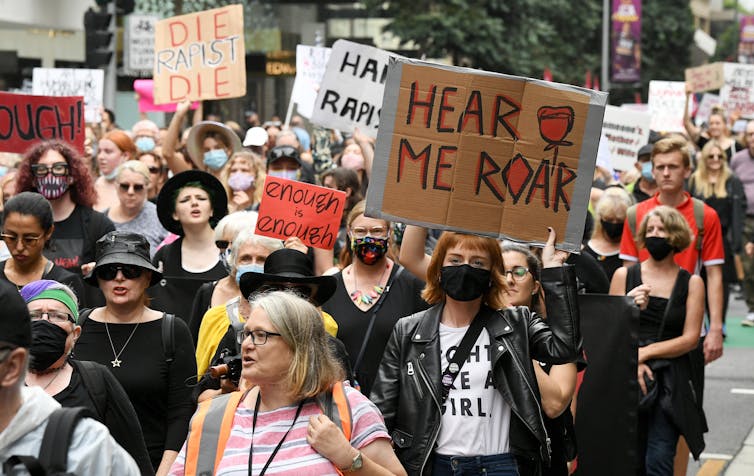 Tens of thousands of protesters marched on Monday, in more than 40 locations. Dave Hunt/AAP
Activists will need to devise clear and telling ways to keep attention focused on their cause, in a media environment primed to move on and seek out the new. It is one thing to organise a successful day of protest. It is another to devise novel ways to keep the media engaged over time, racheting up pressure on the government to change its stance.
Labor’s task now is to position the Prime Minister’s handling of Higgins’ alleged rape, and the Attorney-General’s fitness for office, into a bigger picture of general government incompetence and specific neglect of women’s needs.
If Labor can demonstrate this incompetence and neglect are part of a bigger pattern, the government will pay a price. Women’s rage over the specific instances of gendered violence that triggered the March 4 Justice protests will have yielded a visible dividend.
And work on fixing the wider problem can energetically advance.
References
- ^ take to the streets (theconversation.com)
- ^ around the world (www.bbc.com)
- ^ refusing to attend (www.sbs.com.au)
- ^ clumsy description (www.abc.net.au)
- ^ moved (www.news.com.au)
- ^ Jennifer Hewett wrote (www.afr.com)
- ^ in The Australian (www.theaustralian.com.au)
- ^ latest Newspoll (theconversation.com)
- ^ View from The Hill: Christian Porter finds a target, and so does Brittany Higgins (theconversation.com)
- ^ Samantha Maiden’s report (www.news.com.au)
- ^ 'What are you afraid of ScoMo?': Australian women are angry — and the Morrison government needs to listen (theconversation.com)
- ^ Porter’s defamation case (theconversation.com)