
Torres Strait Islanders face more than their fair share of health impacts from climate change
- Written by: Nina Lansbury Hall, Senior Lecturer, School of Public Health, The University of Queensland
Torres Strait Islander peoples intend to live on their traditional country long-term. Living on the northernmost islands of Queensland allows these “saltwater people” to maintain their cultural responsibilities, identity and kinship connections.
Caring for country and keeping these connections can also bring health benefits[1]. However, climate change increases the risks of negative health impacts.
There is escalating outrage[2] about these and other climate impacts on health by Traditional Owners and by medical personnel[3]. Both groups are calling for urgent climate action.
Our research team includes two Badu Island[4] men who are public health researchers, an infectious diseases doctor, and two environmental health researchers. We reviewed the evidence about climate-sensitive infectious diseases in the region.
Read more: Monday's IPCC report is a really big deal for climate change. So what is it? And why should we trust it?[5]
“If our connection to these lands disappears, our Indigenous culture disappears”
Mr Kabay Tamu is one of eight of Torres Strait Islanders who sought action against the Australian government through the United Nations’ Human Rights Committee[6] in 2019. They assert Australia’s responses to reduce climate change-causing emissions or to develop adaptation measures are inadequate, and constitute human rights violations.
Mr Tamu said in his speech[7]:
Our islands have been continuously inhabited by Indigenous people for tens of thousands of years, but the climate crisis is endangering all of this. Rising seas caused by man-made climate change are threatening homes, swamping burial grounds and washing away sacred cultural sites […] We, as a people, are connected to these islands through our cultural practices and traditions. If our connection to these lands disappears, our Indigenous culture disappears.
Research[8] provides further evidence[9] of human-induced climate change impacts in the Torres Strait Islands. Cyclones are projected to become more intense. Drought conditions in this region have affected the security of water supply, requiring the installation of mobile desalination plants. Changes to temperature and rainfall have affected the range and extent of mosquito species that are vectors for dengue virus.
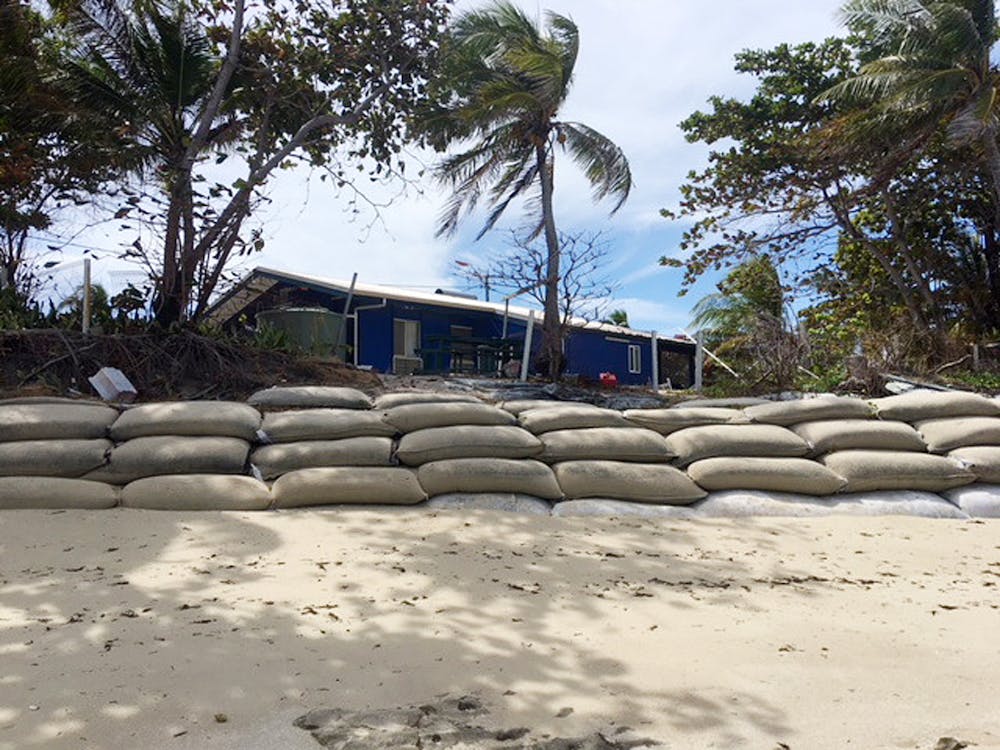 A metre-high wall of sandbags is all that stands between the high tide and the back door of the house, due to rising sea levels.
AAP Images[10]
A metre-high wall of sandbags is all that stands between the high tide and the back door of the house, due to rising sea levels.
AAP Images[10]
“Ensure our population is as healthy as possible for climate change”
An emergency call for increased attention to climate change and health impacts on Torres Strait Islander peoples[11] was made in 2019 by 22 medical professionals working in the Queensland government’s Torres and Cape Health and Hospital Service region. They stated:
[In the Torres Strait], climate change is a health emergency. We [medical officers] are concerned about the immediate effects of heat stress and extreme weather events as well as the long-term effects […] Vulnerable populations are disproportionately affected by climate change and unabated climate change will only steepen this social health gradient […] Proper investment […] is required to ensure our population is as healthy as possible for climate change
20% of Queensland’s diagnoses in only 0.5% of the state’s population
In our research, we sought to identify climate-sensitive infectious diseases that are currently or speculated to increase occurrence in the Torres Strait Islands. We compiled case data of infectious diseases with proven, potential and speculative climate sensitivity.
We found[12] there are five climate-sensitive infectious diseases present in the region: tuberculosis, dengue, Ross River virus, melioidosis (a potentially life-threatening bacterial infection) and nontuberculous mycobacterial infection.
These are recorded at a greater proportion than anticipated for the population size. The Torres Strait Islands have 0.52% of Queensland’s population but over 20% of Queensland’s melioidosis cases, 2.4% of tuberculosis cases and 2.1% of dengue cases.
Tuberculosis[13] occurrence can rise with humidity, rainfall and temperature - factors exacerbated by climate change. Mosquitoes carrying dengue and Ross River viruses[14] thrive with increases in temperature, rainfall, humidity and solar radiation. Increased cyclones, intense rainfall and flooding change soil conditions and elevate risk of life-threatening melioidosis[15]. These same conditions can increase disease with nontuberculous mycobacteria[16].
The Torres Strait Islander population already experiences a higher burden of chronic disease[17] than the general Australian population. This raises the risk of negative health outcomes from these climate-sensitive infections even further.
Read more: 'Although we didn’t produce these problems, we suffer them': 3 ways you can help in NAIDOC's call to Heal Country[18]
Torres Strait Islander voices must be privileged in climate change responses
The Torres Strait region is a part of Australia where the environmental and health impacts of climate change are being felt keenly. Torres Strait Islander voices need to be heard loudly and centrally to self-determine responses to protect their health and homeland[19] in the present and future.
Of course, localised efforts will not be sufficient in isolation. Actions to mitigate the causes of climate change and adapt to the impacts must occur in parallel nationally and globally. The Torres Strait Islands are the canary in the climate change coalmine.
References
- ^ bring health benefits (pubmed.ncbi.nlm.nih.gov)
- ^ outrage (www.clientearth.org)
- ^ by medical personnel (www.theguardian.com)
- ^ Badu Island (www.tsra.gov.au)
- ^ Monday's IPCC report is a really big deal for climate change. So what is it? And why should we trust it? (theconversation.com)
- ^ Torres Strait Islanders who sought action against the Australian government through the United Nations’ Human Rights Committee (www.theguardian.com)
- ^ Mr Tamu said in his speech (www.clientearth.org)
- ^ Research (www.tandfonline.com)
- ^ further evidence (www.tsra.gov.au)
- ^ AAP Images (photos.aap.com.au)
- ^ Torres Strait Islander peoples (www.theguardian.com)
- ^ found (onlinelibrary.wiley.com)
- ^ Tuberculosis (www.nature.com)
- ^ dengue and Ross River viruses (apo.ansto.gov.au)
- ^ melioidosis (pubmed.ncbi.nlm.nih.gov)
- ^ nontuberculous mycobacteria (www.ncbi.nlm.nih.gov)
- ^ burden of chronic disease (www.aihw.gov.au)
- ^ 'Although we didn’t produce these problems, we suffer them': 3 ways you can help in NAIDOC's call to Heal Country (theconversation.com)
- ^ self-determine responses to protect their health and homeland (apo.org.au)