
In Kabul's 'Saigon moment', Australia faces the shame of repeating its mistakes exiting the Vietnam war
- Written by: John Blaxland, Professor, Strategic and Defence Studies Centre, Australian National University
Scenes of mayhem unfolded at Kabul airport overnight, as foreigners and Afghans try to flee Afghanistan following the seizure of the capital by the Taliban.
As many, including myself, observed, this is Kabul’s “Saigon moment”.
What we are seeing — with, for now, the airport remaining open and the Taliban talking in benign terms about the governance of Kabul — echoes what happened in Saigon in 1975, as the United States and its allies exited the Vietnam War. Then, there was a fight north of the city but the North Vietnamese forces didn’t roll directly into town.
In that moment, there was a hiatus — a window of opportunity to leave. A brief moment for extraction of US personnel, their allies, including Australians, and the local people who helped them, before the final takeover of the city occurred.
The way things have unfolded in Kabul, with the airport remaining open for now, speaks to a level of collaboration between the Taliban and the US government in its negotiations about how US and coalition partners would be able to extricate themselves.
Whether Australia can extract its people — particularly the Afghans who helped us and are now in grave danger — remains to be seen. In Saigon, the window of opportunity was open for just a matter of days before it slammed shut.
Read more: Afghanistan: Taliban victory inevitable despite the trillions the US poured in[1]
Australia’s moral responsibility
I think there is considerable moral responsibility for the Australian government to continue to try to get out as many Afghans who helped us, even though their government seems to have collapsed.
In Saigon in 1975, Australia basically turned its back on locally employed staff and refused to repatriate them. Many people feel a bit ashamed about Australia’s attitude back then.
That may have informed the attitude of our government in recent weeks. Bowing to pressure, it has agreed to work toward extricating hundreds of Afghan people who have worked for us.
What is concerning is we haven’t gone hard or quick enough. There is a considerable number of people who remain very vulnerable, who would be worried about being earmarked as collaborators if they stayed.
Eyewitness reports at the airport speak of up to 1,000 people trying to board a plane designed to take 300. It is worth noting that a lot of aircraft can take more people than they are designated for if they don’t fill the cargo bay with luggage. That’s particularly true with big cargo aircraft. It’s not very safe but for some, it’s safer than staying in Kabul.
Australia, a bit late in the piece, has ramped up forces to go in and help extract people who are associated with Australia’s presence there over the past 20 years. I hope that is still on track and those people can still get out.
It is hard to know, because it’s so opaque whether that will materialise. It’s not entirely clear whether Australia’s RAAF flights can get in, or whether we will be able to piggyback off what the British and Americans, and perhaps the Canadians, are doing.
It’s worth noting that Kabul airport is quite vulnerable. It’s surrounded by hills, from which Taliban with ill intent can create havoc. That’s why the US has talked about deploying extra troops to support the extraction.
Turkey, which is still technically a NATO ally but is also a Muslim democracy that is seen as more palatable for the Taliban, has promised to provide security at the airport in Kabul as the Americans and their allies leave.
So there’s an arrangement for a transition out and we will see whether it comes to fruition.
Morale defeats physical force
More broadly, what we have seen in Afghanistan in recent weeks is a vast military power being clearly outfoxed by a Taliban force that, materially, is significantly inferior. Yet in terms of morale, resolve and endurance, the Taliban has clearly outmatched the US and its coalition partners, including Australia.
The saying, “you have the watches but we have the time” speaks to a problem we were not able to address.
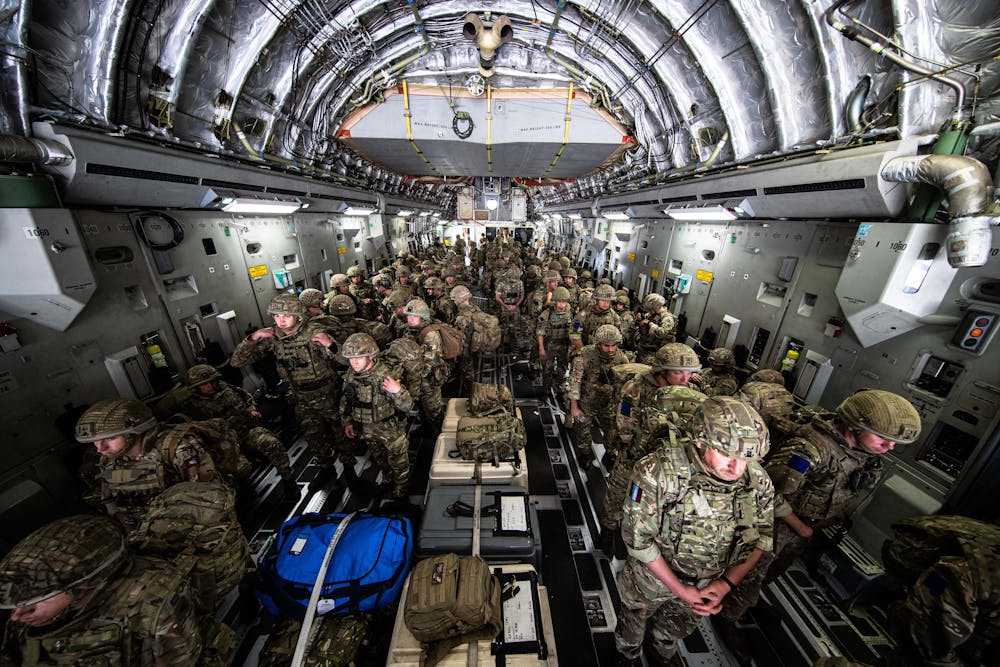 British military personnel are deployed to assist in evacuating British nationals and ‘entitled persons’ from Afghanistan.
BRITISH MINISTRY OF DEFENCE/EPA
British military personnel are deployed to assist in evacuating British nationals and ‘entitled persons’ from Afghanistan.
BRITISH MINISTRY OF DEFENCE/EPA
The Taliban’s smooth talking has seen city after city give in without a fight, despite having been equipped in a way that shows, on paper, the Afghan security forces on the ground should have been able to defeat the Taliban.
But in battle, morale is three to one to physical force and the morale just wasn’t there.
If you don’t have soldiers and police resolved to defend and hold off the Taliban, it’s worse than useless. Because now the Taliban is replete with American high-tech drones and sophisticated weaponry.
Cauterising the wound
There’s another dimension to this which is important for the future: what all this means for America’s fighting resolve.
In 1975, there was a sense that America’s pullout from Vietnam represented a major catastrophe and a failure of the West’s ability to hold off Communism. But in hindsight it seemed like that was just a low point. The Berlin wall still eventually fell.
There was also a sense in 1975 of the US and its allies being untrustworthy, that they leave people behind and that this will cause would-be allies not to trust them.
So perhaps there’s an argument that this exit from Afghanistan throws up similar issues.
On the other hand, others will argue it is a case of the US and its allies finally seeing reason and cutting their losses in a war that is, according to a hard-nosed realpolitik calculus, of little consequence strategically in the context of Russia modernising and being in cahoots with China.
Regardless of how it unfolded, many pundits saw little long-term prospect of the Taliban being pushed back forever in Afghanistan — particularly given the deep, behind-the-scenes support it got from Pakistan and, increasingly, elsewhere.
The US and its allies had to exit sooner or later. The bottom line is that, at some level, the wound had to be cauterised.
The question is: was there a better way to cauterise the wound?
The scenes unfolding at Kabul airport suggest that perhaps what was done to help those who helped us was a case of too little, too late.
Read more: As the Taliban surges across Afghanistan, al-Qaeda is poised for a swift return[2]
References
- ^ Afghanistan: Taliban victory inevitable despite the trillions the US poured in (theconversation.com)
- ^ As the Taliban surges across Afghanistan, al-Qaeda is poised for a swift return (theconversation.com)