What happens to your brain when you lose all sensory input in a float tank
You probably were not expecting it. You stepped into the float tank looking for calm or maybe a reset. At first everything felt ordinary. Then the shift arrived. You were not fully awake and not fully asleep. Shapes moved behind your eyes. Sounds that were not real drifted in and out. Time stretched until it felt thin. Then it folded back on itself. You wondered if this was your mind relaxing or something closer to a trip.
Experiences like this happen more often than people think. They appear in beginners and experienced meditators and anyone curious enough to lie in the dark with no sound and no movement. When your senses stop feeding information to the brain, the brain does not switch off. It turns inward. This is not mystical. It is simply what happens when the world outside goes quiet enough for the world inside to reveal itself.
To understand why these strange and often vivid states appear, it helps to look at how the brain behaves under normal conditions and what changes when all the usual noise disappears.
From the moment you wake, your brain manages a constant stream of signals. Light enters your eyes even when your eyelids are closed. Traffic sounds carry through walls. The weight of your body presses into the mattress. You smell breakfast or coffee or the air in the room. Even without noticing, your brain is sorting and organising all of this.
To make life manageable, it filters. It removes most of what does not matter so you can concentrate on the rest. This is why you do not feel your clothing unless you think about it. It is why you do not notice the quiet buzz of a nearby appliance until the moment someone mentions it. Without this filtration you would be overwhelmed within moments.
Very few people ever experience true reduction in sensory input. Even when resting in a dark bedroom you still feel the pillow, the sheet, the faint light behind your eyes. A float tank changes all of that.
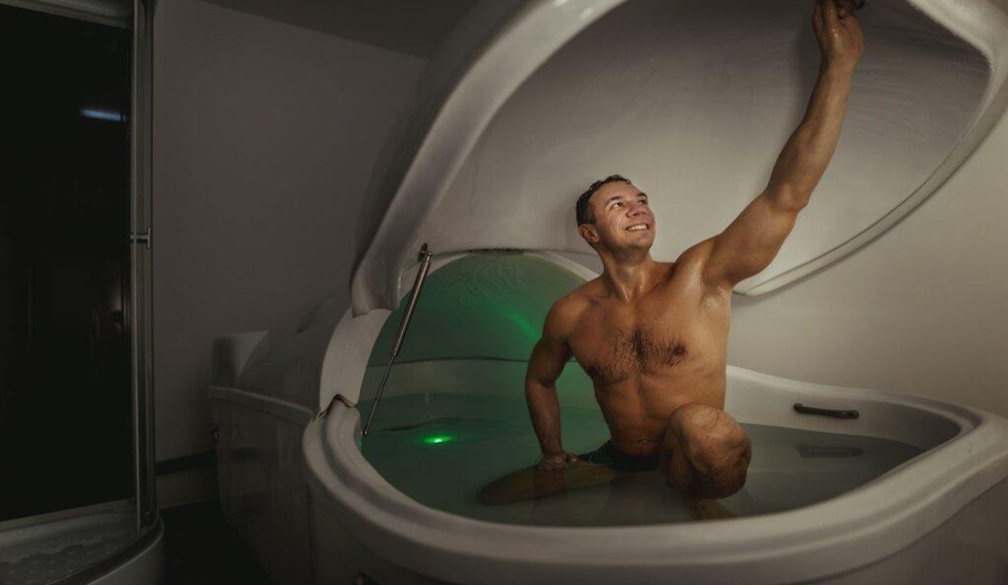
Inside a sensory deprivation tank, familiar anchors vanish. The water warms to match your skin so closely that you lose track of where your body meets the surface. There is no sound. No light. No movement. You float with no effort at all. Your body stops providing information to your brain and your surroundings fade into something that feels like nothing at all.
This absence is not simply calming. It pushes your mind into a place that is rare and strangely open. With no signals coming in, the mind begins to shift from processing the outside world to generating its own internal landscape. At first it can feel like still water. Then something stirs. Thoughts stretch out. Images form without warning. The mind begins to show you what it usually hides beneath everyday attention.
When input drops away, the brain fills the space. It has done this all your life. In the tank it simply becomes clearer.
One of the first changes involves the default mode network. This collection of brain regions becomes active when you are not occupied by a task. It carries self reflection, memory loops, imagination, and spontaneous thought. In the quiet of the float tank this network becomes stronger. Without external distraction your inner world becomes louder and more present.
Then the visual areas of the brain begin to spark. Normally they respond to light. In darkness they begin to create their own activity. Colours form. Shapes drift. Some people see gentle patterns. Others experience vivid scenes that feel like waking dreams. These moments are not symptoms of a disorder. They are natural responses to a brain that has no external work to do.
Sound can appear too. A gentle tone. A voice. A fragment of music. These sounds arise from within the mind and echo outward as if carried by the room even though the tank is completely silent.
Time becomes difficult to measure. Your internal clock depends on changes in the environment. Without those cues, minutes can feel like seconds. Or an entire landscape of thoughts can unfold in what turns out to be a very short session. Time becomes fluid. It gathers and opens and slips away.
Some people experience strong effects on their first float. Others feel nothing unusual at all. Both are normal.
What you bring into the tank shapes your experience. A restless mind may resist the stillness for a while. Yet that same restlessness can create an even stronger shift once your thoughts begin to settle. People who practise meditation often enter deeper states more easily, but surprising first sessions are common. The tank does not require skill. It requires softness and curiosity and a willingness to stop forcing the mind to behave in a particular way.
The tank does not transport you to a different world. It clears out everything except the interior one.
Even without visuals or sound or a sensation of drifting through space, the float experience is powerful. When the usual noise drops out, your nervous system finally has space to settle. Breathing slows. Muscles release. The chatter in your mind softens. Stress chemicals fall. This is not a short term trick. It is a shift that supports repair.
Many people find unexpected clarity after a session. Thoughts that felt tangled before you stepped in begin to sort themselves out. Emotions that were buried rise briefly then dissolve. Creative ideas appear without effort. The absence of stimulation becomes a kind of nourishment. You leave feeling lighter and clearer even if you did nothing but lie still.
That is the deeper value of floating. It is not the vivid moments or the dreamlike scenes. It is the space those moments come from. A place where your mind does not have to defend itself against constant noise. A place where you can rest without performing rest. A place where you can hear what your mind sounds like without the world interrupting.
Float tanks do not promise visions. They offer silence. What the mind does with that silence is the real experience.