What Certifications Should You Check for Lab-Grown Diamonds in Australia?
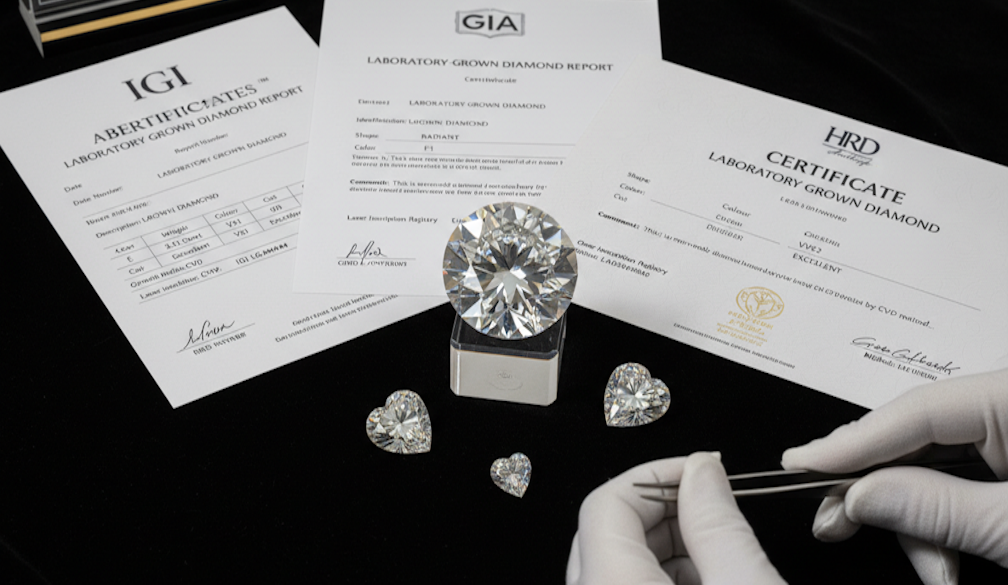
You want clear proof that your lab-grown diamond meets recognized quality standards. Certification provides that assurance and helps you make a confident, well-informed investment in the Australian market.
You should check for certification from respected laboratories such as IGI, GIA, DCLA, GCAL, or HRD Antwerp before purchasing a lab-grown diamond in Australia. Each lab follows established grading standards, allowing you to compare stones accurately and understand the true value behind your purchase.
IGI (International Gemological Institute) – Widely used for lab-grown diamond grading in Australia
IGI ranks among the most recognized laboratories for lab-grown diamonds in Australia. Many jewellers rely on IGI reports for engagement rings and fine jewellery, including certified lab-grown diamond collections from premium brands like LOHR Jewellery, where consistent grading and transparency are essential.
IGI reports outline the diamond’s cut, colour, clarity, and carat weight. The certificate also clearly confirms that the stone is lab-grown. In addition, reports often include a plotted diagram and laser inscription details, allowing you to match the physical diamond to its certification.
Because IGI grades both natural and lab-grown diamonds under globally recognized standards, you will commonly encounter IGI-certified stones across Australian retailers. Always check that the report number matches the diamond’s inscription to verify authenticity.
GIA (Gemological Institute of America) – Global benchmark for strict grading standards
The Gemological Institute of America is one of the most trusted authorities in diamond grading worldwide. As an independent non-profit organization, it focuses on research, education, and unbiased evaluation.
For lab-grown diamonds in Australia, a GIA report confirms both the origin and quality of the stone. It evaluates the 4Cs—cut, colour, clarity, and carat weight—and clearly identifies the diamond as laboratory-grown.
Each report includes a unique number that you can verify through GIA’s online database. This allows you to cross-check details and compare diamonds with confidence, ensuring your purchase aligns with recognized global standards.
DCLA (Diamond Certification Laboratory Australia) – Local expertise within the Australian market
DCLA is an Australian-based grading laboratory located in Sydney. It was established to bring international grading standards to the local market, offering a convenient option without requiring overseas certification.
For lab-grown diamonds, DCLA reports specify whether the stone is laboratory-grown and may include details about its growth method, such as CVD or HPHT. The report also covers the 4Cs, allowing direct comparison with both natural and lab-grown diamonds.
DCLA emphasizes transparency and consumer protection, making it a practical choice for buyers who prefer working within the Australian jewellery market while still maintaining international grading consistency.
GCAL (Gem Certification & Assurance Lab) – Advanced grading with added assurance
GCAL is an independent grading laboratory known for its detailed analysis and additional guarantees. Unlike many other labs, GCAL provides a written assurance backing the accuracy of its grading under specific terms.
Its reports include full 4Cs grading along with advanced cut and light performance analysis. GCAL’s 8X grading system evaluates brightness, fire, and symmetry at a deeper level, offering a more technical understanding of how a diamond performs visually.
For buyers who value precision and added confidence, GCAL certification provides an extra layer of assurance beyond standard grading reports.
HRD Antwerp – Established European grading standards
HRD Antwerp is a long-standing European laboratory operating under the Antwerp World Diamond Centre. It follows strict grading procedures and is recognized internationally, including within Australia.
An HRD certificate includes the 4Cs—cut, colour, clarity, and carat weight—along with confirmation that the diamond is lab-grown. Additional details may cover polish, symmetry, and fluorescence.
It is worth noting that HRD has announced a shift away from grading loose lab-grown diamonds, focusing instead on natural stones. However, it still provides certification for jewellery containing lab-grown diamonds. When reviewing an HRD report, check the issue date and scope to ensure it applies directly to your piece.
Conclusion
You should always ensure your lab-grown diamond comes with certification from a recognized, independent laboratory and that the report clearly identifies it as laboratory-grown. Review the 4Cs carefully, verify the report number, and match it with any laser inscription on the diamond to confirm accuracy.
In addition, pay attention to details such as growth methods and any listed treatments so you fully understand what you are purchasing. With the right certification, you can evaluate quality with clarity and choose a diamond that reflects both craftsmanship and long-term value.