Why Australian Brands Keep Running Ads That Sound American
- Written by: Times Media
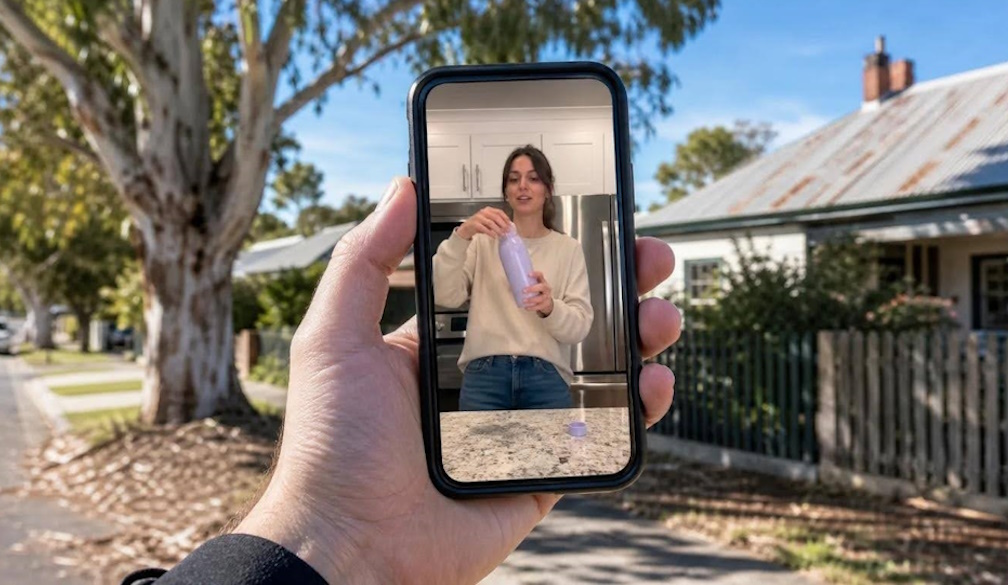
A phone held on an Australian suburban street showing a product video filmed in an obviously American kitchen
Scroll through the sponsored posts on an Australian phone for ten minutes and a pattern shows up quickly. A surprising share of the product videos aimed at local shoppers were clearly made somewhere else. The kitchen has an American fridge and an American outlet on the wall. The presenter says "awesome" in an accent that belongs in Texas or California. Someone mentions shipping in two days, or a price in dollars that turns out not to be Australian dollars.
Nobody sets out to make an ad that feels imported. It happens because of a very ordinary supply problem, and it is one that smaller Australian brands feel far more sharply than their counterparts in the United States.
The creator pool is smaller than it looks
Creator-style advertising depends on a large supply of people willing to film short, casual product videos to a brief. In the United States that supply is enormous. There are marketplaces, agencies and freelance networks with thousands of creators sorted by niche, age, city and style, and a brand can usually find someone who fits within a day or two.
Australia has good creators, but far fewer of them relative to demand, and the ones who deliver consistently are in steady work. For a local skincare label, a pet brand in Brisbane or a homewares shop in Adelaide, that shows up as longer waits, higher rates and less choice. Finding a presenter who fits a particular product and a particular customer, rather than just anyone available, can take weeks.
So brands compromise. They reuse footage bought from overseas creators, license generic clips, or run the supplier's own American ads with a local logo added at the end. It gets something into the feed. It rarely gets the same result as an ad that sounds like it came from down the road.
What Australian shoppers notice
The mismatch is not only about accent, although accent is the first thing people register. It is the accumulation of small signals that tell a viewer this was not made for them.
The setting is one of them. Australian homes, backyards and streets look different, and so does the light. The vocabulary is another. Australians say thongs rather than flip-flops, mention the servo or Woolies, and talk about paying with Afterpay because that is how a lot of them actually shop. Seasons run the other way, so a video about cosy winter bedding landing in January reads as careless.
None of these details would matter much in a polished brand film. In creator-style advertising they matter a great deal, because the whole premise is that the viewer is hearing from someone like them. The format sells relatability, and relatability breaks the moment the viewer realises the person is not from here.
A creator-style product video filmed on an Australian back deck, with a rotary clothesline and gum trees behind
Localisation used to mean a reshoot
Historically, fixing this meant doing the work twice. Brief an Australian creator, wait for delivery, review, request changes, and then do the same for every new product or angle worth testing. For a small team with a modest ad budget, that is often where the idea dies. The local version is better, but it is slow and expensive enough that only one or two ever get made.
That is part of why tools for ai ugc ads have found a real audience among smaller brands outside the big creator markets. Instead of starting with a person to hire, they start with the product page. UGCfy AI, for example, reads the page, drafts scripts in the language of the source material and pairs them with a synthetic presenter chosen from a library, which means a local brand can produce several versions of an ad in an afternoon rather than several weeks.
A tool does not make an ad Australian on its own, though. Somebody still has to rewrite the lines so they use local vocabulary, check that the setting does not look like a Florida kitchen, and listen to whether a presenter's voice actually sounds right to an Australian ear. What changes is the cost of trying. When a new version takes minutes rather than a fresh booking, it becomes practical to test a local script against the imported one and let the results decide.
The consumer law question
There is a line Australian businesses need to be especially careful with here, and it is set by the Australian Consumer Law rather than by any platform policy.
The ACCC has been clear for years that fake or misleading testimonials are a problem under the prohibition on misleading and deceptive conduct. Presenting someone as a genuine customer who used a product and got a particular result, when they did not, falls squarely into that territory. It does not become acceptable because the person is synthetic. If anything, a generated presenter describing personal results they could not have had is an easier case for a regulator to make.
The practical reading is straightforward. A synthetic presenter can demonstrate a product, explain what it does and walk through how it is used. It should not claim to be a real customer, invent personal before-and-after results, or imply an endorsement that never happened. Brands that keep scripts to demonstration and explanation, and that label AI-generated content where platforms ask for it, are working within the spirit of the rules rather than around them.
What a sensible local approach looks like
For a small Australian brand, the workable version tends to follow the same pattern. Start from what the product page can actually support, so the ad makes promises the store keeps. Write or edit the script with genuinely local language and references. Produce a handful of variations that differ in angle and presenter rather than one expensive hero ad. Run them against whatever imported creative is currently live, and keep the ones that hold attention.
Where a real local creator is available and fits, use them, particularly for the ads that perform. Synthetic presenters are most useful for the testing stage, where the question is which angle works at all, and least useful as a substitute for genuine customer voices.
The imported-ad problem is not really about technology. It is about how expensive it has been for smaller Australian brands to sound like themselves. That cost is coming down, and the brands that notice first will be the ones whose ads stop sounding like they were made for somebody else.