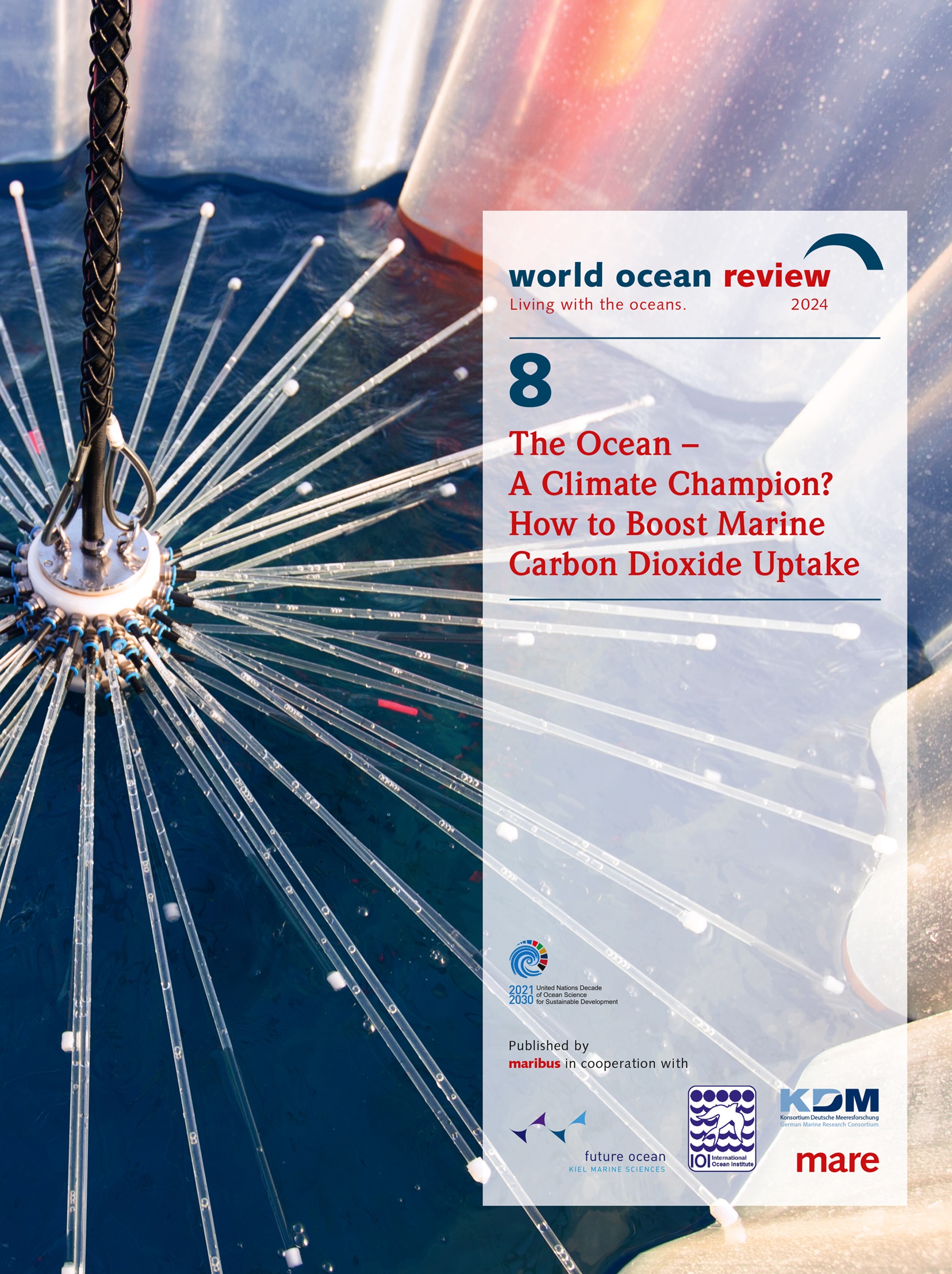
maribus publishes the eighth edition of World Ocean Review: "The ocean – a climate champion? How to boost marine carbon dioxide uptake"
The new World Ocean Review – available free of charge – synthesizes the current state of knowledge around ocean-based carbon dioxide removal (CDR). It aims to initiate a much-needed debate on whether humankind can and should intervene further in the ocean in order to protect the climate.
Measures to avoid greenhouse gas emissions are surely the main priority – but the truth is that in the coming decades, we will also have to remove large quantities of carbon dioxide from the atmosphere and store it securely. The new World Ocean Review (WOR 8) explores this issue with reference to the oceans' role in the Earth's carbon cycle and looks at the benefits, risks and knowledge gaps around the main marine carbon dioxide removal techniques. To the question whether humankind should intervene further in the ocean in order to protect the climate, this eighth edition of World Ocean Review provides some answers. Available from today, it can be ordered or downloaded free of charge from https://worldoceanreview.com/en/.
HAMBURG/KIEL, GERMANY - Newsaktuell - 24 January 2024 - In recent decades, the ocean has absorbed and stored around a quarter of the carbon dioxide emissions caused by human activities and has thus done much to slow down climate change. The purpose of marine carbon dioxide removal (CDR) is to support this natural carbon dioxide uptake by the ocean. Researchers are currently engaged in various projects which investigate the feasibility, costs, benefits, risks and sustainability of these CDR techniques. What is lacking, however, is a broad social debate on whether humankind has any right to intervene in ocean processes for the purpose of mitigating climate change, bearing in mind that it will not be possible to predict all the various risks and consequences from the outset. Opponents of ocean-based CDR point to the already parlous state of the world's oceans and the lack of knowledge about the consequences of using CDR. But advocates of CDR insist that effective climate action leaves us no alternative and that by using ocean-based CDR, we can claw back the time we need to develop other options for low-carbon living.
In view of the controversy surrounding the issue and the difficult decisions that are likely to arise in the climate process, this eighth edition of World Ocean Review focuses exclusively on carbon dioxide removal (CDR). With input from more than 20 scientists, it describes the urgent need for effective climate action and explains the mechanisms by which the ocean captures carbon dioxide and stores it for long periods. It explores the potential for uptake of
carbon dioxide by terrestrial vegetation, discusses why the oceans have become a key focus of the climate debate, and provides a detailed overview of promising ocean-based carbon capture and storage methods: from restoration and expansion of species-rich coastal ecosystems to interventions in marine chemistry (alkalinity enhancement) and carbon storage deep under the ocean floor. And finally, it considers key principles and rules which scientists believe must be put in place if society decides in favour of ocean-based CDR in future.
A contribution to a better understanding of the necessary measures and their impacts
"If the warming of the Earth continues at the present rate, a collapse of nature and society is inevitable. In order to reach our climate target, we must resort to methods which are equally impactful and existential. The truth is that stopping avoidable emissions will not be enough. I very much hope that the new World Ocean Review will help to enhance understanding of the measures that will unfortunately be necessary and raise awareness of their impacts," says Nikolaus Gelpke, initiator of the WOR project and Managing Director of maribus gGmbH. World Ocean Review is published by maribus gGmbH in partnership with the German Marine Research Consortium (KDM), the Kiel Future Ocean Network and the International Ocean Institute.
"WOR 8 describes measures which can be or are already being implemented, as well as those which should be assessed as options in terms of their benefits and possible risks. All the German marine research institutions and organizations are involved in related projects, proving once again that collaboration among the various marine research disciplines is capable of making fast, deliverable and sustainable contributions to solving a global problem. WOR 8 provides an impressive overview of current research in 2023 and also identifies where there are knowledge gaps so that even more viable recommendations can be made to executive agencies," Prof. Dr. Ulrich Bathmann, Chair of the German Marine Research Consortium (KDM), writes in his preface.
And as Prof. Dr. Martin Visbeck, Co-Spokesperson of Future Ocean, explains: "The themes addressed in WOR 8 will continue to preoccupy us for many years to come. At the international level, they form part of the climate negotiations towards compliance with the Paris Agreement and are embedded in the UN Decade of Ocean Science for Sustainable Development, which started in 2021 and focuses on the interface between ocean and climate and on the necessary social transformation processes. Research on this topic is therefore future-focused, and the new edition of WOR provides significant impetus for this scientific field."
World Ocean Review is published every two years in German and English and has a worldwide readership of policy-makers, business and civil society stakeholders with an interest in the topics covered. It provides up-to-date background information on relevant ocean-related issues and is aimed at anyone wishing to have a say on marine conservation and use.
The eighth edition of WOR, entitled The ocean – a climate champion? How to boost marine carbon dioxide uptake,is published today. It can be ordered as a printed copy or downloaded free of charge as a pdf from https://worldoceanreview.com/en/.