CPA Australia Urges Measures to Enhance Hong Kong’s Competitiveness in Budget
HONG KONG SAR - Media OutReach Newswire - 6 February 2024 - Today, CPA Australia submitted a series of recommendations for possible inclusion into Budget 2024-25 to the Hong Kong SAR Government.
With an estimated HK$127 billion fiscal deficit for the financial year 2023-24 and HK$708 billion of fiscal reserves, CPA Australia urges the Government to make announcements in the upcoming budget that balance the need to address the deficit with supporting the city's economic rejuvenation and sustainable development.
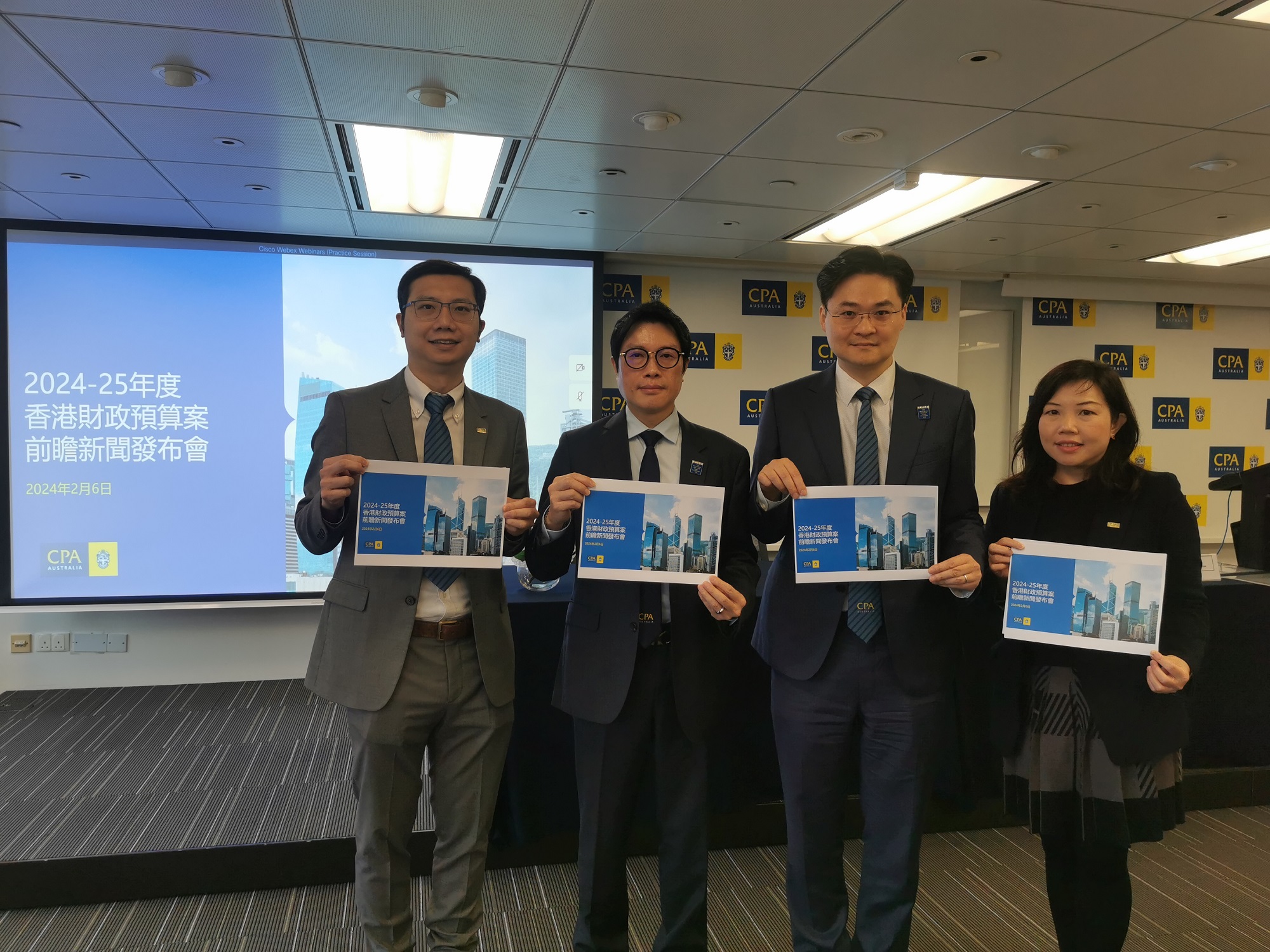
Mr Adam Chiu, Member of CPA Australia’s Taxation Committee – Greater China
Mr Janssen Chan, Co-Chairperson of CPA Australia’s Taxation Committee – Greater China
Mr Anthony Lau, Co-Chairperson of CPA Australia’s Taxation Committee – Greater China
Ms Karina Wong, Divisional Deputy President and Deputy Chairperson of CPA Australia’s Taxation Committee – Greater China
Attracting regional headquarters and investments
To improve Hong Kong's public finances, Mr Anthony Lau, co-chairperson of CPA Australia's Taxation Committee for Greater China, believes it's crucial for the government to increase its revenue by enhancing the city's overall attractiveness to companies, investment and talent, "Facing global uncertainties and volatility, many companies are seeking growth opportunities in Asia. To take advantage of this, Hong Kong should take steps to attract these companies to establish their regional headquarters (RHQ) in the city, by offering a concessional tax rate, for example 8.25 per cent."
"Gulf Cooperation Council (GCC) countries present another opportunity for Hong Kong. Through more government-to-government dialogue and closer bilateral cooperation, the Government can do much to attract more enterprises and investment from the GCC. "We suggest the government develop a bundle of preferential tax incentives to encourage more GCC enterprises to set up in Hong Kong. This can include a two-year exemption on profits tax for GCC companies that establish their RHQs in the city. To stimulate the capital market, we suggest offering a three-year exemption on stamp duty on the shares of GCC companies traded on the Hong Kong Stock Exchange. A similar stamp duty extension could also be given to the shares of Hong Kong private and listed companies GCC's single-family offices holding investment vehicles (FIHV) invest in.
"To strengthen the role of Hong Kong as a super connector between GCC and Mainland, the government can discuss with mainland authorities the possibility of exempting Mainland withholding tax on interest and dividends that GCC sovereign wealth funds receive from investments in strategic industries through Hong Kong such as sustainable development and emerging technologies."
Building a green and vibrant city
Lau also emphasises on the importance of enhancing Hong Kong's appeal as a green and vibrant city for business and tourists alike, "The government should continue to boost the green economy as sustainability has become a crucial factor for investment decisions. For example, the government should extend the Green and Sustainable Finance Grant Scheme to subsidise eligible bond issuers and loan borrowers, which is due to expire this year. The Government may also consider offering a 150 per cent super deduction for the cost of acquiring energy-saving machinery and equipment. A super deduction could also apply to the interest expenses incurred on green bonds issued by Hong Kong corporations.
"To achieve carbon neutrality, the Government should study the possibility of introducing a carbon tax on corporations emitting significant greenhouse gases in Hong Kong starting from 2026 at the earliest. We also suggest increasing fines and penalties for environmental damage."
To promote the mega event economy in Hong Kong, Lau suggests the Government offer a 150 per cent super deduction for event sponsorship expenses.
Stimulating financial services and reviewing tax system
Ms Karina Wong, Deputy Chairperson of CPA Australia's Taxation Committee for Greater China suggests the Government implement additional measures to attract family offices and stimulate growth in the financial sectors, "When determining if the eligible FIHV meet the minimum asset under management requirement of HK$240 million, the government should consider allowing a multiplier of 1.5 be applied to investments in Hong Kong listed shares, subject to a cap."
"Further, we suggest broadening the concessionary tax regime for family offices by including fixed-income products, antiques, artwork, and virtual assets in tax-exempt investments. We also suggest offering a 8.25 per cent concessionary tax rate for fee income derived by fund and family office managers."
Wong also highlights the urgency of Hong Kong signing more Comprehensive Avoidance of Double Taxation Agreement (CDTA) with jurisdictions to minimise double taxation. This is especially so for Australia, "The recently proposed changes to Australia's tax residency rules may significantly increase the tax burden on some of the 100,000 Australian expats residing in Hong Kong due to there being no CDTA signed between two jurisdictions.
"This year, the Government will implement the new Capital Investment Entrant Scheme (CIES) to enrich the talent pool and attract new capital to Hong Kong. If tax changes similar to what is being proposed in Australia are implemented in other non-CDTA jurisdictions, it may discourage talented people and high-net-worth individuals from those jurisdictions from moving to Hong Kong. Therefore, we urge the Government to increase their efforts to negotiate CDTA with other jurisdictions."
To keep pace with the evolving economic and finance systems, an ageing population and to maintain healthy public finances, Wong reiterated CPA Australia's call for the Government to undertake a comprehensive review of the tax system and evaluate reform options.
Supporting SMEs to recover
"While the overall economy has been recovering, many SMEs need more time to return to normalcy. Some of them are still facing challenges such as cash flow difficulties and labour shortages," Says Mr Janssen Chan, co-chairperson of CPA Australia's Taxation Committee for Greater China.
Chan also says, "We suggest extending the application period of the SME Financing Guarantee Loan Scheme on the 80 per cent and 90 per cent Guarantee Product, and Special 100 per cent Loan Guarantee for another 12 months. This aim to improve SME access to finance, with applications currently closing next month."
"To assist SMEs overcome their hiring difficulties, we suggest the Government introduce an additional tax deduction on salaries for employees aged 60 or over. We also suggest the Government review the Sector-specific Labour Importation Schemes and consider broadening its scope to cover more sectors in severe labour shortage.
To assist imported labour obtain the licenses required to work in Hong Kong, we suggest the government provide training subsidies to employers to help their imported workers meet relevant licensing requirements."
Improving living standards and encouraging childbirth
CPA Australia suggests the Government implement relief measures to enhance citizens' quality of life and encourage childbirth. Mr Adam Chiu, a member of CPA Australia's Taxation Committee for Greater China says: "The Government should explore measures to promote healthy lifestyles, such as introducing tax deduction up to HK$6,000 for sports-related expenses."
He further suggests, "To alleviate the financial burden for taxpayers, we suggest increasing the basic allowance to HK$150,000, raising the deduction cap on home loan interest expense to HK$150,000 and increase other personal allowances under salaries tax in subsequent financial years, at the very least in line with inflation."
In terms of policies promoting childbirth, Chiu emphasises the substantial financial strain that childcare places on families. "It is crucial for the government to address this challenge by introducing supportive measures. These measures could involve introducing a childcare expense allowance with a cap of HK$60,000, or providing lower- and middle-income households a subsidy to meet the cost of child care and early childhood education."
Appendix – Key Recommendations for Hong Kong Budget 2024-25
1. Enhancing Hong Kong's competitiveness
|
2. Promoting the green economy
|
3. Stimulating financial services and reviewing tax system
|
4. Supporting SMEs
|
5. Improving living standards and encouraging childbirth
|
6. Diversifying the economy
|
Hashtag: #CPAAustralia #Accounting #Accountant #HongKongBudget #PublicFinance #Tax #Taxation #ESG #SME #HongKongEconomy #Finance #FamilyOffice
https://www.cpaaustralia.com.au/
The issuer is solely responsible for the content of this announcement.
About CPA Australia
CPA Australia is one of the largest professional accounting bodies in the world, with more than 172,000 members in over 100 countries and regions, including more than 22,200 members in Greater China. CPA Australia has been operating in Hong Kong since 1955 and opened our Hong Kong office in 1989. Our core services include education, training, technical support and advocacy. CPA Australia provides thought leadership on issues affecting the accounting profession and the public interest. We engage with governments, regulators and industries to advocate policies that stimulate sustainable economic growth and have positive business and public outcomes. Find out more at cpaaustralia.com.au