Global Scholars Converge in Hong Kong at Hong Kong Baptist University's Inaugural International Interdisciplinary Research Summit
Inspiring Collaboration and Innovation to Drive Impactful Research Addressing Global Challenges
HONG KONG SAR - Media OutReach Newswire - 28 February 2025 - Hong Kong Baptist University (HKBU)’s inaugural International Interdisciplinary Research Summit (IIRS) has convened leading scholars, researchers, and innovators from diverse fields from Hong Kong and worldwide to foster collaboration and address pressing global challenges, particularly in fields including Data Analytics & Artificial Intelligence (AI), and Health and Drug Discovery.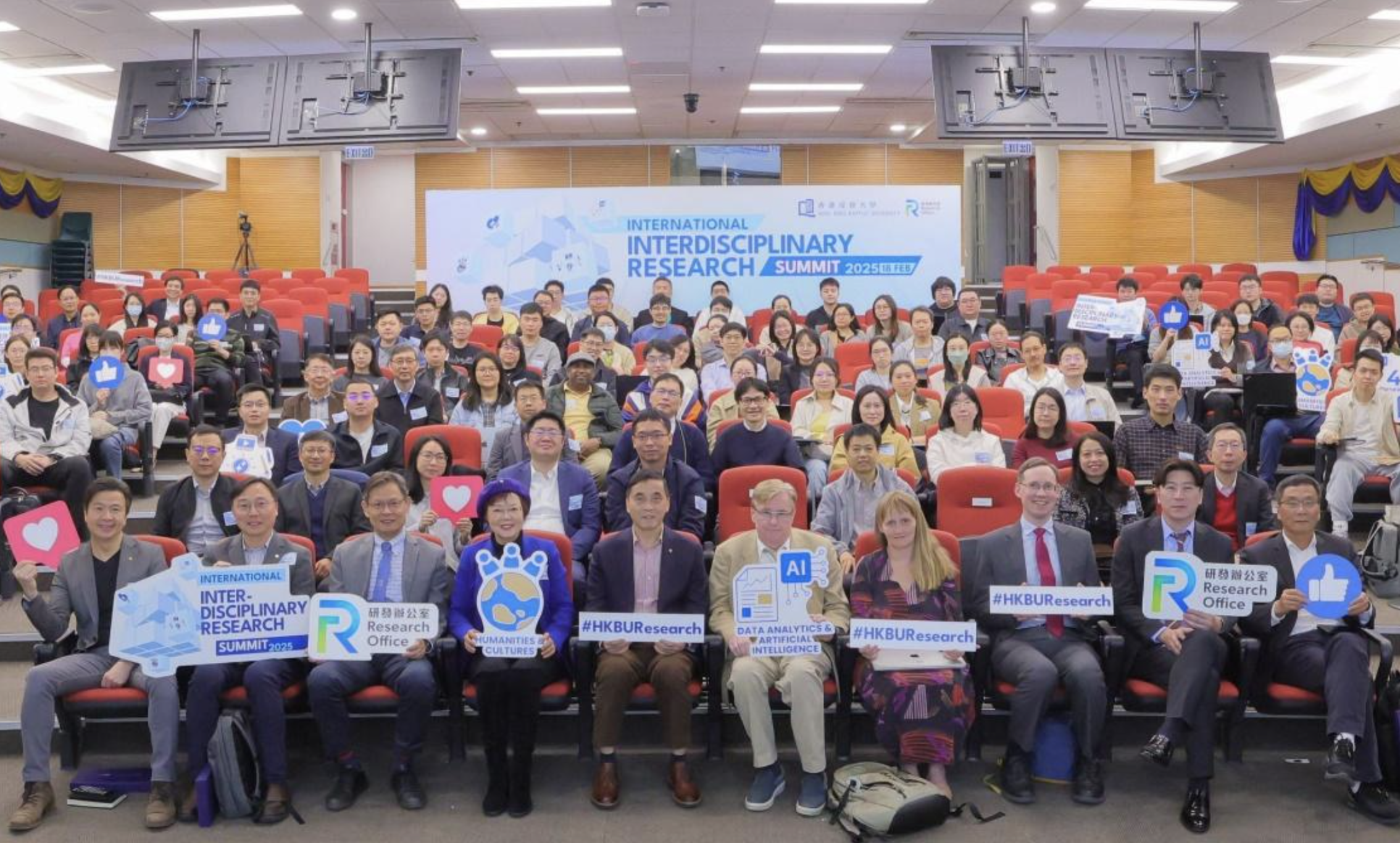
Interdisciplinary Solutions: Enabling Early Identification of High-Risk Individuals for Disease Treatment
In a world where health challenges have reached unprecedented levels, HKBU’s inaugural International Interdisciplinary Research Summit (IIRS) showcased how interdisciplinary collaboration, between Data Analytics & Artificial Intelligence (AI), and Health and Drug Discovery, can revolutionize and accelerate the development of new and more effective treatments for a range of diseases. As highlighted by Vice President (Research and Development) Professor Aiping Lyu, the university is dedicated to fostering international research collaboration against today's complex challenges. He noted that the university's focus on four transdisciplinary clusters - creative media and practice, health and drug discovery, analytics and AI, and humanity and culture, is crucial for fostering innovation.
Keynote speakers of the Summit included Professor Jeremy Nicholson, Director, Australian National Phenome Centre, Murdoch University, Australia; Albert Einstein Honorary Professor of Medical Biochemistry, Chinese Academy of Sciences, China; Emeritus Professor of Biological Chemistry, Imperial College London, UK. Known to be one of the world’s foremost coronavirus experts, Nicholson covered the topic of “Molecular Phenomic Approaches in Population Health and Disease Diagnosis”. He unveiled how AI and advanced data analysis are used to analyse genes and lifestyle, highlighting that studying humans for future scientific relevance requires considering the complex interplay of genes, environment, politics, funding, and human interactions that ultimately influence the translation of science into clinical medicine.
Professor Thomas Efferth, Director, Institute of Pharmaceutical and Biomedical Sciences, and Chair, Department of Pharmaceutical Biology, Johannes Gutenberg University, Germany, leads a research team developing compounds that could replace opioids as pain relief without addiction. In the speech titled “Artificial Intelligence and Network Biomedicine in Natural Product Research”, Efferth highlighted the transformative role of AI and systems biology in natural product research, explaining that tasks previously performed manually by generations of PhD students, such as pipetting in wet labs, can now be automated with robots. Moreover, AI can optimize experiment design, creating significant opportunities for deep learning and AI in research.
Likewise, Professor Gavin Winston, Department of Medicine, Centre for Neuroscience Studies and School of Computing, Queen’s University, Canada, is leveraging AI and ML to revolutionise brain imaging for neurological diagnosis and treatment. In his presentation titled “Machine Learning in Neuroimaging across Disciplines”, he highlighted how advanced techniques like deep learning are enabling more efficient and precise analysis of MRI and CT scans, ultimately leading to improved outcomes. Notably, his current research focuses on utilising robotics and neuroimaging to understand and address cognitive impairment in individuals with epilepsy, demonstrating a commitment to improved patient care.
Professor Jianfeng Feng, Dean of the Institute of Science and Technology for Brain-Inspired Intelligence and School of Data Science at Fudan University, spoke on the topic “From Multi-Omic Data to Brain Diseases, Digital Twin Brains, and Brain-Inspired AI”. One of Feng’s research projects found that blood biomarkers can forecast the risk of dementia 15 years before diagnosis of Alzheimer’s disease. He emphasised that AI and ML are transforming healthcare, from understanding the foundations of diseases to developing personalised medicine.
The summit's panel discussions further amplified the impact of interdisciplinary approaches in disease treatment. Leading experts delved into crucial discussions, enriched by perspectives on natural products and Traditional Chinese Medicine, centred on the challenges and way forward in translating big data into actionable understanding. Key topics included integrating Al capabilities with domain knowledge for data-driven model interpretation, addressing the paradox of using doctor-labelled data for Al training in clinical applications, managing multi-scale parameter calibrations and validations in principle-based modelling, and balancing computational cost with biological predictability through strategic coarse-graining. These sessions generated a wealth of new perspectives and underscored the indispensable role of science in addressing societal health challenges.
Professor Johnny Poon, Associate Vice-President (Interdisciplinary Research), HKBU, remarked that the IIRS cultivated a vibrant atmosphere for sharing knowledge and working together. Scholars have gathered and expressed enthusiasm for the groundbreaking research expected to result from the relationships formed at the summit.
As one of the priorities of the University’s Institutional Strategic Plan 2018-2028, HKBU aspires to be a leading, research-led, liberal arts University in Asia. The University keeps enhancing its capacity and strength to produce world-class research with an aim to bring significant impact to society. To learn more about HKBU’s research strengths and our publications, visit HKBU Research Website.
Hashtag: #HKBU
The issuer is solely responsible for the content of this announcement.
About HKBU Research Office
At Hong Kong Baptist University (HKBU), we nurture and uphold a robust research culture and environment, and equip our remarkable researchers with visionary insights and strategic experiences throughout their intellectual journey. While promulgating our esteemed researchers, their interdisciplinary research initiatives, and HKBU’s research excellence locally and internationally, we value our solid connections with the HKBU community.
Together with every community member, we strive for research excellence in our four strategic research clusters: Creative Media and Practice, Health and Drug Discovery, Data Analytics and Artificial Intelligence, and Humanities and Cultures.
Explore more about HKBU’s research at https://research.hkbu.edu.hk/.