Aiming for 10,000 steps? It turns out 7,000 could be enough to cut your risk of early death
- Written by: Matthew Ahmadi, Postdoctoral Research Fellow, University of Sydney
Many Australians are walking for their permitted fitness activity during lockdown. Some, emerging from winter hibernation, are taking part in STEPtember[1] — a global initiative to raise money for cerebral palsy services and research.
The goal for participants is to reach 10,000 steps each day during the month of September. Indeed, 10,000 steps is the de-facto target around the world that many people associate with being fit, healthy and ageing well.
Now, a new study[2] says a lower — and more achievable — daily goal of 7,000 steps will still yield substantial health benefits.
From marketing to medical advice
The 10,000 step benchmark originated from a marketing campaign rather than a specific health objective. A Japanese company (Yamasa Corporation[3]) built a campaign for their new step-tracker off the momentum of the 1964 Tokyo Olympics[4]. The pedometer’s brand name — Manpo-Kei means 10,000 step meter in English — and a new phenomenon was born.
The new study from the US in 2,100 adults aged over 40 found that while 10,000 steps may well be an optimal health goal, adults can still achieve significant health benefits from only 7,000 steps per day.
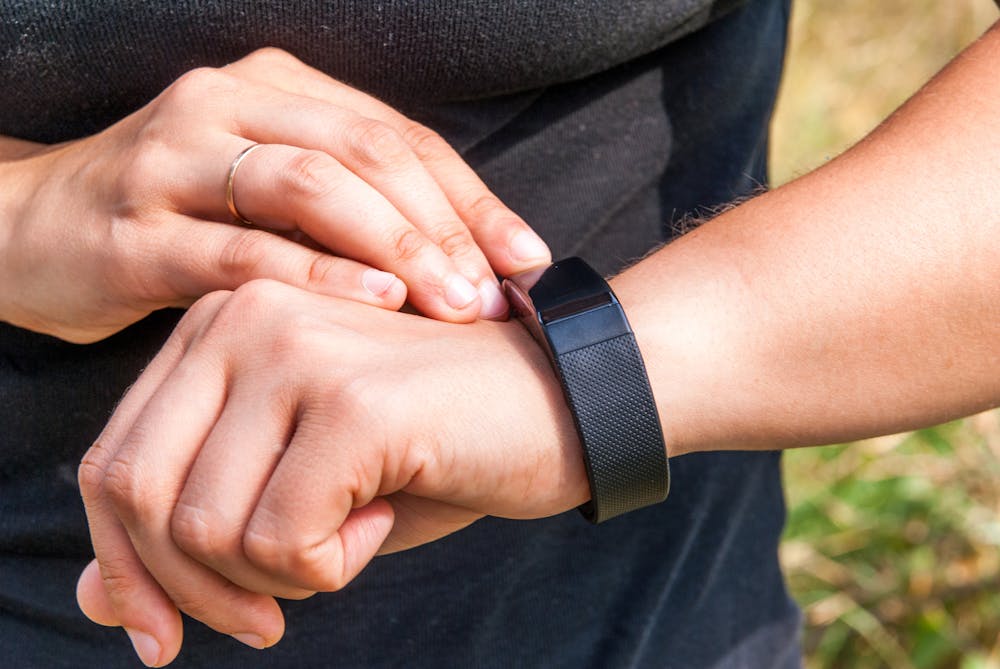 Technology including smart watches help walkers and researchers keep track of steps.
Shutterstock[5]
Technology including smart watches help walkers and researchers keep track of steps.
Shutterstock[5]
The researchers in the new study collected data using wearable sensors (triaxial accelerometers similar to those used in smartwatches and phones) and followed participants over a period of around ten years. Researchers looked at the average step counts and analysed the risk of death (after controlling for other factors that might influence the result, like poor health, smoking, and diet).
Compared to adults who walked less than 7,000 steps per day on average, those who reached between 7,000 and 9,999 steps per day had a 60% to 70% lower risk of early death from any cause. The effect was the same for both men and women. But there wasn’t significant further reduction in the risk of early death for those who walked more than 10,000 steps.
The effective step target might be even lower in older women[6]. A 2019 study of 16,741 women with a mean age of 72 years found those who averaged around 4,400 steps per day had significantly lower mortality rates when they were followed up more than four years later, compared with the least active women in the study.
Read more: Do we really need to walk 10,000 steps a day?[7]
Not such a need for speed
The researchers found health benefits were not affected by walking pace (based on the peak steps per minute over a 30-minute period) or intensity (the total time with over 100 steps per minute).
These findings corroborate a 2020 publication[8] and further confirm the WHO’s 2020 physical activity report that tells us “every move counts[9]”. Such messaging is echoed in Australia’s Move it[10] campaign.
Research has shown walking to increase our individual speed could be more important than absolute speed[11] — emphasising the goal to challenge ourselves while out walking for exercise.
What about during lockdown?
A large UK study shows prolonged lockdown conditions may limit our movement to 3,500 steps a day[12]. And we know less physical activity not only affects physical health, but also mental health[13].
Exercise during lockdown is considered an essential activity by national[14] and international[15] authorities — as important as obtaining food and medical care.
For the millions of Australians in lockdown right now, this new study brings positive news and a more achievable goal for protecting their health[16].
There is no one-size fits all when it comes to fitness. And there are many different innovative ways to stay active[17] while we’re at home.
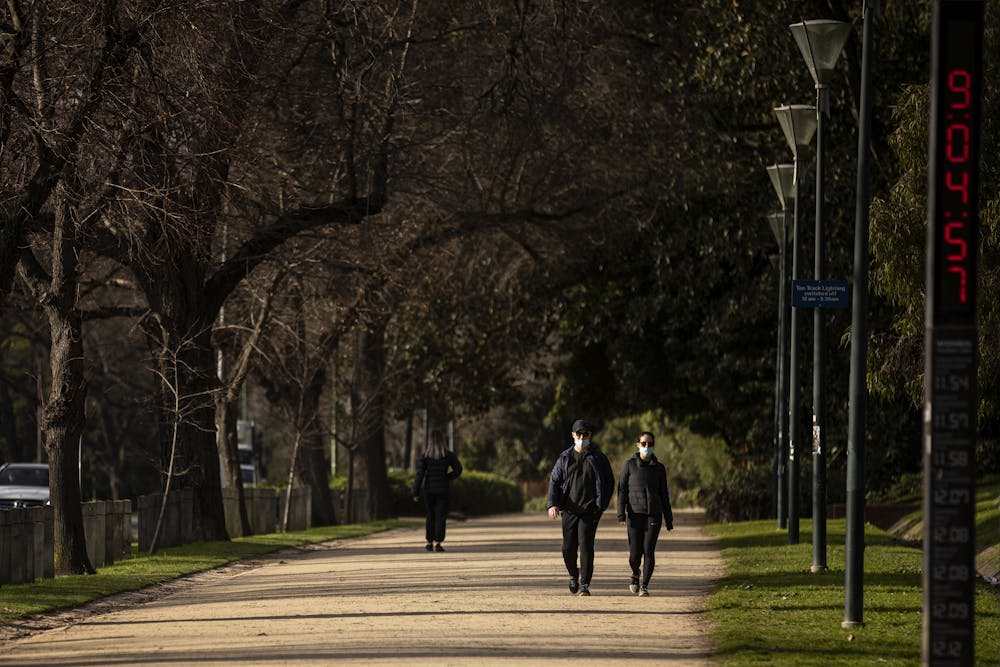 Many Australians are discovering during lockdown why daily walking is considered essential by authorities.
AAP/Daniel Pockett[18]
Many Australians are discovering during lockdown why daily walking is considered essential by authorities.
AAP/Daniel Pockett[18]
Read more: Home cooking means healthier eating – there's an opportunity to change food habits for good[19]
Just keep walking
For those people who don’t have mobility issues, walking provides therapeutic benefits and is an excellent activity for health. It is free of charge, expends energy at any pace, can be done all year round and is a habit forming activity[20].
While it is estimated more than a quarter of the world’s population is physically inactive[21], an easy and achievable solution might be right on our doorstep.
Whether we walk or do other physical activities, it is important we do so at a speed and intensity appropriate to our personal abilities and physical capacity.
More research is needed to understand the potential long-term health benefits across the lifespan of light-intensity activities[22] such as household activities like gardening, watering the garden or vacuuming. But evidence continues to affirm that stepping to the beat of your own drum can ensure health benefits, prevent premature death and set attainable benchmarks to make us want to keep active and motivated to continue.
Public health messaging has emphasised the need to sit less and move more[23]. Events like STEPtember add to heightened public awareness around the health benefits of physical activity[24] and present an opportunity to focus on efficient ways to be active.
Whether you take 7,000 or more steps a day, the most important message is every single step counts.
Read more: Why some people find it easier to stick to new habits they formed during lockdown[25]
References
- ^ STEPtember (www.steptember.org.au)
- ^ new study (jamanetwork.com)
- ^ Yamasa Corporation (www.yamax-yamasa.com)
- ^ 1964 Tokyo Olympics (link.springer.com)
- ^ Shutterstock (image.shutterstock.com)
- ^ older women (jamanetwork.com)
- ^ Do we really need to walk 10,000 steps a day? (theconversation.com)
- ^ 2020 publication (jamanetwork.com)
- ^ every move counts (www.who.int)
- ^ Move it (theconversation.com)
- ^ could be more important than absolute speed (bjsm.bmj.com)
- ^ 3,500 steps a day (onlinelibrary.wiley.com)
- ^ mental health (www.who.int)
- ^ national (www.health.gov.au)
- ^ international (www.euro.who.int)
- ^ health (www.sciencedirect.com)
- ^ innovative ways to stay active (theconversation.com)
- ^ AAP/Daniel Pockett (photos-cdn.aap.com.au)
- ^ Home cooking means healthier eating – there's an opportunity to change food habits for good (theconversation.com)
- ^ habit forming activity (link.springer.com)
- ^ physically inactive (www.thelancet.com)
- ^ light-intensity activities (ijbnpa.biomedcentral.com)
- ^ sit less and move more (www.heartfoundation.org.au)
- ^ health benefits of physical activity (www.thelancet.com)
- ^ Why some people find it easier to stick to new habits they formed during lockdown (theconversation.com)