


How 1910's Big Burn can help us think smarter about fighting wildfires and living with fire
- Written by: William Deverell, Professor of History, USC Dornsife College of Letters, Arts and Sciences
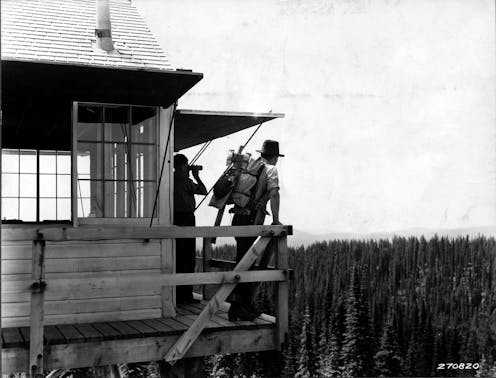
Over two days in the summer of 1910[1], wildfires roared across the bone-dry forests of the inland Northwestern U.S., the Rockies, and parts of British Columbia. Whole towns burned. The blazes scorched 3 million acres of forest, an area the size of Connecticut, and left behind a legacy that profoundly changed how the U.S. managed wildfires – and ultimately how fires behave today.
The Big Burn shook firefighting agencies and officials, most notably the newly formed U.S. Forest Service and its leaders. As those who had witnessed The Big Burn rose through the pre-World War II Forest Service ranks, a firm and unyielding policy[2] rose with them:
Forest fires were to be put out. All of them. By 10 a.m. the morning after they had been discovered.
While not widely known outside the Forest Service, the “10 a.m. policy[3]” is one of the most consequential environmental actions in American history. This absolutist fire suppression ideology, later publicized by Smokey Bear[4], has as its origin the Big Burn complex of forest fires in 1910 and its roots in 19th-century settler colonialism.
The aftermath of 1910 led to bold decision-making[5] in forest and fire management techniques and directives. Fire suppression, at least in the way the Forest Service and allied agencies went about it – militarized, technologically impressive, expensive[6] – led the U.S. down a forest management path that neglected other, more nuanced approaches to fire. The dismissal of Indigenous ecological knowledge about fire and land stewardship undoubtedly contributed to the rise[7] of suppressing all fires.
Now, more than a century later, the 21st century’s big burns are a signal that things have gone terribly wrong[8].
In 2020, fires in California alone burned more than 4 million acres and spawned a new term: the gigafire, a wildfire that burns more than 1 million acres. The August Complex[9] was the first known modern gigafire. The Dixie Fire, which swept through the town of Greenville[10] in northern California in August 2021, will likely be another gigafire[11] before it is finally put out.
As historians of[12] the western U.S.[13] and heads of the Huntington-USC Institute on California and the West[14], we and our colleagues have been exploring what went wrong with wildfire management in the region, and why.
Fire behavior that crews haven’t seen before
Huge swaths of California and the West are on fire again[15] this year, and wildfires are behaving in ways firefighters haven’t experienced before.
Officials say that this year, for the first time on record, a wildfire crossed the Sierra Nevada[16] from West to East – the Dixie Fire did it first, and then the Caldor Fire did the same thing a few weeks later. The Caldor Fire was so hard to control, fire officials in late August talked about trying to steer it[17] into another fire’s burn scar as their best chance to stop its race toward communities around Lake Tahoe. Some fires have become so extreme, they created their own weather[18].
Part of the problem is climate change. Drought and higher temperatures[19] are fueling bigger, hotter and more dangerous fires than at any time in recorded memory. Summer wildfire seasons are lasting longer[20], droughts are leaving more fuel ready to burn[21], and fire weather[22] is becoming more common.
Adding to the risk is the number of people living in wildland areas and all those years of fighting every fire[23].
The U.S. routinely put out about 98%[24] of all fires before they reached a half-square mile in size. That means areas that normally burned every few decades[25] instead built up fuel that can make fires more extreme when they do start.
In an unprecedented move this year, the U.S. Forest Service closed all national forests in California[27] to hikers, campers and others through at least mid-September to lower fire risk and keep people out of harm’s way. Several national forests in Arizona were closed[28] earlier in the summer.
Closing the forests is not a sustainable solution. That it happened drove home the nature of the emergency in the West.
A new fire paradigm
The response to the Big Burn was not only wrongheaded, in our view, but also crude in its single-mindedness. “Put all forest fires out” had a clarity to it, but a 21st-century fire paradigm shift will have to be connected to broader conversations about environmental knowledge and how it can best be shared.
The U.S. has learned that it cannot suppress its way to a healthy relationship with fire in the West. That strategy failed even before climate change proved it to be no strategy at all.
Building a more successful coexistance with fire includes figuring out how to work cooperatively. This includes broader conversations about environmental knowledge, what constitutes it and how best it can be shared. Indigenous communities have long lived with fire and used it to cultivate healthy ecosystems[30]. Prescribed and cultural burning are important tools[31] in mitigating catastrophic fire and simultaneously aiding forest health.
Living with fire also requires teaching everyone about fire. Schools at all levels and grades can teach fire knowledge[32], including the science of fire and its consequences for communities, economies and lives; the history and cultural practices of fire; and the plants, landscapes and materials[33] that can help prevent fires.
Finally, communities and landowners will have to reconsider how and where development takes place in high-risk areas. The idea that people can build wherever they want isn’t realistic[34], and landowners will have to seriously rethink the reflex to rebuild[35] once burned areas have cooled.
In our view, living with fire demands greater attention to learn from and care for each other and our common home. Collaboration, respect, resources and new ideas are keys to the path forward.
References
- ^ two days in the summer of 1910 (www.fs.usda.gov)
- ^ a firm and unyielding policy (foresthistory.org)
- ^ 10 a.m. policy (www.fs.usda.gov)
- ^ Smokey Bear (www.fs.usda.gov)
- ^ bold decision-making (www.fs.usda.gov)
- ^ militarized, technologically impressive, expensive (www.fs.usda.gov)
- ^ contributed to the rise (www.capradio.org)
- ^ gone terribly wrong (theconversation.com)
- ^ August Complex (inciweb.nwcg.gov)
- ^ town of Greenville (theconversation.com)
- ^ likely be another gigafire (inciweb.nwcg.gov)
- ^ historians of (dornsife.usc.edu)
- ^ the western U.S. (dornsife.usc.edu)
- ^ Huntington-USC Institute on California and the West (www.usc.edu)
- ^ on fire again (www.nifc.gov)
- ^ crossed the Sierra Nevada (www.washingtonpost.com)
- ^ steer it (www.tahoedailytribune.com)
- ^ created their own weather (theconversation.com)
- ^ Drought and higher temperatures (www.ipcc.ch)
- ^ wildfire seasons are lasting longer (doi.org)
- ^ more fuel ready to burn (doi.org)
- ^ fire weather (doi.org)
- ^ years of fighting every fire (theconversation.com)
- ^ about 98% (www.doi.org)
- ^ normally burned every few decades (www.fs.fed.us)
- ^ Robyn Beck/AFP via Getty Images (www.gettyimages.com)
- ^ closed all national forests in California (www.fs.usda.gov)
- ^ national forests in Arizona were closed (www.abc15.com)
- ^ AP Photo/Brian Melley (newsroom.ap.org)
- ^ used it to cultivate healthy ecosystems (www.fs.fed.us)
- ^ important tools (www.mdpi.com)
- ^ teach fire knowledge (www.cafiresci.org)
- ^ the plants, landscapes and materials (www.fs.usda.gov)
- ^ isn’t realistic (www.kqed.org)
- ^ rethink the reflex to rebuild (www.wxpr.org)










