


The larrikin lives on — as a conservative politician
- Written by: Frank Bongiorno, Professor of History, ANU College of Arts and Social Sciences, Australian National University
Review: Quarterly Essay 83 Top Blokes: The Larrikin Myth, Class and Power by Lech Blaine (Black Inc)
The top blokes seem to be everywhere. There have been top blokes protesting lockdowns. Labor preselected a top bloke[1] to run for Hunter at the next election. A well-known top bloke from the 1980s, John Elliott[2], has left us for “that better place”. Top blokes can be found in board rooms, cabinet rooms and locker rooms across the country. And Lech Blaine, author of the Quarterly Essay 83, Top Blokes: The Larrikin Myth, Class and Power[3], says we also have a top bloke running the country.
But then it gets complicated. Blaine argues there are some top blokes — particularly politicians — who present themselves as larrikins in the finest Australian tradition but who aren’t the real McCoy.
The original larrikins of the 1870s and 1880s were young urban louts and sometimes serious criminals. By the first world war, the larrikin had become a rather cuddlier national type of the kind Australians use to flatter themselves: an anti-authoritarian with a heart of gold. It would be many years before larrikinism would come to be much associated in public discourse with businessmen or politicians, probably as late as the 1980s.
The modern varieties are descendants of this larrikin. The rest of us are invited to admire rather than condemn, to shake our heads in admiration and amusement at their witty piss-taking and daring mischief.
Kerry Packer was a rich top bloke and although he liked gambling, sport and meat pies rather than cordon bleu, he wasn’t, Blaine suggests, a real larrikin. Paul Hogan was another rich top bloke, but Crocodile Dundee was only a pale imitation of the real bushman he was modelled on — who met his end in a shootout with police. So Hogan wasn’t a real larrikin either, especially not when he complained the tax office wasn’t giving him a fair go.
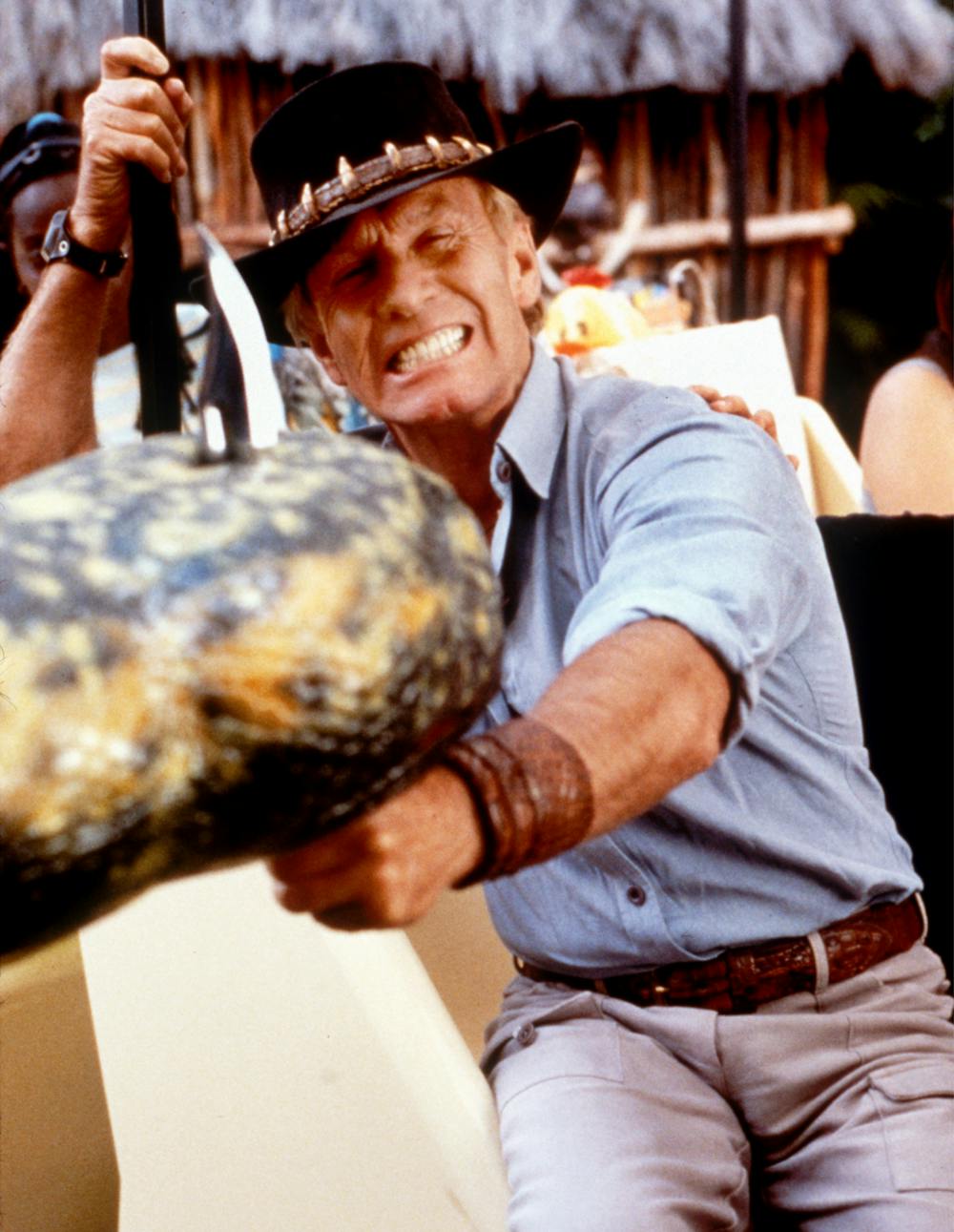
Bob Hawke was a top bloke who might almost have been a real larrikin but with his middle-class upbringing (the son of a clergyman), he had to put some work into being a champion pisspot and rooter. And then Hawke became a reformed larrikin.
You can generally identify a real larrikin, says Blaine, by his favourite football code, although the test only works north of the Barassi Line in the Rugby League-playing states. Real larrikins are are born-and-bred League men. Top blokes who are pretenders go for Rugby Union.
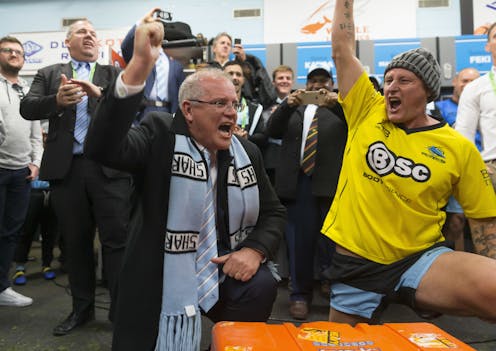
Scott Morrison, whose faux larrikinism is at the heart of Blaine’s essay, is a Rugby man who now pretends to be a League man. He picked up the Cronulla Sharks allegiance[4] rather in the way Liberal National Party Senator from Queensland, Matt Canavan, has acquired a striking resemblance to a coal-miner (belying his university education and career in the public service, consulting and political advising).
Read more: The larrikin as leader: how Bob Hawke came to be one of the best (and luckiest) prime ministers[5]
His colleague, the latter-day “Dad Rudd[6]” Barnaby Joyce, went to Sydney’s posh Saint Ignatius’ College Riverview before qualifying as an accountant. Blaine believes there is a grand political confidence trick at the heart of this cosplay. Conservative political parties who govern consistently to increase inequality and do over ordinary folk are populated by leaders who pretend to be ordinary folk.
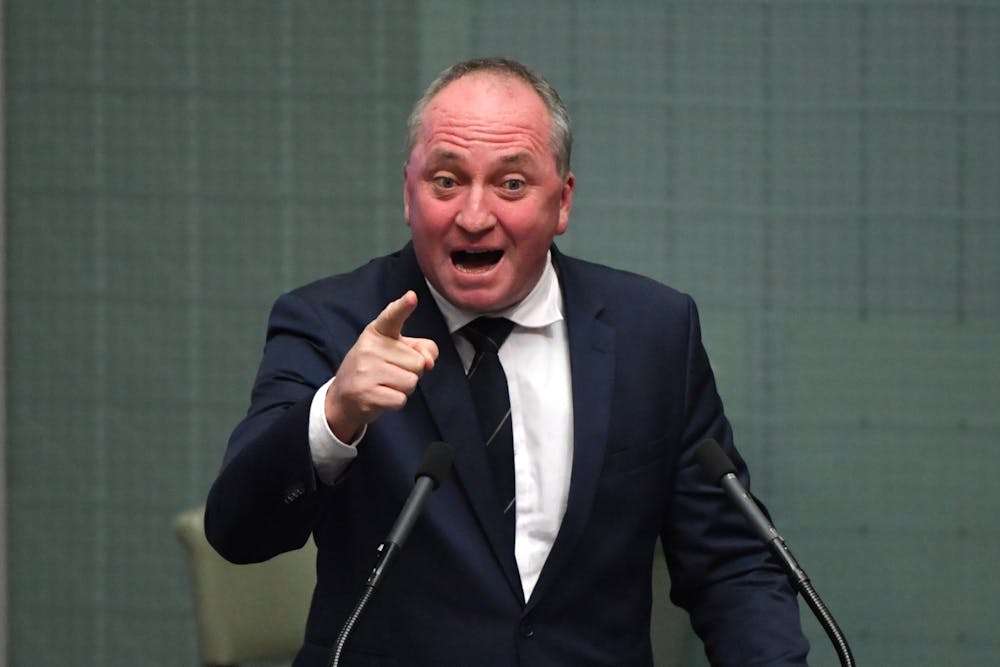 Barnaby Joyce: went to Sydney’s Riverview.
Mick Tsikas/AAP
Barnaby Joyce: went to Sydney’s Riverview.
Mick Tsikas/AAP
Blaine locates the phenomenon in both a long cultural history — the veneration of the noble bushman explored brilliantly by Russel Ward in his 1958 book The Australian Legend[7] — and in a more recent past. In particular, the aggressive and largely successful bid by conservative parties since John Howard’s victory in 1996 to win over blue-collar male workers has been achieved by the expropriation of a national iconography of white male virtue, vigour and victimhood.
At the same time, Labor became more white-collar, less attractive to what remained of the old working class, and more appealing to university graduates — the very kinds of people who had once voted for the Liberal Party. Some of these people skived off to the Greens, and some of the blue-collar conservatives have headed into the camp of One Nation.
But the key point is that the Liberal and National parties are led by men who have found it necessary to “pass” as ordinary blokes and sometimes even as beer-swilling larrikins when they are really — well — Rugby Union types or churchy puritans of the Morrison kind.
Blaine is a fluent, insightful and often amusing essayist who, like several younger cultural commentators in Australia, is willing to talk seriously about class once again — a habit that is stronger in Britain. His approach is often anecdotal. There is some family memoir — much of it moving and evocative — and we are regularly returned to a working-class foster brother John whose attitudes become a kind of litmus test for many of Blaine’s claims.
This is naturally problematic: how representative is John, a Liberal voting “battler” all his life, of a wider body of thought, feeling and electoral behaviour?
Working-class conservatives always have been, and always will be. Menzies would not have won a single election if he hadn’t attracted the votes of blue-collar unionists. Howard, probably for the first time in Australian political history, gained a majority of blue-collar votes in 1996 but he quickly lost many of them again. (Murray Goot and Ian Watson have suggested[8] that only in 2004, the Mark Latham election, was Howard able to bring most of them back).
Read more: An obedient nation of larrikins: why Victorians are not revolting[9]
Blaine also has little to say about where their mothers, wives, girlfriends and daughters fit into this psephology. At Scott Morrison’s “miracle” election, as the Australian Election Study[10] pointed out, 48% of men voted Liberal or National, but just 38% of women.
Of course, such a gender gap — it has been opening up since the 1990s — supports the thrust of Blaine’s argument, although cause and effect here are hard to disentangle. Male politicians are performing a style of masculinity calculated to appeal to a group of voters they hope will be attracted to it; the shift of men to the conservative parties motivates such role-play to keep them there and gather more members of the fraternity of mates. But this also highlights the vulnerability of such a strategy: can “Go the Sharkies” cosplay of the Morrison kind make further incursions on the male vote when it is aleady so high?
Blaine gives Anthony Albanese a show at the next election. With his working-class background and long involvement with the South Sydney Rabbitohs, he has better claims to the larrikin tradition, according to Blaine, even while showing few signs of identifying openly with it. That is another of the ironies at the heart of Blaine’s case.
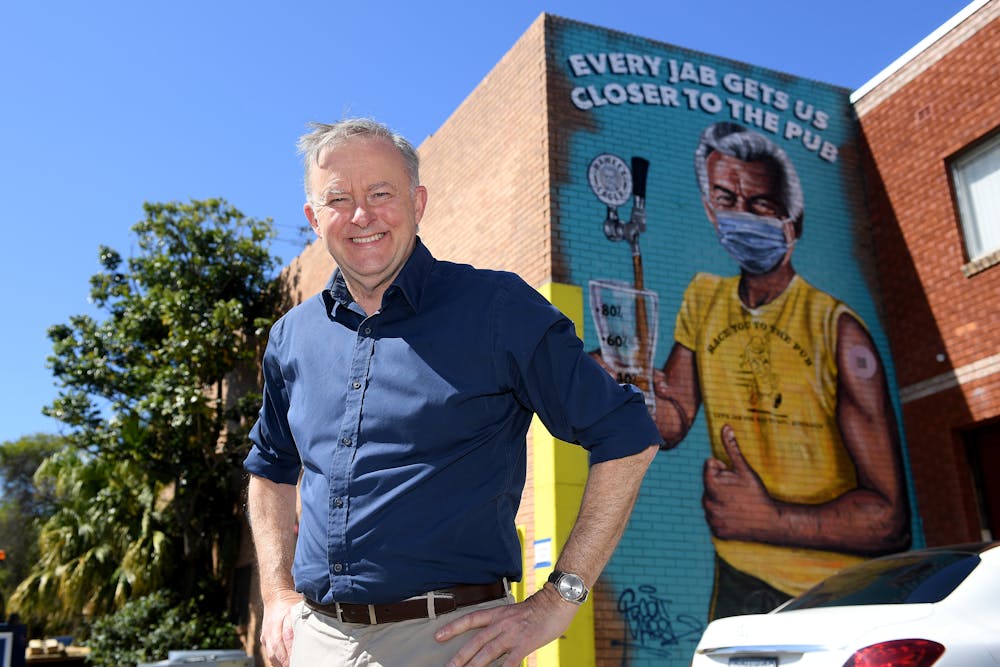 Anthony Albanese: has better claims to the larrikin tradition but is reluctant to claim it.
Dan Himbrechts/AAP
Anthony Albanese: has better claims to the larrikin tradition but is reluctant to claim it.
Dan Himbrechts/AAP
Blaine thinks Labor must do more to appeal to coal-miners. A striking feature of this essay is that in line with much analysis of the 2019 election, coal has come to carry the heavy baggage of standing in for the entire old economy and its working class. It is perhaps an equation too easily made, and one that might be broken more easily than some have imagined.
Top Blokes sometimes skates over historical complexities too easily and occasionally gets things wrong, but it is a serious effort to come to grips with the modern political exploitation of a long-standing Australian male image, that of the larrikin.
Reading it, I recalled an astute early 1960s observation from the late Peter Coleman: academic, author, editor and Liberal politician. Australian “democratic innocence”, said Coleman, kept company with “the snarl of the collectivist bully”, “the open smile” being joined by “the broken bottle”.
Scott Morrison, I’ve often thought, has a nice, friendly and open smile.
References
- ^ preselected a top bloke (www.theguardian.com)
- ^ John Elliott (www.smh.com.au)
- ^ Quarterly Essay 83, Top Blokes: The Larrikin Myth, Class and Power (www.quarterlyessay.com.au)
- ^ picked up the Cronulla Sharks allegiance (junkee.com)
- ^ The larrikin as leader: how Bob Hawke came to be one of the best (and luckiest) prime ministers (theconversation.com)
- ^ Dad Rudd (en.wikipedia.org)
- ^ The Australian Legend (readingaustralia.com.au)
- ^ Murray Goot and Ian Watson have suggested (www.tandfonline.com)
- ^ An obedient nation of larrikins: why Victorians are not revolting (theconversation.com)
- ^ as the Australian Election Study (australianelectionstudy.org)
Read more https://theconversation.com/the-larrikin-lives-on-as-a-conservative-politician-168464










