Children live online more than ever – we need better definitions of ‘good’ and ‘bad’ screen time
- Written by: Kathryn MacCallum, Associate Professor of Digital Education Futures, University of Canterbury
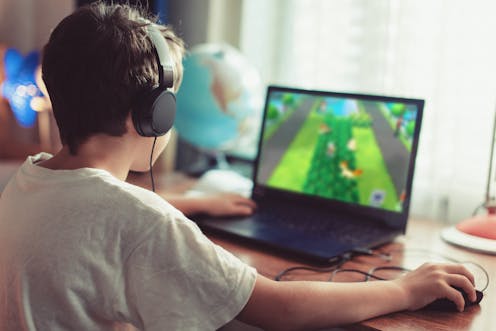
The pandemic has fundamentally altered every part of our lives, not least the time we spend on digital devices. For young people in particular, the blurred line between recreational and educational screen time presents new challenges we are only beginning to appreciate.
Even before COVID, there were concerns about screen time for children. A 2019-20 survey[1] found four in five children were exceeding the current Ministry of Health recommendation of two hours’ recreational screen time a day. This was on top of screen time linked to learning.
With lockdowns and social restrictions now a new normal, it is increasingly difficult to disengage from screens. Children are growing up in a digital society, surrounded by a multitude of devices used for everything from social connection to learning and entertainment.
The boundaries between recreation, communication and learning are becoming less distinct. Screen time that may seem on the surface to be purely recreational can in reality be important for learning, supporting mental health[2] and driving awareness of important issues.
YouTube, for example, can be both entertaining and educational. It is increasingly used in classes to supplement teaching. But it is also used in other ways, including to drive social change, as German star Rezo demonstrated with a viral climate change video that prompted sweeping public reforms[3].
Likewise the popular online game Minecraft has been shown to provide rich educational and social benefits. Even games like Roblox or Fortnite, where those benefits may be less apparent, still provide opportunities[4] for rich social engagement and spaces for problem solving and experiential learning.
Are official guidelines outdated?
This all presents an interesting dilemma: can we really fit screen time into discrete categories, and should we apply limits to some but not others?
This blurring of boundaries has led researchers from the University of Auckland’s Centre for Informed Futures – Koi Tū[5] – to call for clearer and more detailed official screen time recommendations.
Read more: Minecraft can increase problem solving, collaboration and learning - yes, at school[6]
Specifically, they felt the current recommended limits failed to represent the variety of screen time students experience. This was supported by a review of the academic literature[7] covering the impacts of screen time.
While research indicates a broad association between excessive screen time and a range of behavioural, learning and other problems, the results are far from conclusive and can generally be attributed to other factors.
The review also found the type of screen time is important: in many cases, negative effects were driven by passive screen use, whereas interactive use didn’t have the same impacts. In fact, the latter can have positive influences, such as better learning achievement and enhanced cognitive skills.
Getting the balance right
This suggests we need to reorient our views of screen time away from a blunt measure of time spent on screens and towards better understanding what children are really doing on those screens.
While balancing passive and interactive screen time is clearly important[8], so is finding ways to encourage and prioritise more socially and educationally productive online behaviour.
Read more: Stop worrying about screen 'time'. It's your child’s screen experience that matters[9]
This should also guide the adoption of technology in schools. Rather than wholesale integration within every aspect of learning, devices should clearly add value or improve teaching and learning, not simply replace traditional practices.
The role of screen devices in classrooms is particularly relevant in light of New Zealand’s 2018 PISA results, which indicated children using devices in subjects like mathematics and science achieved lower scores than those who didn’t.
In August this year, the Ministry of Education responded[10] by saying:
Digital devices have the potential to enhance learning, but there are few situations where this happens currently and many in which learning may be hindered.
Active versus passive time
It’s true there is considerable scepticism about the validity of the PISA tests, and wider research[11] into the influence of screens in classrooms has shown mixed results.
Generally, however, we cannot claim a causal, linear relationship between use of devices and academic outcomes. Rather than assuming the PISA results indicate screen time is detrimental to learning, we need to consider how screens are actually being used in classes.
We need to focus on integrating technology that makes a difference and enhances learning. Students learn best when they are actively engaged[12] and create and drive their own learning.
Read more: Problems with PISA: Why Canadians should be skeptical of the global test[13]
The same principles can apply to the use of digital devices – limiting passive consumption in favour of students being actively creative. This will open up new learning opportunities[14] and provide students with authentic experiences.
For example, rather than students simply watching a YouTube clip to learn about the solar system, they might create their own augmented reality simulation, requiring them to apply their knowledge to correctly place, size and animate digital objects.
Rebalancing screen time in this way will help avoid the more negative consequences of these ubiquitous devices and highlight some of their unique advantages.
But this will require deeper and more critical thinking about what might be gained or lost in a world where engaging with digital technology is increasingly unavoidable.
References
- ^ 2019-20 survey (www.health.govt.nz)
- ^ mental health (www.commonsensemedia.org)
- ^ sweeping public reforms (www.cogitatiopress.com)
- ^ provide opportunities (www.sciencedirect.com)
- ^ Koi Tū (informedfutures.org)
- ^ Minecraft can increase problem solving, collaboration and learning - yes, at school (theconversation.com)
- ^ review of the academic literature (informedfutures.org)
- ^ clearly important (clalliance.org)
- ^ Stop worrying about screen 'time'. It's your child’s screen experience that matters (theconversation.com)
- ^ responded (www.educationcounts.govt.nz)
- ^ wider research (educationendowmentfoundation.org.uk)
- ^ actively engaged (clalliance.org)
- ^ Problems with PISA: Why Canadians should be skeptical of the global test (theconversation.com)
- ^ learning opportunities (gazette.education.govt.nz)