Google AI
The Times Australia
The Times World News

.

Morrison's climate plan has 35% 2030 emissions reduction 'projection' but modelling underpinning 2050 target yet to be released

  • Written by Michelle Grattan, Professorial Fellow, University of Canberra
Morrison's climate plan has 35% 2030 emissions reduction 'projection' but modelling underpinning 2050 target yet to be released

The government claims Australians would be nearly $2000 better off on average under its plan to reach net zero by 2050 compared with taking no action.

According to the modelling – which the government has yet to release – gross national income would be 1.6% higher, and 62,000 new regional mining and heavy industry jobs would be created under the plan.

Scott Morrison and energy minister Angus Taylor released the plan and a “projection” of up to 35% for emissions reduction by 2030. The prime minister will take the plan to the Glasgow climate conference next week.

Morrison reiterated Australia would not make this a “target”, but would stick with its present 2030 target of reducing emissions by 26-28% on 2005 levels by 2030.

The expected overshoot is being driven by three factors: the rapid uptake of renewables, especially solar; business and household energy efficiency using new and emerging technology, and changes in land use.

Morrison said the target had been an election commitment, while also saying Australia “may even achieve better” than the 35% reduction. He ruled out promising a bigger medium term figure before the election.

But, unexpectedly, the government has not accompany the plan’s release with a list of what the Nationals won in their agreement to sign up to the 2050 target. The only measure announced was that the Productivity Commission would review progress every five years, starting in 2023, looking at the socioeconomic impacts.

The government says existing priority technologies enabled by the plan would get Australia 85% of the way to net zero by 2050. The gap would be closed by emerging technologies.

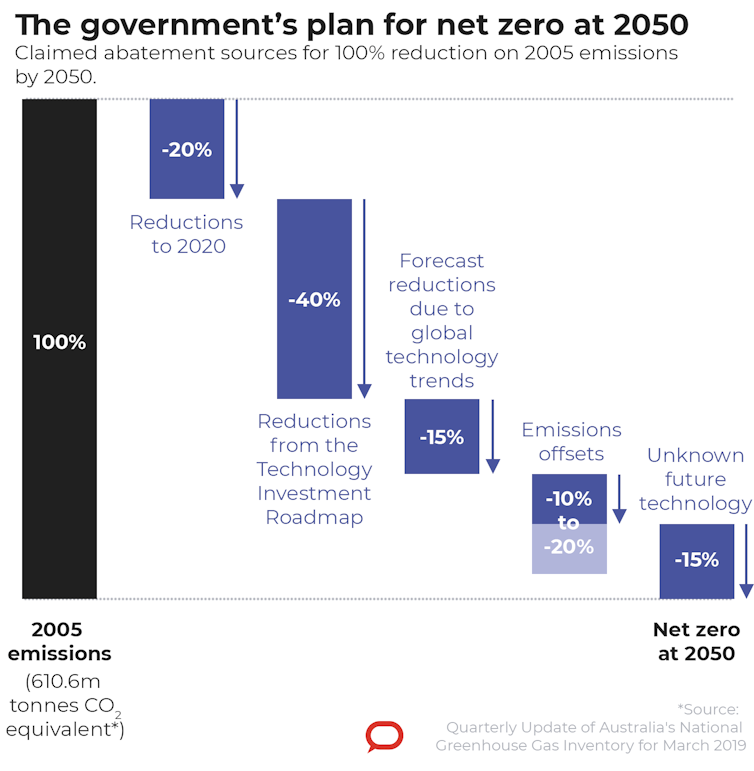
The breakdown of the sources of abatement in the plan is: reductions already made up to 2020, 20%; the technology investment roadmap, 40%; global technology trends, 15%; international and domestic offsets, 10-20%; and further technology breakthroughs, 15%.

The government’s plan for net zero at 2050.

Asked about the total cost of the plan, Morrison avoided the question. He said the government would release the modelling underpinning the policy “soon”.

He stressed the economic side of the plan, acknowledging but placing less emphasis on the environmental need to get to net zero by 2050.

The plan was “uniquely Australian”, Morrison said. “It is an energy, trade, an economic plan, not just an environmental plan. It’s about delivering results through technology, not taxes.”

It worked by “enabling” rather than legislating or mandating.

The plan would “not shut down our coal or gas production or exports.

"It will not impact households, businesses or the broader economy with new costs or taxes imposed by the initiatives that we are undertaking.

"It will not cost jobs, not in farming, mining or gas, because what we are doing in this plan is positive things, enabling things. It will not increase energy bills.

"it is not a revolution but a careful evolution.”

Australia's long-term emissions reduction plan[1] Morrison said the plan was removing any blockage to investment in technologies, saying, “We are going to do this. If you want to do this thing with us then we’re the place you want to do it.” He said Australians “understand and they support the need to take action on climate change. So do I. So does our government.” Morrison indicated he will spruik Australia’s record at Glasgow. “There will be lots of words in Glasgow but I’ll be able to point to the actions of Australia and the achievements of Australia.” He argued other countries could learn from Australia. “The Australian way shows a way for other countries to follow. The challenges that we face here in Australia, particularly with the nature of our economy are not that dissimilar to those being faced in Indonesia or in Vietnam or in India or places like that or indeed China. Opposition leader Anthony Albanese said Morrison had announced "a vibe rather than a target”. Labor’s climate spokesman Chris Bowen said “I’ve seen more detail on fortune cookies than on the documents released by the government”.

References

  1. ^ Australia's long-term emissions reduction plan (www.industry.gov.au)

Read more https://theconversation.com/morrisons-climate-plan-has-35-2030-emissions-reduction-projection-but-modelling-underpinning-2050-target-yet-to-be-released-170635

Times Magazine

CRO Tech Stack: A Technical Guide to Conversion Rate Optimization Tools

The fascinating thing is that the value of this website lies in the fact that creating a high-cali...

How Decentralised Applications Are Reshaping Enterprise Software in Australia

Australian businesses are experiencing a quiet revolution in how they manage data, execute agreeme...

Bambu Lab P2S 3D Printer Review: High-End Performance Meets Everyday Usability

After a full month of hands-on testing, the Bambu Lab P2S 3D printer has proven itself to be one...

Nearly Half of Disadvantaged Australian Schools Run Libraries on Less Than $1000 a Year

A new national snapshot from Dymocks Children’s Charities reveals outdated books, no librarians ...

Growing EV popularity is leading to queues at fast chargers. Could a kerbside charger network help?

The war on Iran has made crystal clear how shaky our reliance on fossil fuels is. It’s no surpri...

TRUCKIES UNDER THE PUMP AS FUEL PRICES BECOME TWO THIRDS OF OPERATING COSTS FOR SOME BUSINESS OWNERS

As Australia’s fuel crisis continues, truck drivers across the nation are being hit hard despite t...

The Times Features

Mortgage Stress – it is happening. Here is what is driv…

Mortgage stress is no longer a fringe issue confined to a small group of overextended borrowers...

Mortgage Lending in Australia: Brokers vs Banks — Trust…

For most Australians, taking out a mortgage is the single largest financial decision they will e...

Building Costs in Australia: Permits, Taxes, Contributi…

Australia’s housing debate is often framed around supply and demand, interest rates, and populat...

Airfares: What the Iran Disarmament Campaign Means for …

For Australians planning their next interstate getaway or long-awaited overseas holiday, the cos...

Interest-free loans needed for agriculture amid fuel cr…

The Albanese Government should release the details of its plan to provide interest-free loans to b...

Next stage of works to modernise Port of Devonport

TasPorts is progressing the next stage of its QuayLink program at the Port of Devonport, with up...

‘Cuddle therapy’ sounds like what we all need right now…

Cuddle therapy is having a moment[1]. The idea for this emerging therapy is for you to book in...

The Decentralized DJ: How Play House is Rewriting the M…

The traditional music industry model is currently facing its most significant challenge since the ...

What Australians Use YouTube For

In Australia, YouTube is no longer just a video platform—it is infrastructure. It entertains, e...