Are employers and workers at odds over NZ's workplace vaccine mandates? Our research suggests they might be
- Written by: Stephen Croucher, Professor and Head of School of Communication, Journalism, and Marketing, Massey University
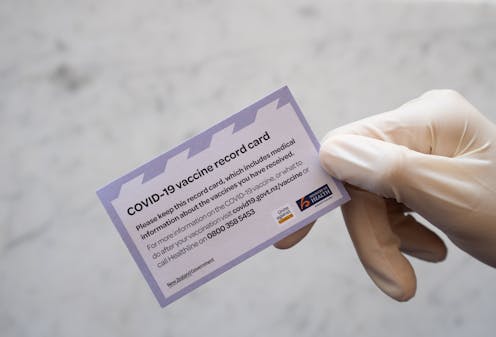
The New Zealand government’s announcement yesterday of expanded mandatory vaccination requirements[1] raises important questions about legality and compliance.
Vaccination will become mandatory for staff at any business where vaccine certificates are required for customers, including hospitality, hairdressers and gyms. But our research suggests this will not be without its challenges.
The new system comes into effect under the government’s recently revealed “traffic light” protection framework[2], central to transitioning the country out of the current COVID elimination strategy. The system requires each regional district health board to achieve at least a 90% vaccination rate.
Vaccination had already been mandated for border and other frontline workers through the Public Health Response (Vaccinations) Order 2021[3]. Mandates for health and disability workers and teachers were then announced[4] on October 11.
Yesterday’s public health order amendment broadens the scope of vaccine mandates and will allow businesses to terminate the employment of someone who refuses to comply.
This is a major shift in policy. Mandated vaccination has existed in New Zealand before, between 1863 and 1920 to combat smallpox, but compliance was very low[5]. Since then, New Zealand has largely relied on education to encourage vaccination, not compulsion.
Employers have generally welcomed[6] the latest news, but how do workers feel about mandatory vaccination and the new rights conferred on employers?
Who supports vaccine mandates?
Our research[7], conducted between June and August 2021, examined support for employer mandated vaccinations. We surveyed 1,852 New Zealanders and found 46.4% of participants agreed or strongly agreed with employers having the right to require employees prove they have been vaccinated.
Breaking this down, we found 46.2% of Pākehā, 51.9% of Māori, 25% of Pasifika, and 58.6% of others agreed or strongly agreed with a workplace’s right to require vaccination proof.
Looking at it politically, we found 32.8% of National, 52.2% of Labour, 40.9% of Green, 51.3% of Māori and 32.2% of other voters agreed or strongly agreed with this requirement.
Read more: Parents were fine with sweeping school vaccination mandates five decades ago – but COVID-19 may be a different story[8]
We also asked participants the extent to which they supported an employer having the right to terminate the employment of someone who refuses to get vaccinated.
We found 56.7% of participants disagreed or strongly disagreed with this employer right. Ethnically, 54% of Pākehā, 56.5% of Māori, 75% of Pasifika and 44.8% of others disagreed or strongly disagreed.
And by party preference, 69.6% of National, 53% of Labour, 60.9% of Green, 55.9% of Māori and 64.4% of other voters disagreed or strongly disagreed.
How will a new law work?
These results suggest there is limited support for businesses either knowing the vaccine status of their employees or having the power to terminate their employment if they are unvaccinated.
On the other hand, businesses appear willing to mandate vaccination out of a duty of care but are cautious due to legal uncertainty. The Business Leaders’ Health and Safety Forum found[9] “a solid desire […] to take a risk-based duty of care”, but a desire for greater clarity from the government about how to do that.
For its part, the government has signalled[10] a
new law to introduce a clearer and simplified risk assessment process for employers to follow when deciding whether they can require vaccination for different types of work.
Read more: To be truly ethical, vaccine mandates must be about more than just lifting jab rates[11]
That law will need to align with existing legislation in this area. The Bill of Rights Act guarantees the right of citizens to refuse medical treatment and thus vaccinations. However, the Health and Safety at Work Act places obligations on managers and organisations to evaluate risk and protect workers and customers from harm.
While businesses can require workers to be vaccinated when they are in certain frontline jobs (with higher risks) or supporting those in frontline roles, how this is enforced remains confusing.
The Health and Safety at Work Act states employers must provide a workplace with no unreasonable levels of risk and must actively pursue this. And yet the health and safety watchdog Worksafe advises that any risk evaluation must take into account the prevalence of COVID-19 in the region.
A mandate for vaccine mandates?
So, while most legislation states businesses cannot generally require all employees to be vaccinated, businesses can require certain roles involving certain kinds of work be done only by the vaccinated – but only if the virus is prevalent in a particular area.
This leaves businesses such as Air New Zealand and Auckland Airport, which want to require vaccination for all frontline employees, in a potential legal quandary.
Read more: Vaccination status – when your medical information is private and when it's not[12]
But New Zealand is not alone in grappling with these issues. Many companies in the US have said they will require[13] all staff interacting with customers to be vaccinated. And many other countries are introducing[14] strict vaccine mandates for various sectors of their workforces.
Such measures are always contentious. Given our own research findings that suggest only limited support for employees having to reveal their vaccination status, or for employer rights to terminate employment for the unvaccinated, they will remain contentious in New Zealand, too.
References
- ^ mandatory vaccination requirements (covid19.govt.nz)
- ^ protection framework (covid19.govt.nz)
- ^ Public Health Response (Vaccinations) Order 2021 (www.legislation.govt.nz)
- ^ announced (www.beehive.govt.nz)
- ^ compliance was very low (teara.govt.nz)
- ^ welcomed (www.rnz.co.nz)
- ^ research (www.researchgate.net)
- ^ Parents were fine with sweeping school vaccination mandates five decades ago – but COVID-19 may be a different story (theconversation.com)
- ^ found (forum.org.nz)
- ^ signalled (www.beehive.govt.nz)
- ^ To be truly ethical, vaccine mandates must be about more than just lifting jab rates (theconversation.com)
- ^ Vaccination status – when your medical information is private and when it's not (theconversation.com)
- ^ require (www.nbcnews.com)
- ^ introducing (www.reuters.com)