How commercialization over the centuries transformed the Day of the Dead
- Written by: Mathew Sandoval, Lecturer in Culture & Performance, Arizona State University
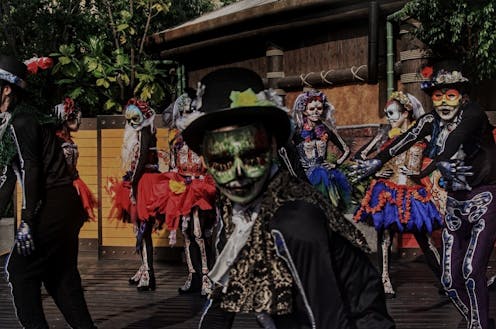
As a Mexican-American who celebrates Día de los Muertos, or the Day of the Dead, at the end of October and beginning of November, I’ve noted an increasing concern the past several years that the holiday is becoming more commercialized.
Indeed, for those who hold the holiday sacred, it’s jarring to see the extent to which it’s now mass-marketed. The evidence is everywhere. The holiday aisles of Target[1] are stuffed with cheap Day of the Dead crafts during October. Halloween stores sell Day of the Dead costumes[2]. Nike makes Day of the Dead shoes[3]. California and Arizona sell Day of the Dead lottery tickets[4]. Disney famously tried to trademark[5] “Día de los Muertos” before its 2017 film “Coco.” The examples go on and on.
The bottom line is that Día de los Muertos and its associated imagery, skulls and skeletons have become trendy and a prime opportunity for companies to make a profit.
But as a researcher[6] of culture and performance, I know only too well that the truth is Day of the Dead has always been commodified.
The roots of commercialization
Day of the Dead is what anthropologist Hugo Nutini[7] calls a syncretic holiday[8], meaning it’s a cultural product of two different religious traditions that hybridized during the European colonization of the Americas.
Day of the Dead brings together the annual feasts for the dead celebrated by pre-Hispanic Indigenous cultures such as the Aztec, Maya, Zapotec and Mixtec peoples. During Mexico’s 300-year-long colonial period, which started in 1521, these Indigenous rituals were merged with the Spanish Catholic holy days for the dead known as All Saints, celebrated on Nov. 1, and All Souls on Nov. 2.
Early Spanish chroniclers in Mesoamerica such as Diego Duran and Bernardino Sahagún documented the Aztec feasts for the dead known as Miccailhuitontli and Huey Miccailhuitl. Duran wrote in the 1570s that he was astounded to see how lavishly[9] the Aztecs spent on supplies for their offerings to the dead.
Sahagún noted the overwhelming bustle and financial activity[10] that took place at the market in the capital city of Tenochtitlán, modern-day Mexico City, during the Aztec ritual feasts.
All manner of foods and goods were sold to citizens to celebrate the Aztec[11] feasts of the dead. In this respect, there wasn’t much distinction between commercial and religious activity. The religious feasts supported the market[12] and vice versa.
The Catholic religion also emphasized commercial activity in relation to All Saints and All Souls Day. According to 16th- and 17th-century Catholic belief, the majority of souls landed in purgatory after death, rather than heaven or hell. It was the responsibility of the living to help alleviate the suffering of souls in purgatory and assist them in getting to heaven. This could be done through prayer or by making offerings[13] to the souls.
In Mexico that meant Spanish colonizers and newly converted Indigenous Catholics were tasked with purchasing[14] directly from the church candles and other religious items that could be used in offerings to those souls in purgatory. Additionally, they could pay their local priest to say special prayers for the souls[15] during Día de los Muertos, a practice that remained in effect through the 20th century.
The colonial era
As Day of the Dead became a more popular and elaborate festival in Mexico, the associated commercial activity grew in size. According to anthropologist Claudio Lomnitz[16], in the 1700s Day of the Dead generated the largest annual market in Mexico City[17].
In fact, the plazas and streets were so overwhelmed during the holiday with vendors, carts, booths and makeshift markets that the local government deemed it a “public disorder[18].” Mexico City’s mayor and city council eventually had to control Day of the Dead’s economic frenzy by enacting laws and issuing vendor permits. In other words, the holiday had become so commodified in Mexico City that it required government regulation[19].
By and large the markets and vendors in Mexico sold items related to the holiday – food, candy, bread, alcohol, candles, toys and religious items. However, according to Lomnitz[20], by the 1800s, the Day of the Dead markets in Mexico City were also selling clothing, shoes, furniture, tools, home decor and many other things.
The swell of commercial activity on Day of the Dead also presented an opportunity for musicians, dancers and other entertainers to perform on the streets for money[21]. In short, Day of the Dead in Mexico City and other urban areas carried both religious and economic significance.
Modern-day commercialization
Day of the Dead’s commercialization was also quite pronounced in rural Mexico. A number of[22] anthropologists[23] in Mexico and the U.S. writing about[24] Day of the Dead in the early and mid-20th century make special note[25] of the sizable holiday markets[26]. They write that villages are transformed into commercial fairs where people gather from communities many miles away to buy and sell foods, goods and services during the festival.
The scholarship of anthropologists Stanley Brandes[27] and Ruth Hellier-Tinoco[28] has been influential for understanding how Mexico began “selling” Day of the Dead[29] to the outside world in the mid-20th century[30]. Mexico’s tourism industry started promoting[31] the holiday to U.S. and European travelers as an “authentic” Mexican experience.
Many guidebooks and travel brochures highlighted Day of the Dead as a cultural event for tourists to attend and buy folk art related to the holiday. Additionally, Mexico’s tourism industry positioned certain regional celebrations as the most “traditional” Day of the Dead festivals for tourists to explore.

Hellier-Tinoco has shown how Mexico’s “selling” of the Day of the Dead on the rustic island of Janitzio in the state of Michoacán transformed the small community ceremony into a spectacle[33] attended by more than 100,000 tourists a year.
Given all this evidence, there doesn’t appear to be an era when Day of the Dead wasn’t intimately tied to financial activities and profiteering. But the holiday’s commercialization has also ensured its survival.
In 2019, I talked to a grandmother building a Day of the Dead ofrenda, an altar with offerings for her family’s dearly departed that included candles, food, flowers, and festive decorations. For years she’d tried to get her grandchildren to help her erect the altar for their ancestors, to no avail. It wasn’t until they watched Disney’s “Coco” and saw sugar skulls at Target that they took interest in the holiday. Now they eagerly help their grandmother build the altar.
Commercialization is and has been transforming Day of the Dead. But, from what I’ve seen, it’s also giving a new generation a chance to be proud of their culture.
[Get the best of The Conversation, every weekend. Sign up for our weekly newsletter[34].]
References
- ^ aisles of Target (www.target.com)
- ^ Day of the Dead costumes (www.spirithalloween.com)
- ^ shoes (www.nicekicks.com)
- ^ lottery tickets (arizonalottely.com)
- ^ Disney famously tried to trademark (www.cnn.com)
- ^ researcher (isearch.asu.edu)
- ^ Hugo Nutini (press.princeton.edu)
- ^ syncretic holiday (press.princeton.edu)
- ^ astounded to see how lavishly (oupress.com)
- ^ noted the overwhelming bustle and financial activity (uofupress.lib.utah.edu)
- ^ celebrate the Aztec (www.wiley.com)
- ^ supported the market (doi.org)
- ^ making offerings (www.jstor.org)
- ^ purchasing (press.princeton.edu)
- ^ say special prayers for the souls (www.worldcat.org)
- ^ Claudio Lomnitz (anthropology.columbia.edu)
- ^ generated the largest annual market in Mexico City (press.princeton.edu)
- ^ public disorder (press.princeton.edu)
- ^ required government regulation (press.princeton.edu)
- ^ according to Lomnitz (press.princeton.edu)
- ^ perform on the streets for money (press.princeton.edu)
- ^ number of (www.nytimes.com)
- ^ anthropologists (www.britannica.com)
- ^ writing about (www.tshaonline.org)
- ^ make special note (www.worldcat.org)
- ^ of the sizable holiday markets (upcolorado.com)
- ^ Stanley Brandes (anthropology.berkeley.edu)
- ^ Ruth Hellier-Tinoco (www.lais.ucsb.edu)
- ^ Day of the Dead (www.wiley.com)
- ^ to the outside world in the mid-20th century (doi.org)
- ^ promoting (oxford.universitypressscholarship.com)
- ^ ©fitopardo/Moment via Getty images (www.gettyimages.com)
- ^ into a spectacle (doi.org)
- ^ Sign up for our weekly newsletter (theconversation.com)