Australia is about to be hit by a carbon tax whether the prime minister likes it or not, except the proceeds will go overseas
- Written by: Peter Martin, Visiting Fellow, Crawford School of Public Policy, Australian National University
Ten years ago, in the lead-up to Australia’s short-lived carbon price[1] or “carbon tax” (either[2] description is valid), the deepest fear on the part of businesses was that they would lose out to untaxed firms overseas.
Instead of buying Australian carbon-taxed products, Australian and export customers would buy untaxed (possibly dirtier) products from somewhere else.
It would give late-movers (countries that hadn’t yet adopted a carbon tax) a “free kick[3]” in industries from coal and steel to aluminium to liquefied natural gas to cement, to wine, to meat and dairy products, even to copy paper.
It’s why the Gillard government handed out free permits to so-called trade-exposed industries, so they wouldn’t face unfair competition.
As a band-aid, it sort of worked. The firms with the most to lose were bought off.
But it was hardly a solution. What if every country had done it? Then, wherever there was a carbon tax (and wherever there wasn’t), trade-exposed industries would be exempt. The tax wouldn’t do enough to bring down emissions.
We are about to face carbon tariffs
The European Union has cottoned on to the imperfect workarounds introduced by countries such as Australia, and is about to tackle things from the other direction.
Instead of treating foreign and local producers the same by letting them both off the hook, it’s going to place both on the hook.
It’s about to make sure producers in higher-emitting countries such as China (and Australia) can’t undercut producers who pay carbon prices.

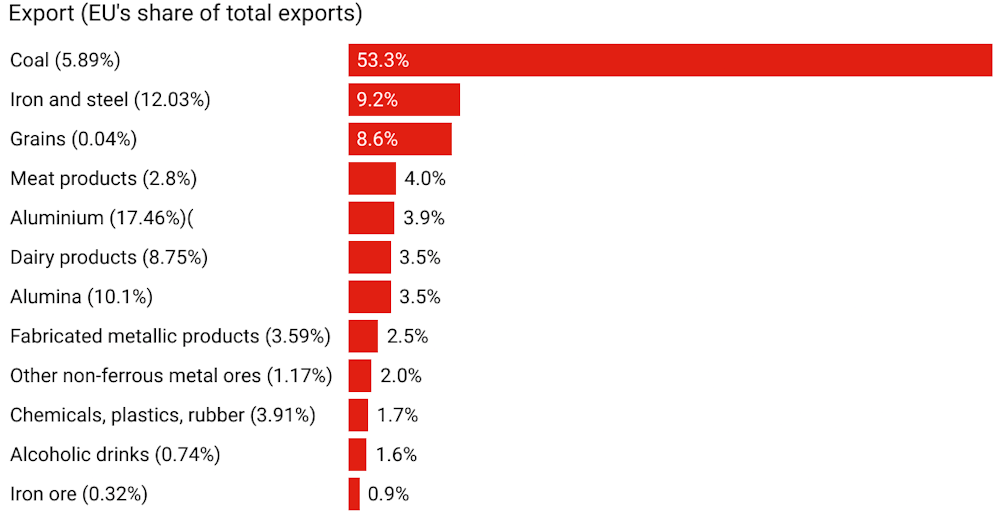 Assumes an EU carbon price of 60 euro per tonne, which is roughly today’s price; assumes the CBAM covers CO2 emissions including fugitive emissions involved in production other than direct combustion emissions that are priced already by the EU Emissions Trading Scheme.
The tariffs could also be avoided if Australia were to introduce a carbon price or something similar, and collected the money itself.
This makes a compelling case for another look at an Australian carbon price. If Australian emissions are on the way down anyway, as Prime Minister Scott Morrison contends, it needn’t be set particularly high. If he is wrong, it would need to be set higher.
Read more:
No point protesting, Australia faces carbon levies unless it changes course[19]
One thing the sad story of Australia’s on-again, off-again, now on-again (through carbon tariffs) history of carbon pricing has shown is that politicians aren’t the best people to set the rates.
In 2011, Prime Minister Julia Gillard set up an independent, Reserve Bank-like Climate Change Authority to advise on the carbon price and emissions targets, initially chaired by a former governor[20] of the Reserve Bank.
Astoundingly, despite attempts to abolish it[21], it still exists. It might yet have work to do.
References^ carbon price (en.wikipedia.org)^ either (www.ausstats.abs.gov.au)^ free kick (www.theaustralian.com.au)^ Australia Institute (australiainstitute.org.au)^ Carbon Border Adjustment Mechanism (economics.rabobank.com)^ dead against (www.smh.com.au)^ 2026 (www.climatecouncil.org.au)^ levelling the playing field (budget.gc.ca)^ undermining our workers and manufacturers (joebiden.com)^ pollution havens (onlinelibrary.wiley.com)^ The EU is considering carbon tariffs on Australian exports. Is that legal? (theconversation.com)^ unstaffed (www.wto.org)^ parcels (sellercentral.amazon.com.au)^ services purchased online (www.ato.gov.au)^ Paul Krugman (messaging-custom-newsletters.nytimes.com)^ protectionist (www.smh.com.au)^ Victoria University (theconversation.com)^ by Europe (australiainstitute.org.au)^ No point protesting, Australia faces carbon levies unless it changes course (theconversation.com)^ governor (www.climatechangeauthority.gov.au)^ abolish it (www.aph.gov.au)
Assumes an EU carbon price of 60 euro per tonne, which is roughly today’s price; assumes the CBAM covers CO2 emissions including fugitive emissions involved in production other than direct combustion emissions that are priced already by the EU Emissions Trading Scheme.
The tariffs could also be avoided if Australia were to introduce a carbon price or something similar, and collected the money itself.
This makes a compelling case for another look at an Australian carbon price. If Australian emissions are on the way down anyway, as Prime Minister Scott Morrison contends, it needn’t be set particularly high. If he is wrong, it would need to be set higher.
Read more:
No point protesting, Australia faces carbon levies unless it changes course[19]
One thing the sad story of Australia’s on-again, off-again, now on-again (through carbon tariffs) history of carbon pricing has shown is that politicians aren’t the best people to set the rates.
In 2011, Prime Minister Julia Gillard set up an independent, Reserve Bank-like Climate Change Authority to advise on the carbon price and emissions targets, initially chaired by a former governor[20] of the Reserve Bank.
Astoundingly, despite attempts to abolish it[21], it still exists. It might yet have work to do.
References^ carbon price (en.wikipedia.org)^ either (www.ausstats.abs.gov.au)^ free kick (www.theaustralian.com.au)^ Australia Institute (australiainstitute.org.au)^ Carbon Border Adjustment Mechanism (economics.rabobank.com)^ dead against (www.smh.com.au)^ 2026 (www.climatecouncil.org.au)^ levelling the playing field (budget.gc.ca)^ undermining our workers and manufacturers (joebiden.com)^ pollution havens (onlinelibrary.wiley.com)^ The EU is considering carbon tariffs on Australian exports. Is that legal? (theconversation.com)^ unstaffed (www.wto.org)^ parcels (sellercentral.amazon.com.au)^ services purchased online (www.ato.gov.au)^ Paul Krugman (messaging-custom-newsletters.nytimes.com)^ protectionist (www.smh.com.au)^ Victoria University (theconversation.com)^ by Europe (australiainstitute.org.au)^ No point protesting, Australia faces carbon levies unless it changes course (theconversation.com)^ governor (www.climatechangeauthority.gov.au)^ abolish it (www.aph.gov.au)