How photos of Afghan suffering shown over and over perpetuate inequality and harm
- Written by: Azeta Hatef, Assistant Professor of Journalism, Emerson College
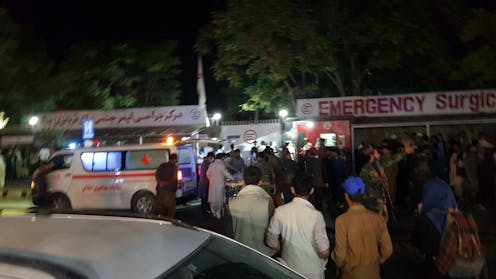
Devastating photos and videos emerged from Afghanistan as the Taliban regained control of the country and U.S. troops prepared to withdraw in August 2021.
A video of 19-year-old Zaki Anwari[1] and others falling to their deaths as they clung to the side of a U.S. evacuation airplane circulated in the news and on social media. Then, a week later, after an attack at the Kabul airport[2] killed at least 169 Afghans and 13 U.S. military personnel, images of Afghans being wheeled off to hospitals, bodies lining the street and blood filling a nearby sewer beamed across media outlets.
Through these photos, Afghan suffering was hypervisible; however, the news stories accompanying the photos largely focused on American soldiers’ suffering and the loss of American lives.
As a media scholar[3], my research focuses on coverage of Afghans and other underrepresented groups. And as a professor of journalism studies[4], whose work focuses on ethics and global journalism, I guide my students through critically examining the role of journalism within societies and how we can more fairly represent the people and communities we write about. The recent coverage of Afghanistan has brought to light how sharing images of suffering – especially without the right context – can perpetuate inequality and harm.
Examining the coverage
The day after the attack at the airport, The Washington Post[5], The Boston Globe[6], the Chicago Tribune[7] and other outlets ran headlines like “13 US troops die in Kabul attacks” and “Kabul blasts kill at least 13 US troops.” Accompanying these headlines were photographs of the aftermath of the attack but not of U.S. soldiers, as the headlines suggest.
Instead, photos of injured and crying Afghan families gathered around lifeless bodies accompanied these headlines. Images of injured Americans were missing; photos of Americans who died were somber images of coffins draped in U.S. flags[8], not of people themselves.
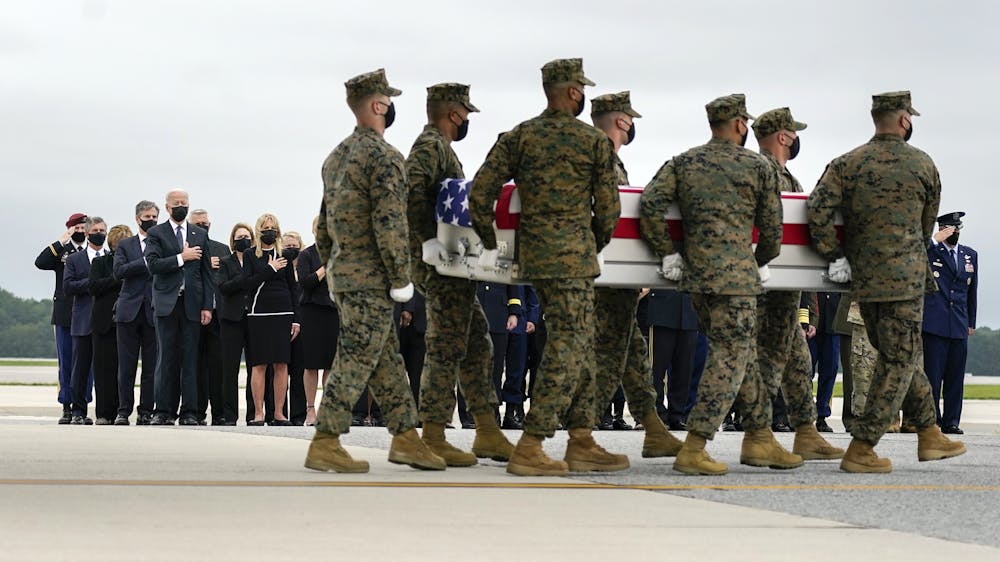
Images of dead or suffering Americans, especially during times of war, are often seen as too unsettling. In fact, an 18-year media ban[10] that prohibited photographs of the returning coffins of American soldiers was just lifted in 2009. The military suggested that the ban protected the privacy[11] of the dead and their loved ones, while opponents argued that such practices attempted to conceal the real impact of the wars[12] in Iraq and Afghanistan.
Hiding the suffering and deaths of some from public view while showing others creates a value system in which certain lives are viewed as more valuable and worthy of respect and recognition[13].
The normalization of Afghan suffering
In my research, I’ve found that during the past 20 years of the war in Afghanistan, Afghans have been used as rhetorical and visual tools[14] to justify ongoing war in the country. Instead of nuanced, complex portrayals of Afghans as individuals, they are often portrayed[15] through tropes as helpless, backward or in need of saving.
This perceived “otherness” is often emphasized during times of war to support and justify military action. Some media amplify these stereotypes of Afghanistan and the region[16] and rely upon dehumanizing portrayals[17]. Media coverage reducing women to victims[18] and depicting Afghan men as hostile enemies, for example, makes Afghan suffering seem inevitable[19].
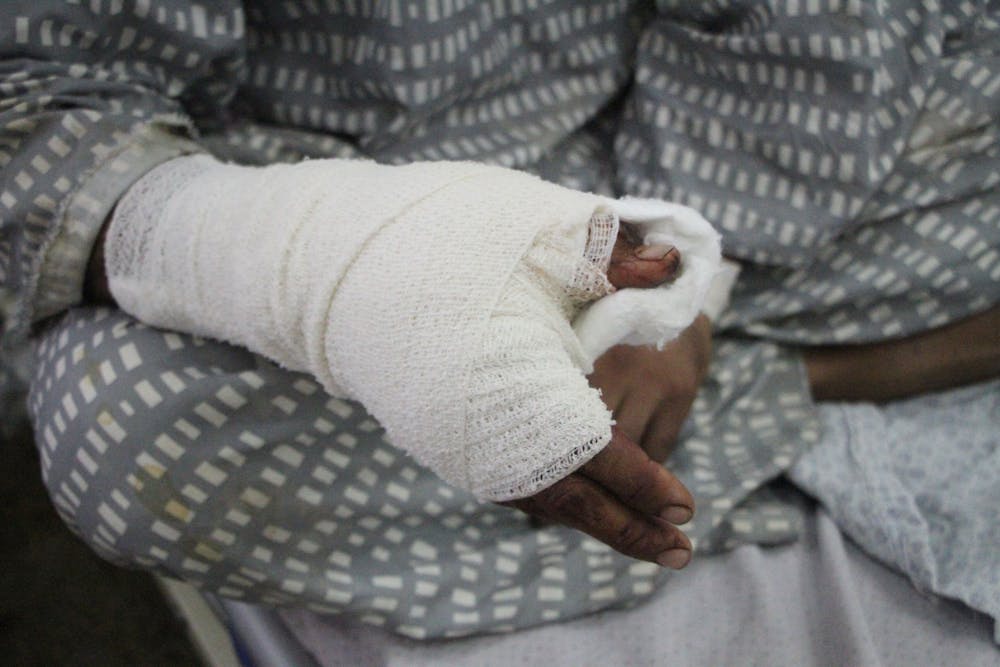 The hands of an injured man at Wazir Akbar Khan Hospital in Kabul.
Saifurahman Safi/Xinhua via Getty Images[20]
The hands of an injured man at Wazir Akbar Khan Hospital in Kabul.
Saifurahman Safi/Xinhua via Getty Images[20]
The ethics of publishing graphic images
Photographs and videos can help capture an emotion that words may not, however unsettling they may be. But it’s important to consider how these images are shared – for example, with the consent of family members, or without warning and played on repeat. Thinking about whose bodies are displayed in states of suffering raises important questions about the boundaries of publishing and engaging with graphic images – as well as who is worthy of dignity and respect in death.
Some images are too difficult to bear witness to, and often these are the ones that are too close to home[21]. Discussing a photograph of a young Salvadoran father and daughter whose lifeless bodies were photographed in the Rio Grande, Washington Post columnist Paul Waldman suggested that we are able to look at these types of images “because they were not American[22], and therefore there’s just enough distance for the agony not to overwhelm us.”
Engaging with graphic content responsibly
People have a finite capacity to process and share in feelings of despair – a phenomenon known as compassion or empathy fatigue[23]. Viewing graphic images may contribute to this feeling, as people may become overwhelmed and shut off from engaging with the issue at hand.
Twenty years of war have supplied the public with many images of Afghan suffering. The withdrawal of American troops from the country offers an opportunity to shift this narrative – not by looking away but by looking with care, seeking context and pushing back on the normalization of Afghan suffering.
References
- ^ 19-year-old Zaki Anwari (www.nytimes.com)
- ^ after an attack at the Kabul airport (www.businessinsider.com)
- ^ media scholar (www.researchgate.net)
- ^ professor of journalism studies (www.emerson.edu)
- ^ The Washington Post (www.washingtonpost.com)
- ^ The Boston Globe (www.bostonglobe.com)
- ^ the Chicago Tribune (www.chicagotribune.com)
- ^ coffins draped in U.S. flags (www.news4jax.com)
- ^ AP Photo/Carolyn Kaster (newsroom.ap.org)
- ^ 18-year media ban (www.nytimes.com)
- ^ protected the privacy (www.cnn.com)
- ^ conceal the real impact of the wars (www.npr.org)
- ^ more valuable and worthy of respect and recognition (doi.org)
- ^ rhetorical and visual tools (doi.org)
- ^ they are often portrayed (doi.org)
- ^ stereotypes of Afghanistan and the region (doi.org)
- ^ rely upon dehumanizing portrayals (doi.org)
- ^ reducing women to victims (doi.org)
- ^ Afghan suffering seem inevitable (doi.org)
- ^ Saifurahman Safi/Xinhua via Getty Images (www.gettyimages.com)
- ^ too close to home (www.nytimes.com)
- ^ because they were not American (www.washingtonpost.com)
- ^ compassion or empathy fatigue (www.taylorfrancis.com)