A new, lower threshold for lead poisoning in children means more kids will get tested – but the ultimate solution is eliminating lead sources
- Written by: Gabriel Filippelli, Chancellor's Professor of Earth Sciences and Director of the Center for Urban Health, IUPUI
The U.S. Centers for Disease Control and Prevention has updated its blood lead reference value[1] – the level at which children ages 1-5 are considered to have high exposure to lead. Since 2012, this threshold had been set at 5 micrograms of lead per deciliter of blood; children at or above this level represented the top 2.5% with the highest blood lead levels in the nation. Now, in response to recent federal health surveys, the CDC has updated that number to 3.5 micrograms per deciliter. Environmental scientist Gabriel Filippelli[2], who has studied urban lead poisoning in children, explains what this shift means for public health.
Will this change affect how doctors detect and treat childhood lead poisoning?
The Centers for Disease Control periodically reviews national data on blood lead levels in children. This new lower value is the average blood lead level exceeded by 2.5% of children tested[3].
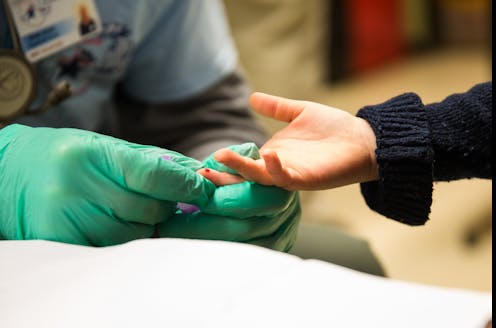
Many clinics have an on-site screening device that uses electrochemical detection to quickly test a small amount of blood from a fingertip prick. If children test positive, doctors refer them to have a larger blood sample drawn from a vein and analyzed in a diagnostic laboratory. The clinical test is fast, cheap and relatively painless, but the venous blood draw is the gold standard for diagnosing lead poisoning.
On-site clinical devices typically can detect lead at concentrations as low as 3.2 micrograms per deciliter, so the new CDC guidance means that nearly all children who show positive results at the screening level will be referred for follow-up testing. That’s much more protective from a public health perspective.
However, it will roughly double[4] the number of children who are classified as at highest risk for lead poisoning. Formerly, children had to have at least 5 micrograms per deciliter of lead in their blood to fall into that group; now it will include thousands more children with slightly lower blood lead levels.
Larger numbers of children means that many states will have trouble affording testing and follow-up care – which can involve dietary changes and medications[5], as well as removing lead exposure sources – unless Congress increases federal support for programs to prevent and treat lead poisoning.
How are children commonly exposed to lead?
The most pervasive source, especially in cities, is soil and dust generated from soil. Thanks to many years of emissions from degraded lead-based paint, leaded gasoline and industrial sources, typical urban soils have lead concentrations that range from benign to toxic[6]. Children are exposed when they touch or play in contaminated dirt or inhale the dust.
The U.S. Environmental Protection Agency’s limit for lead in soils in public play areas is 400 parts per million[7]. That’s significantly higher than typical background levels, which are roughly 20 to 50 parts per million.
Some U.S. states, such as California[8], have much lower limits. In my experience, it’s not unusual to find urban soils with much higher levels, particularly near the exterior walls of buildings where lead may accumulate from degraded paints or dust buildup[9].
The most lead-contaminated neighborhoods in cities are often the poorest and home to the highest percentage of nonwhite children[10]. This is a legacy of racist housing practices[11] that concentrated people of color in less desirable neighborhoods. Residents in these zones can have significantly higher rates of elevated blood lead levels than people in wealthier neighborhoods.

Lead-based paint is also a major exposure risk, particularly in poorly maintained buildings. Lead paint tastes sweet, so children sometimes chew on paint chips or painted wood.
Lead water pipes are a third source, although less common than paint or soil. Many cities and towns across the U.S. have lead service lines[13] that deliver water to homes. If their water is treated properly, a protective plaque forms on the inside of water pipes and seals their lead content away from the water.
But some cities, including Washington, D.C.[14], Newark[15], New Jersey, and Flint, Michigan[16], have changed their water sources or treatment processes in ways that stripped out the protective plaque and carried lead to household taps. These water crises disproportionately affected communities of color.
How does lead exposure at these levels affect children’s health?
Historically, public health interventions focused on acutely poisoned children who exhibited clear neurocognitive issues such as attention deficit, memory lapses, agitation and even tremors. As lead was slowly removed from most home uses in the mid-20th century and the U.S. population’s blood lead levels decreased, these obvious clinical presentations for lead poisoning declined.
What we see now are more subtle neurocognitive deficits, which scientists and medical experts measure through neurological and behavioral testing. A child who is diagnosed as having high blood lead levels today may perform poorly on standardized exams, behave disruptively in the classroom or at home or have trouble retaining information. Follow-up research in Flint shows that many infants and toddlers who were exposed to lead in water there in 2015 are struggling now that they are in school[17].
These types of tests show that blood lead levels even lower than the new standard still affect performance[18]. This research is the basis for statements from scholars and the CDC that there is no safe blood lead level in children[19].
A study that tracked 579 children born in the 1970s in New Zealand for more than 30 years found modest but long-lasting mental health and personality effects from exposure to lead early in life.What’s the trend for childhood lead poisoning in the US?
It has been falling since most major environmental sources of lead, such as leaded gasoline, lead-based paints and industrial emissions, were eliminated starting in the 1970s. Recent analyses show that the median blood lead level for all U.S. children between ages 1 and 5 is about 0.7 micrograms per deciliter today, compared with 15 micrograms per deciliter in the late 1970s[20].
But Black children and children living in poverty have average blood lead levels that are 13% higher than this national average[21], which means that many of them are at risk.
For example, in a 2019 study, I worked with colleagues at Notre Dame to analyze blood lead levels of over 18,000 children in St. Joseph County, Indiana, which includes the town of South Bend. In some neighborhoods, over 30% of children had blood lead levels higher than 5 micrograms per deciliter, and over 65% of the census tracts had average blood lead levels over that safety limit[22].
We also found that there was no systematic, risk-informed approach to testing. In areas that had the highest potential risks based on poverty levels, less than 6% of eligible children had lead test results reported to the county health department – the same rate as in other, wealthier census tracts. Without more screening, and more work to eliminate lead exposure in the communities most at risk, this problem won’t be solved for a long time.
[Understand new developments in science, health and technology, each week. Subscribe to The Conversation’s science newsletter[23].]
References
- ^ updated its blood lead reference value (www.cdc.gov)
- ^ Gabriel Filippelli (scholar.google.com)
- ^ average blood lead level exceeded by 2.5% of children tested (www.cdc.gov)
- ^ roughly double (www.beckershospitalreview.com)
- ^ dietary changes and medications (www.aap.org)
- ^ range from benign to toxic (doi.org)
- ^ 400 parts per million (www.atsdr.cdc.gov)
- ^ such as California (dtsc.ca.gov)
- ^ dust buildup (doi.org)
- ^ highest percentage of nonwhite children (doi.org)
- ^ racist housing practices (www.npr.org)
- ^ Joshua Lott/Getty Images (www.gettyimages.com)
- ^ lead service lines (theconversation.com)
- ^ Washington, D.C. (wtop.com)
- ^ Newark (www.nytimes.com)
- ^ Flint, Michigan (www.npr.org)
- ^ are struggling now that they are in school (www.cbsnews.com)
- ^ still affect performance (doi.org)
- ^ there is no safe blood lead level in children (www.cdc.gov)
- ^ 15 micrograms per deciliter in the late 1970s (www.epa.gov)
- ^ 13% higher than this national average (www.epa.gov)
- ^ over that safety limit (doi.org)
- ^ Subscribe to The Conversation’s science newsletter (theconversation.com)