Taking your first rapid antigen test? 7 tips for an accurate result
- Written by: Thea van de Mortel, Professor, Nursing and Deputy Head (Learning & Teaching), School of Nursing and Midwifery, Griffith University
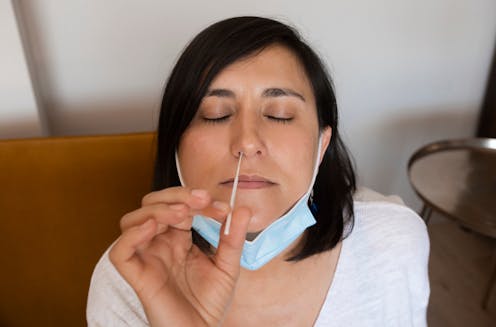
You can now buy rapid antigen tests in supermarkets and pharmacies to test yourself at home for COVID-19 in about 15 minutes.
You’ll get your results much sooner than standard PCR tests, which most of us will be familiar with.
Here’s how to make the most of these rapid antigen tests, and to increase your chance of a meaningful result.
Read more: Rapid antigen tests have long been used overseas to detect COVID. Here's what Australia can learn[1]
Remind me, what’s a rapid antigen test?
A rapid antigen test detects proteins[2] from SARS-CoV-2, the virus that causes COVID-19, in a sample. You can collect the sample yourself at home using a nasal swab or saliva.
The test most of us will be familiar with, the polymerase chain reaction or PCR[3] test, is different. It detects genetic material from the virus. PCR samples are collected by trained health workers, and are processed in the lab by trained technicians.
Rapid antigen tests can be done anywhere by any reasonably competent person. You can get a result in about 15 minutes, depending on the test, versus hours to days for a PCR result.
Here’s how one COVID-19 rapid antigen test works.However, rapid antigen tests are not as reliable as PCR tests. You are more likely to get false negatives (the test indicates you don’t have COVID-19 when you do), or false positives (the test indicates you have it when you don’t).
However, the accuracy[4] of rapid antigen tests improve[5] if you do them when you have symptoms or within seven days of a potential exposure.
Read more: What's the difference between a PCR and antigen COVID-19 test? A molecular biologist explains[6]
Why use one?
Rapid antigen tests are useful if you want to quickly check whether you have COVID-19. For instance, you might have a family gathering coming up, with lots of vulnerable, elderly relatives attending, and want to keep them safe.
You might also use a rapid antigen test if you have COVID-19 symptoms and can’t immediately get a PCR test.
Read more: Home rapid antigen testing is on its way. But we need to make sure everyone has access[7]
Which test to use?
Rapid antigen tests for sale in Australia need to have been approved by the Therapeutic Goods Administration (TGA), and its website lists[8] tests approved for use at home.
Broadly, they fall into two groups. They test:
nasal secretions, from a nasal swab, or
saliva, from spitting into a tube or swabbing inside the mouth.
The TGA describes each approved test as having “acceptable sensitivity”, “high sensitivity” or “very high sensitivity”.
Ones with “very high sensitivity” are more likely to detect an actual SARS-CoV-2 infection and use nasal swabs.
Read more: Goodbye, brain scrapers. COVID-19 tests now use gentler nose swabs[9]
How do you perform the test?
Tests come with instructions (and a QR code linking to a video). You must follow the instructions to the letter to get an accurate result.
Depending on the test type, you will collect a sample of nasal secretions or saliva, which you place into a chemical solution.
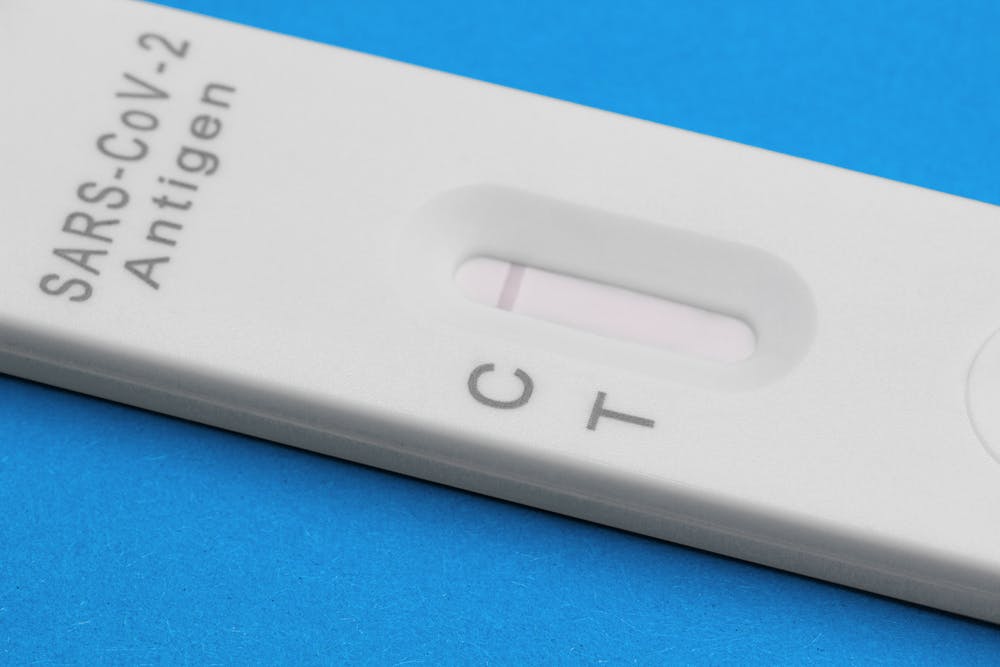
You then place that chemical solution containing your sample onto an indicator device[10] – a bit like a pregnancy test. This shows a positive result via a detectable colour change.
7 tips to get an accurate result
These tips come from analysing instructions on the TGA website[12] about how to use approved rapid antigen tests. Here’s what to consider:
check the expiry date. Don’t use a test that has expired
some tests need to be at room temperature for 30 minutes before use. So plan ahead
if you are using a nasal swab, blow your nose before collecting the sample. If using a saliva test, don’t eat or drink 10 minutes before collecting the sample
avoid contaminating the sample. Regardless of which test you use, instructions can ask you to clean a flat surface; wash or sanitise and dry your hands; and lay out the test items. Never, ever touch the business end of the swab (the soft end that goes in your nose) as you will contaminate it
follow the instructions on sample collection to the letter. For example, with a nasal swab you will be asked to insert the swab 2cm, rotate the swab five times, and do this in both nostrils. Once you have collected the sample it goes into the chemical solution
place a set number of drops of the solution on the indicator device. Don’t add extra “for good luck”
read the results at the exact time recommended. For example, the instructions may ask you to read the result no earlier than 15 minutes after adding the solution and no later than 20 minutes. After 20 minutes the result may no longer be accurate.
What do the coloured lines mean?
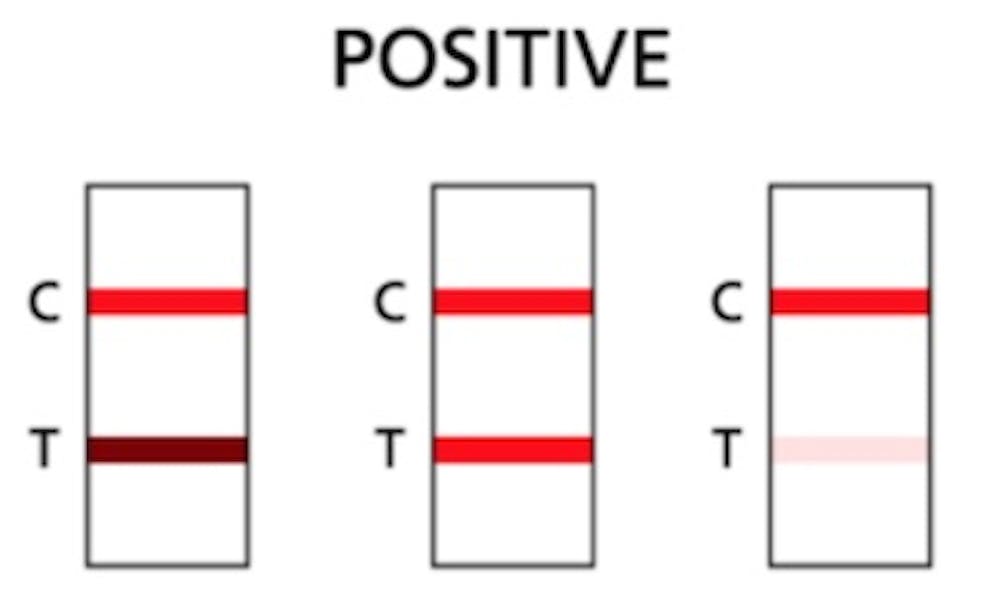 Both the C and T lines need to show up for a positive COVID result.
www.vic.gov.au/screenshot[13]
Both the C and T lines need to show up for a positive COVID result.
www.vic.gov.au/screenshot[13]
There are two coloured lines to look for. One is a C (the control). This tells you if the test is working properly. The other is a T (test) or Ag (antigen). And it’s the combination of these that gives the result:
if the C coloured line fails to show, the test is invalid. The test kit may have expired, or you didn’t take the test correctly
if the C coloured line shows and the T (or Ag) line does not, your result is negative (you’re unlikely to have COVID-19)
if both the C and T (or Ag) lines show up, your result is positive (you’re likely to have COVID-19).
What next?
If you get a negative result and don’t have symptoms, congratulations! If you have a negative result but have symptoms, take a PCR test[14] to be sure. Avoid contact with others in the meantime.
If you get a positive result, follow up as soon as possible with a PCR test to confirm[15] and self-isolate in the meantime.
References
- ^ Rapid antigen tests have long been used overseas to detect COVID. Here's what Australia can learn (theconversation.com)
- ^ detects proteins (www.tga.gov.au)
- ^ polymerase chain reaction or PCR (www.tga.gov.au)
- ^ accuracy (journals.asm.org)
- ^ improve (www.tga.gov.au)
- ^ What's the difference between a PCR and antigen COVID-19 test? A molecular biologist explains (theconversation.com)
- ^ Home rapid antigen testing is on its way. But we need to make sure everyone has access (theconversation.com)
- ^ website lists (www.tga.gov.au)
- ^ Goodbye, brain scrapers. COVID-19 tests now use gentler nose swabs (theconversation.com)
- ^ indicator device (www.coronavirus.vic.gov.au)
- ^ Shutterstock (www.shutterstock.com)
- ^ on the TGA website (www.tga.gov.au)
- ^ www.vic.gov.au/screenshot (www.coronavirus.vic.gov.au)
- ^ take a PCR test (www.coronavirus.vic.gov.au)
- ^ PCR test to confirm (www.coronavirus.vic.gov.au)