Who's in? Who's out? The ethics of COVID-19 travel rules
- Written by: Nancy S. Jecker, Professor of Bioethics and Humanities, School of Medicine, University of Washington
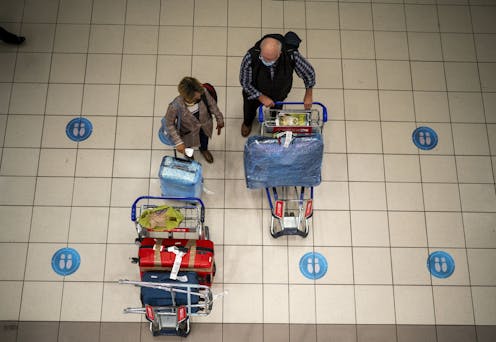
Omicron, the latest COVID-19 variant dubbed a “variant of concern[1]” by the World Health Organization, has prompted new travel restrictions in many nations[2]. Although little is known about omicron, scientists have expressed concern that it may be more transmissible[3] or vaccine-resistant than previous variants.
On Nov. 26, 2021, the United States[4] joined a growing list of nations[5] banning travelers from countries in southern Africa, where the variant was first identified. The U.S. decision followed another recent change[6], which went into effect on Nov. 8, 2021, requiring non-citizens entering the U.S. by plane to be fully vaccinated, with limited exceptions. Everyone entering by plane, including citizens, must provide a negative COVID-19 test.
As bioethicists based in the U.S.[7] and Ghana[8], we explore the intersection of global health and ethics in our research[9]. In the U.S. government’s recent rules for entry, we see far-reaching consequences that should prompt policymakers to consider not just science, but ethics.
Buying time?
There are multiple arguments to support travel rules imposing bans or requiring full vaccination. U.S. policy aims to “prevent further introduction, transmission, and spread of COVID-19 into and throughout the United States,” President Joe Biden said[10] as he introduced the vaccination requirement. He noted that the Centers for Disease Control and Prevention “has determined that the best way to slow the spread of COVID-19, including preventing infection by the delta variant, is for individuals to get vaccinated.”
Ethically, the reason to contain the spread is to protect health and save lives. It could be argued that a country’s first duty is to keep its own people safe[11]. However, many countries manage to protect their people while building in flexibility, such as by testing and quarantining visitors in lieu of travel bans or strict vaccination requirements. France, for example, tailors requirements to infection rates. It considers the U.S. an “orange” country[12], meaning unvaccinated Americans must show negative COVID-19 tests and self-isolate for seven days.
One argument in favor of travel bans holds that they could slow the spread of the virus and buy time while scientists learn more. Anthony Fauci, the U.S. government’s top infectious disease advisor, reportedly told the president[13] it would take two weeks to have definitive answers about omicron. A travel ban gives scientists more time[14] to assess how well existing vaccines fare against new variants, and to begin reformulating vaccines[15] if needed.
An ethical argument for vaccine requirements is that people should be held accountable for their choices, including refusing vaccination. Yet throughout much of the world, particularly poorer regions, people cannot access vaccines. On average, only 6% of people in low-income countries have received a dose[16] of a COVID-19 vaccine, compared to 74% in rich countries.
Science in flux
Critics of travel bans and vaccine requirements point out that such controls are hardly foolproof. There is scant evidence[17] that travel restrictions reduce disease spread, particularly if they are not timed right and paired with other prevention strategies[18]. Meanwhile, many studies have highlighted the negative consequences[19] of international travel restrictions, such as xenophobia and mental health concerns.
Vaccines are currently highly effective at preventing hospitalization and death[20] from COVID-19. But vaccinated people can still be infected[21] and transmit the virus[22], although they are less likely[23] than unvaccinated people to be contagious, and less likely to get COVID-19 in the first place. Vaccines could also become less effective if undercut by new virus variants[24], though it is not yet clear[25] if omicron reduces vaccine efficacy. Finally, there is uncertainty about how long[26] vaccine protection lasts.
Banning travelers in response to omicron is intended to keep people safe. But bans could backfire if they are seen as punitive, and could make countries less likely to share information about new variants[27]. After South Africa reported the omicron variant, its health minister said travel bans had made the country a scapegoat[28] for a “worldwide problem,” while the foreign ministry claimed, “Excellent science should be applauded and not punished[29].” Targeting African countries with travel bans “attacks global solidarity[30],” the World Health Organization’s Africa director said in a statement.
Health and justice
Travel bans and vaccine rules also raise equity concerns, given the dramatic disparity in vaccination rates across the globe. Travel restrictions disproportionately impact people from low-income nations where few vaccines are available.
It might appear that requiring vaccination for entry would not leave many people worse off, if people in poorer countries can rarely afford travel. Yet many people traveling to wealthier countries do so for jobs. Pre-pandemic, in 2019, the U.S. issued more than 900,000 work-eligible visas[32].
Many opponents of travel restrictions emphasize that new variants are not surprising[33], given how unequally vaccines have been distributed around the globe. When nations in southern Africa protested the new travel ban, they pointed to previous warnings[34] that the delay in rolling out vaccinations there would increase the risk[35] of new variants.
Equity concerns are intensified by wealthy nations’ partial responsibility for poorer nations’ difficulty accessing vaccines. Early in the pandemic, rich countries struck advance market agreements and secured as much as 500%[36] of their predicted vaccine need, exacerbating global vaccine scarcity and bidding up prices.
Wealthy nations pledged 1.8 billion doses of vaccine to low-income nations through COVAX, a global initiative to equitably distribute vaccines. Yet only 14% of them have been delivered[37], according to The People’s Vaccine[38], an alliance calling for equal access to COVID-19 vaccines.
[Research into coronavirus and other news from science Subscribe to The Conversation’s new science newsletter[39].]
Some ethicists have argued that governments should hold off on vaccination requirements[40] for international travelers until there is more universal access to vaccines, or allow alternatives, such as testing or vaccination upon arrival. The U.S. vaccine requirement for visitors does make humanitarian exceptions[41] for travelers from countries where fewer than 10% of people are fully vaccinated. Still, it bars entry to people on a tourist or business visa, and citizens of many low- and middle-income nations where vaccination rates are low, but just above the bar.
Do as I say, not as I do?
The U.S. vaccination requirement also sounds hypocritical, because it does not apply to Americans. Unvaccinated citizens are allowed to reenter the country with a negative test result. Though free COVID-19 vaccines are widely available, just 58% of the U.S. population is fully vaccinated[42].
In addition, U.S. rules exclude unvaccinated foreigners from countries with far lower COVID-19 rates. The U.S. has about 210 confirmed cases per million people[43], but excludes unvaccinated people from countries including India (6 per million), Paraguay (8 per million), Cambodia (2 per million) and Zimbabwe (3 per million), although lack of testing[44] may contribute to low case counts.
In our research, we argue global health can be protected by more equitable methods, like following the WHO’s recommendation[45] to delay booster shots until 10% of people in every nation have received first shots; expanding vaccine manufacturing through waiving vaccine patents[46]; and showing solidarity in the global distribution of vaccines[47] by prioritizing countries with low ability to obtain vaccines.
Ultimately, the best way for wealthy nations to protect their own citizens is to vaccinate people across the globe. “If the variant shows up anywhere in the world, you can pretty much count on it being everywhere in the world,” as infectious disease specialist Michael Osterholm[48] told the New York Times[49]. Vaccinating more people reduces the chance of new variants appearing that are impervious to vaccines[50].
References
- ^ variant of concern (www.who.int)
- ^ new travel restrictions in many nations (www.nytimes.com)
- ^ more transmissible (theconversation.com)
- ^ the United States (www.whitehouse.gov)
- ^ a growing list of nations (www.reuters.com)
- ^ another recent change (www.cdc.gov)
- ^ the U.S. (depts.washington.edu)
- ^ Ghana (www.ug.edu.gh)
- ^ in our research (dx.doi.org)
- ^ President Joe Biden said (www.whitehouse.gov)
- ^ a country’s first duty is to keep its own people safe (doi.org)
- ^ an “orange” country (www.diplomatie.gouv.fr)
- ^ reportedly told the president (www.reuters.com)
- ^ more time (www.ndtv.com)
- ^ begin reformulating vaccines (www.cnbc.com)
- ^ have received a dose (ourworldindata.org)
- ^ scant evidence (doi.org)
- ^ other prevention strategies (doi.org)
- ^ the negative consequences (doi.org)
- ^ preventing hospitalization and death (theconversation.com)
- ^ still be infected (theconversation.com)
- ^ transmit the virus (www.cdc.gov)
- ^ less likely (theconversation.com)
- ^ undercut by new virus variants (www.ncbi.nlm.nih.gov)
- ^ not yet clear (doi.org)
- ^ how long (doi.org)
- ^ less likely to share information about new variants (www.npr.org)
- ^ a scapegoat (www.aljazeera.com)
- ^ Excellent science should be applauded and not punished (www.bbc.com)
- ^ attacks global solidarity (www.afro.who.int)
- ^ AP Photo/Seth Wenig (newsroom.ap.org)
- ^ issued more than 900,000 work-eligible visas (www.cfr.org)
- ^ are not surprising (www.theguardian.com)
- ^ pointed to previous warnings (www.nytimes.com)
- ^ increase the risk (www.theatlantic.com)
- ^ as much as 500% (doi.org)
- ^ only 14% of them have been delivered (app.box.com)
- ^ The People’s Vaccine (peoplesvaccine.org)
- ^ Subscribe to The Conversation’s new science newsletter (theconversation.com)
- ^ hold off on vaccination requirements (doi.org)
- ^ humanitarian exceptions (www.cdc.gov)
- ^ just 58% of the U.S. population is fully vaccinated (ourworldindata.org)
- ^ cases per million people (ourworldindata.org)
- ^ lack of testing (ourworldindata.org)
- ^ following the WHO’s recommendation (dx.doi.org)
- ^ waiving vaccine patents (jme.bmj.com)
- ^ solidarity in the global distribution of vaccines (onlinelibrary.wiley.com)
- ^ Michael Osterholm (www.cidrap.umn.edu)
- ^ the New York Times (www.nytimes.com)
- ^ new variants appearing that are impervious to vaccines (doi.org)
Read more https://theconversation.com/whos-in-whos-out-the-ethics-of-covid-19-travel-rules-172053