Most Australian households are well-positioned for electric vehicles – and an emissions ceiling would help
- Written by: Ingrid Burfurd, Senior Associate, Transport and Cities Program, Grattan Institute, Grattan Institute
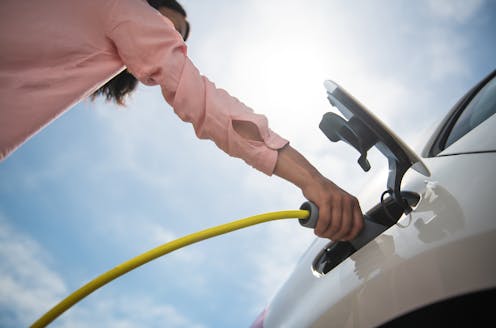
Many people believe Australia’s shift to electric vehicles is stuck in the slow lane – another strollout, rather than a rollout. But while federal policies are still lacklustre, most Australians themselves are ready for the shift, according to our recent research[1].
We found most car-owning households will be able to charge their cars in their garage or driveway. Electric vehicles are also getting more attractive as purchase costs fall and battery range rises.
Australia’s world-beating solar uptake is another plus. Many of our three million solar households[2] would be able to effectively charge their cars for free at daytime.
Surveys have found 56%[3] of Australians would consider going electric with their next car purchase, while the share of consumers who would not purchase an electric car is declining quickly.
Will electric vehicles come suddenly or slowly?
The shift will not be sudden and disruptive but gradual, as people trade in their old petrol clunkers for sleek new electric vehicles. Many will buy an electric car for everyday driving, while holding onto a petrol or diesel SUV for longer trips. No weekends need be sacrificed[4].
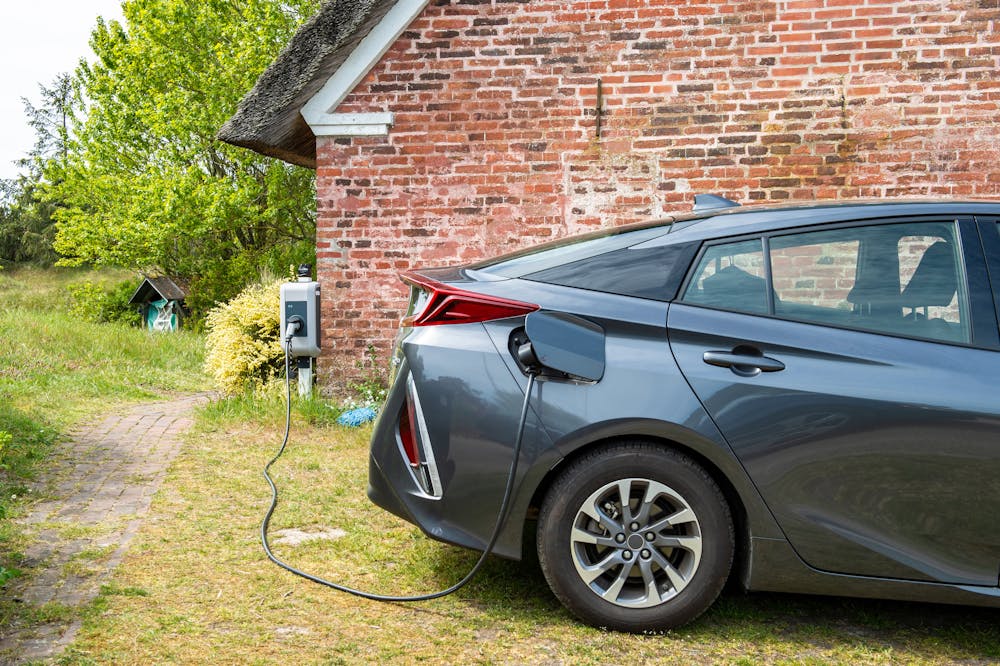
About half of Australia’s car-owning households live in houses with off-street parking and own more than one car. These households will be the first to shift to electric cars.
Almost all owners charge their electric vehicles[5] at home. For most houses with off-street parking, charging a vehicle is as simple as getting an electrician to check your wiring and install an outlet[6] in your garage or near your driveway. In most cases installation isn’t expensive.
Some households will install a small charger on the wall of their garage to speed up the charging process, which will mean they can completely charge their electric vehicle overnight.[7]
But what about range anxiety and sticker shock, two issues many consumers cite?
Read more: The embarrassingly easy, tax-free way for Australia to cut the cost of electric cars[8]
While surveys still show[9] drivers worry about battery range for electric vehicles, the underlying technology is improving year by year. As batteries get better and cheaper, these issues will fade into memory. Technology isn’t standing still.
This year, for instance, electric vehicles came on market[10] in Australia with a battery range of up to 650km, and on average 400km. That’s more than enough for common weekend round trips, such as Melbourne to Phillip Island (280km), Sydney to Kiama (260km), or Brisbane to Sunshine Coast (200km).
While everyone knows running an electric vehicle is cheaper than petrol or diesel – due to much cheaper energy and vastly reduced maintenance costs – the upfront cost has to date been a deterrent. That, too, is changing.
The cost of an electric car is falling. Price parity in many market segments should be reached by the mid 2020s[11]. That means one-car households who currently rely on utes or 4WDs for weekend trips will be able to easily switch in time to contribute to our target of net-zero by 2050 target.
Not only that, but our research has found the number of public electric vehicle chargers has soared to more than 2500 standard chargers. There are now almost 500 fast chargers, which can get your electric vehicle back to 80% charged in under an hour.
 As range anxiety fades, electric vehicle road trips are set to grow. Pictured: Sea Cliff Bridge, north of Wollongong. Shutterstock
How can we shift to electric vehicles faster?
For us to reach net zero by 2050, we need electric vehicles to make up an increasing share[12] of Australia’s cars. The federal government is belatedly embracing the technology[13] as part of the new 2050 target.
While Australia is increasingly ready to shift, at present electric vehicles still make up less than 1% of new car sales. By contrast, Norway will sell its last fossil fuel-powered car next year [14]if current trends hold.
At present, many manufacturers have skipped Australia entirely[15] to focus on more attractive markets, leaving us with a limited range and older models.
So what needs to happen? As our report explains, the best way to bring down prices and increase the variety of electric vehicles is for the federal government to introduce an “emissions ceiling” on new vehicles.
Read more: Government assumes 90% of Australia’s new car sales will be electric by 2050. But it's a destination without a route[16]
This ceiling would limit the average emissions from vehicles and encourage manufacturers to bring Australia’s electric vehicle range up to par with the rest of the world.
Do these policies work? In a word, yes. Countries with emissions ceilings in place have a much wider range of electric vehicles for sale. Last year there were only 31 zero-emissions vehicles for sale in Australia, compared to more than 130 in the United Kingdom.[17]
If we had an emissions ceiling in place, drivers would find it easier to switch to electric vehicles, as more choice brings cheaper cars and a wider range. Of course, no one would be forced to shift. Those who want to wait for an electric ute or SUV will be able to.
While people who own detached homes with off-street parking will find it easier to switch to electric cars, Australians who rent or live in apartments may find it harder or more expensive to get a charger installed at home.
Once homeowners with offstreet parking begin to shift to electric vehicles, charging will get easier for everyone else. Why? Because the increase in electric vehicles will prompt commercial operators to add more and more public chargers in accessible locations. The federal government’s Future Fuels and Vehicles Strategy[18] also has plans to close gaps in the network.
If you want a glimpse of the future, look at South Korea. There, companies are building ultra-fast charging stations[19] as a replacement for petrol stations, offering recharging in under 20 minutes and a cafe to fill the time. In the near future we’ll use clean, fume-free charging stations like these in the same way we use petrol stations today.
As a bonus for switching, the air in our cities will become ever cleaner, and traffic noise will plummet.
Even if our leaders drag their feet on electric cars, we don’t need to. Australians are ready to swap petrol for electric. And we’ll never look back.
References
- ^ recent research (grattan.edu.au)
- ^ three million solar households (www.smh.com.au)
- ^ 56% (electricvehiclecouncil.com.au)
- ^ need be sacrificed (www.afr.com)
- ^ charge their electric vehicles (www.infrastructurevictoria.com.au)
- ^ check your wiring and install an outlet (renew.org.au)
- ^ completely charge their electric vehicle overnight. (www.whichcar.com.au)
- ^ The embarrassingly easy, tax-free way for Australia to cut the cost of electric cars (theconversation.com)
- ^ surveys still show (www.infrastructurevictoria.com.au)
- ^ electric vehicles came on market (electricvehiclecouncil.com.au)
- ^ by the mid 2020s (www.bloomberg.com)
- ^ increasing share (theconversation.com)
- ^ embracing the technology (www.industry.gov.au)
- ^ next year (www.drive.com.au)
- ^ skipped Australia entirely (www.abc.net.au)
- ^ Government assumes 90% of Australia’s new car sales will be electric by 2050. But it's a destination without a route (theconversation.com)
- ^ more than 130 in the United Kingdom. (electricvehiclecouncil.com.au)
- ^ Future Fuels and Vehicles Strategy (www.industry.gov.au)
- ^ ultra-fast charging stations (www.hyundai.com)