America survived a decade of anger in the 18th century – but can it now?
- Written by: Maurizio Valsania, Professor of American History, Università di Torino
Americans have an anger problem[1].
People rage at each other[2]. They are angry at public officials[3] for shutting down parts of society. Or for the opposite reason because they aren’t doing enough to curb the virus[4]. Democrats vent their rage at Republicans. And Republicans treat Democrats not as opponents, but as enemies[5].
Meanwhile, the American founders are being literally taken off of their pedestals[6] in a rejection of the history they represent. And, of course, a violent mob of Donald Trump supporters stormed the U.S. Capitol in early 2021, trying to disrupt that most fundamental of U.S. institutions, the peaceful transfer of presidential power.
But public rage and hysteria in America aren’t new. The 1790s, as well, were a period of political violence.
Over that entire decade, political opponents pelted each other with the accusation that they had lost the true American principles. Just as today, delusion stood in place of reality[7].
Despite that decade of rage, however, America came together as a nation. Today’s rage-filled country may not end the same way.

Strong passions, angry mobs
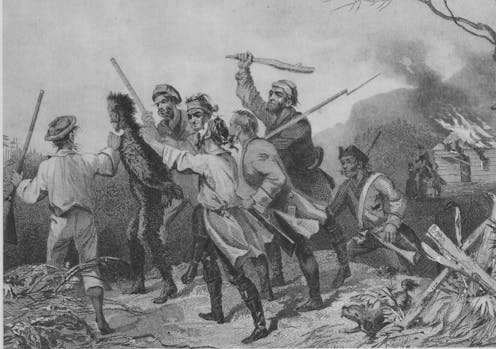
Following a 1791 tax on whiskey[9], western Pennsylvania was set ablaze. Angry mobs torched buildings. Federal tax inspectors were beaten up, stripped naked and tarred and feathered[10]. A few people died.
Political discourse was similarly inflamed. Passions were strong. Articles appeared in newspapers that portrayed President George Washington as a scoundrel, a swindler, the king of all Pied Pipers[11].
“If ever a nation was debauched by a man, the American nation has been debauched by WASHINGTON[12],” read the Philadelphia Aurora General Advertiser from December 1796. “If ever a nation has suffered from the improper influence of a man, the American nation has suffered from the influence of WASHINGTON.”
One could also hear Virginians drinking to the toast “A speedy Death to General Washington[13].”
Thomas Jefferson noticed that times had changed. He had seen warm debates and high political passions before, but never such levels of bigotry: “Men who have been intimate all their lives cross the streets to avoid meeting, and turn their heads another way, lest they should be obliged to touch their hat[14],” he wrote in June 1797.
America as family
As a historian of the early republic[15], I offer that if Americans have always been so angry and ready to snap, it is because they care – at least at some level, at least instinctively. Popular despondency and disillusionment would be much worse.
They may not admit it, but Americans care because the United States is like a family – and in the family, passions are strong.
This is no sentimentalism: Americans have long defined themselves as a family. They’ve done it from the birth of the republic.
A quick reading of the Constitution[16] shows that the nation has never been treated as a contract among strangers, a deal that could be severed at short notice. It was conceptualized as an expansive family, a living organism, the truest embodiment of “We The People.”
In the late 18th century, the framers of the Constitution[17] saw affection as the defining trait of the American experiment; but the main problem, for them, was to build and sustain affection.
Do not listen, framer James Madison averred[18], “to the unnatural voice which tells you that the people of America, knit together as they are by so many cords of affection, can no longer live together as members of the same family; can no longer continue the mutual guardians of their mutual happiness; can no longer be fellow citizens of one great, respectable, and flourishing empire.”
During the years of the Revolution, it was relatively easy. An external enemy, the British, was a sufficient incentive for Americans to love one another.
With independence gained, things got murky. Alexander Hamilton, the most famous among the framers, was uncomfortable[19]: “Upon the same principle that a man is more attached to his family than to his neighborhood, to his neighborhood than to the community at large, the people of each State would be apt to feel a stronger bias towards their local governments than towards the government of the Union.”
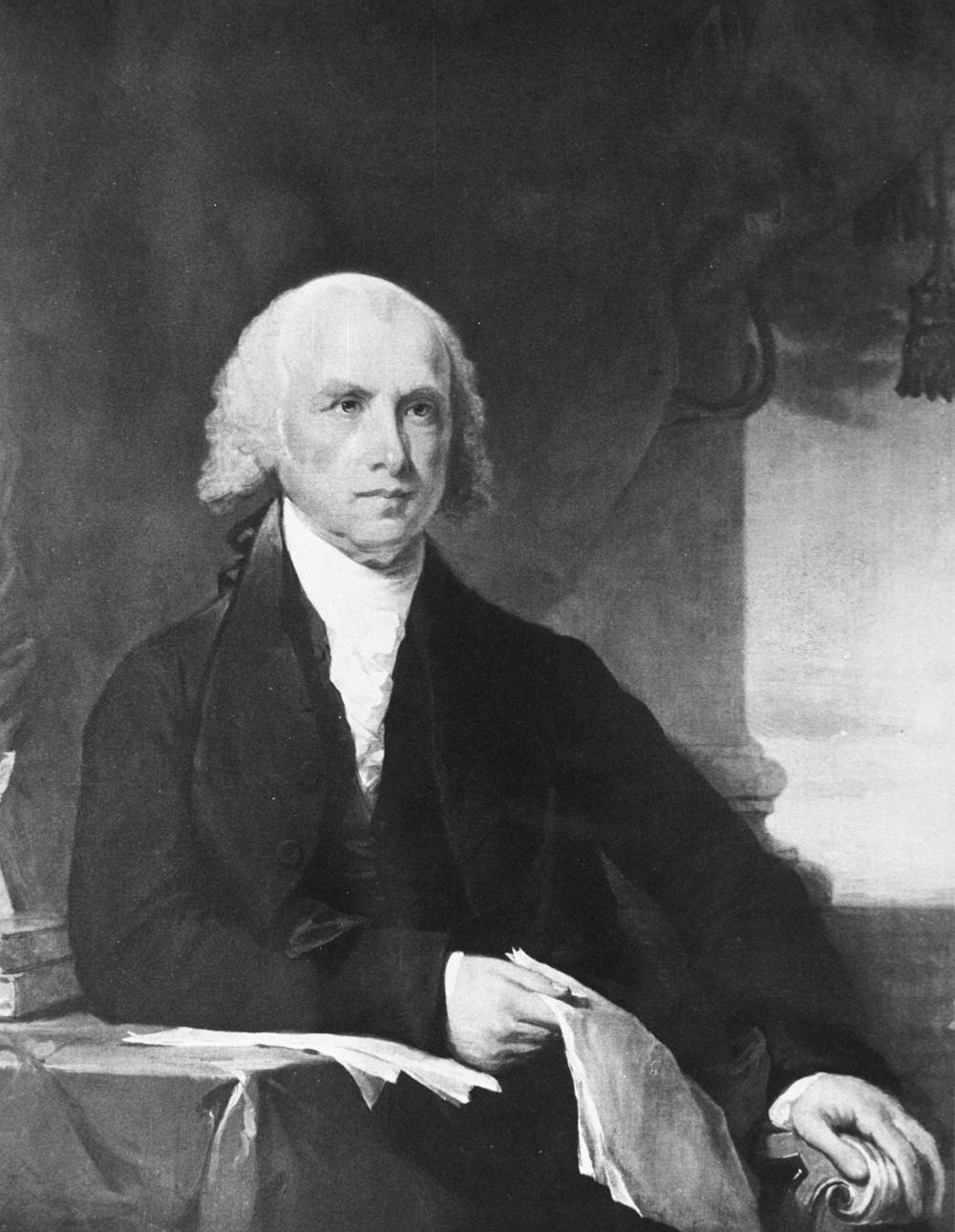 Founding father James Madison described Americans as ‘knit together … by so many cords of affection.’
National Archives/Hulton Archive/Getty Images[20]
Founding father James Madison described Americans as ‘knit together … by so many cords of affection.’
National Archives/Hulton Archive/Getty Images[20]
Sticking together
Devising practical methods to boost attachment and counter rage was the big challenge of the 1790s. As professor of government Emily Pears[21] points out, 18th-century political leaders suggested three main approaches to achieve this[22].
The first was building a better federal administration that could deliver personal and material benefits to its citizens. Providing funding for infrastructure, creating efficient networks for commerce or levying equitable taxes would eventually win people’s attachments.
The second was forming shared cultural practices. Making citizens feel that they have the same political values, and that there is a common history and tradition they are part of, would generate pride and comradeship. Symbols like flags, songs, toasts or parades would help develop these connections.
[The Conversation’s Politics + Society editors pick need-to-know stories. Sign up for Politics Weekly[23].]
The third was trying to increase participation. Through the process of voting, citizens would get closer to one another and to their representatives. Participation would make connections stronger, thus fostering affection.
Can the center hold?
Whether any of these three approaches is still viable today is unclear.
The first, the utilitarian approach, depends on leaders’ ability to tackle issues of social justice and inclusion: Who are the beneficiaries of the federal government? Who are its citizens?
The second, the cultural approach, is obviously marred by the “other side” of national history, slavery. The question is unavoidable: Whose history, whose traditions are Americans talking about?
And the third, the participatory approach, is discouraged by the very parties that put obstacles in place. Is there a way to get rid of gerrymandering and other barriers[24] to full representation?
And yet, finding strategies that would enhance emotional bonds is crucial to any nation. Especially today. Rage is on the rise[25]. Eventually, popular despondency and disillusionment may come.
Family will be broken.
References
- ^ an anger problem (doi.org)
- ^ People rage at each other (youtu.be)
- ^ are angry at public officials (www.bbc.com)
- ^ they aren’t doing enough to curb the virus (www.washingtonpost.com)
- ^ not as opponents, but as enemies (www.washingtonpost.com)
- ^ taken off of their pedestals (www.nytimes.com)
- ^ delusion stood in place of reality (www.jstor.org)
- ^ Roberto Schmidt/AFP via Getty Images (www.gettyimages.com)
- ^ 1791 tax on whiskey (www.history.com)
- ^ tarred and feathered (revolution.h-net.msu.edu)
- ^ portrayed President George Washington as a scoundrel, a swindler, the king of all Pied Pipers (www.washingtonpost.com)
- ^ the American nation has been debauched by WASHINGTON (washingtonpapers.org)
- ^ A speedy Death to General Washington (www.americanheritage.com)
- ^ lest they should be obliged to touch their hat (founders.archives.gov)
- ^ As a historian of the early republic (unito.academia.edu)
- ^ the Constitution (www.senate.gov)
- ^ framers of the Constitution (www.archives.gov)
- ^ Do not listen, framer James Madison averred (avalon.law.yale.edu)
- ^ Alexander Hamilton, the most famous among the framers, was uncomfortable (avalon.law.yale.edu)
- ^ National Archives/Hulton Archive/Getty Images (www.gettyimages.com)
- ^ Emily Pears (www.cmc.edu)
- ^ three main approaches to achieve this (kansaspress.ku.edu)
- ^ Sign up for Politics Weekly (theconversation.com)
- ^ gerrymandering and other barriers (theconversation.com)
- ^ Rage is on the rise (www.washingtonpost.com)