Learn how to make a sonobe unit in origami – and unlock a world of mathematical wonder
- Written by: Julia Collins, Lecturer of Mathematics, Edith Cowan University
This article is part of a series[1] explaining how readers can learn the skills to take part in activities that academics love doing as part of their work.
Many of us could happily fold a paper crane[2], yet few feel confident solving an equation like x³ – 3 x² – x + 3 = 0, to find a value for x.
Both activities, however, share similar skills: precision, the ability to follow an algorithm, an intuition for shape, and a search for pattern and symmetry.
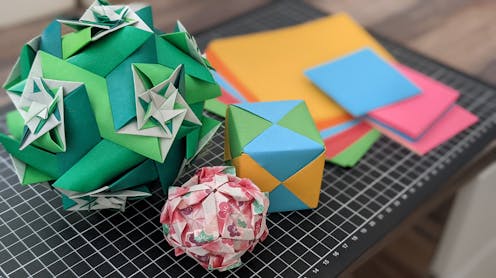
I’m a mathematician whose hobby is origami, and I love introducing people to mathematical ideas through crafts like paper folding. Any piece of origami will contain mathematical ideas and skills, and can take you on a fascinating, creative journey.
Read more: Why bother calculating pi to 62.8 trillion digits? It's both useless and fascinating[3]
The ‘building blocks’ of origami models
As a geometer (mathematician who studies geometry), my favourite technique is modular origami. That’s where you use several pieces of folded paper as “building blocks” to create a larger, often symmetrical structure.
The building blocks, called units, are typically straightforward to fold; the mathematical skill comes in assembling the larger structure and discovering the patterns within them.
Many modular origami patterns, although they may use different units, have a similar method of combining units into a bigger creation.
So, for a little effort you are rewarded with a vast number of models to explore.
My website Maths Craft Australia[4] contains a range of modular origami patterns, as well as patterns for other crafts such as crochet, knitting and stitching.
They require no mathematical background but will take you in some fascinating mathematical directions.
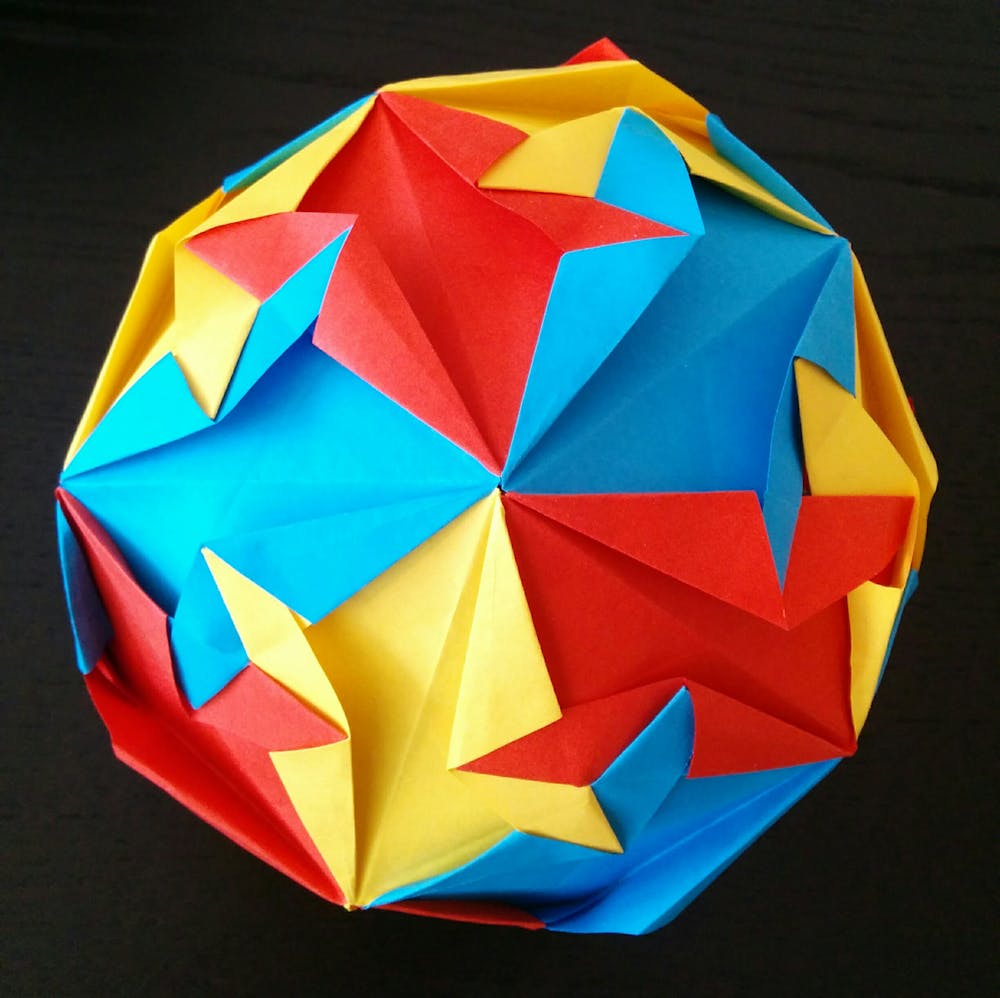
 This model, folded by the author, uses a design from the book Perfectly Mindful Origami - The Art and Craft of Geometric Origami by Mark Bolitho.
Building 3D shapes from smaller 2D units
In mathematics, the shapes with the most symmetry are called the Platonic solids[5]. They’re named after the ancient Greek philosopher Plato (although they almost certainly predate him and have been discovered in ancient civilisations around the world).
The Platonic solids are 3D shapes made from regular 2D shapes (also known as regular polygons) where every side and angle is identical: equilateral triangles, squares, pentagons.
While there are infinitely many regular polygons, there are, surprisingly, only five Platonic solids:
the tetrahedron (four triangles)
the cube (six squares)
the octahedron (eight triangles)
the dodecahedron (12 pentagons) and
the icosahedron (20 triangles).
To build Platonic solids in origami, the best place to start is to master what’s known as the “sonobe unit[6]”.
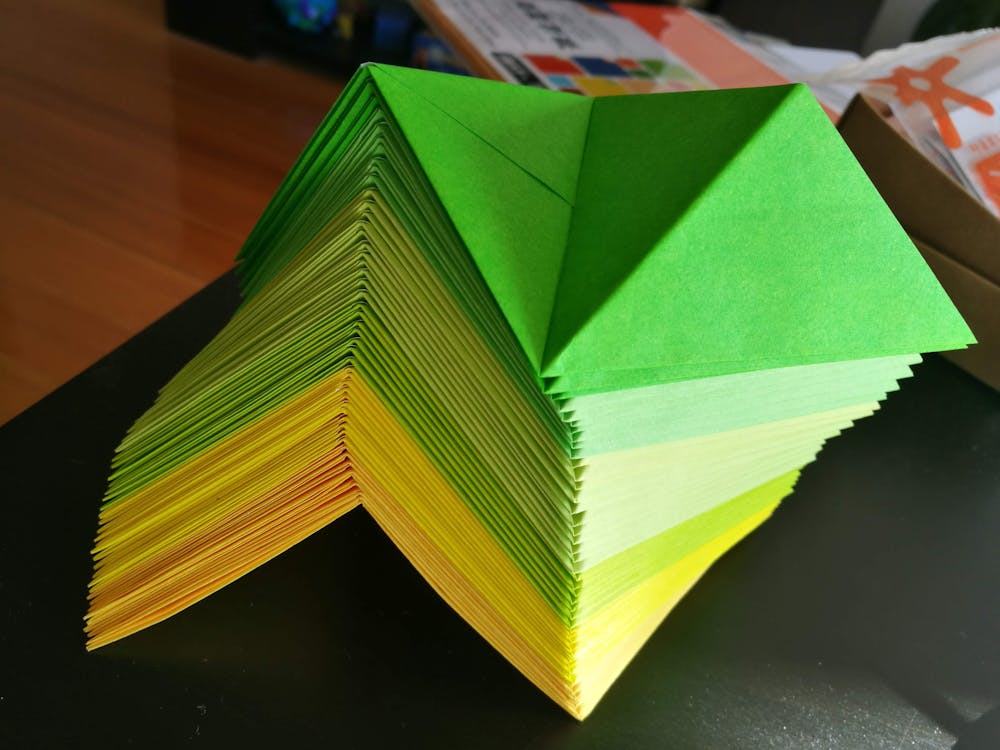 Sonobe units, like these ones piled in a stack, can be put together to create 3D shapes.
Julia Collins, Author provided
Sonobe units, like these ones piled in a stack, can be put together to create 3D shapes.
Julia Collins, Author provided
Enter the sonobe unit
A sonobe unit (sometimes called the sonobe module) looks a bit like a parallelogram with two flaps folded behind.
I’ve got instructions for how to make a sonobe unit on my website[7] and there are plenty of videos online, like this one:
How to make a sonobe unit.Sonobe units are fast and simple to fold, and can be fitted together to create beautiful, intriguing 3D shapes like these:
You will need six sonobe units to make a cube like the yellow-blue-green one pictured above, 12 to make an octahedron (the red-pink-purple one), and 30 to make an icosahedron (the golden one). (Interestingly, it’s not possible to build a tetrahedron and dodecahedron from sonobe units).
I’ve got written instructions for building the cube on my website[8], and some quick searching online will find you instructions for the larger models.
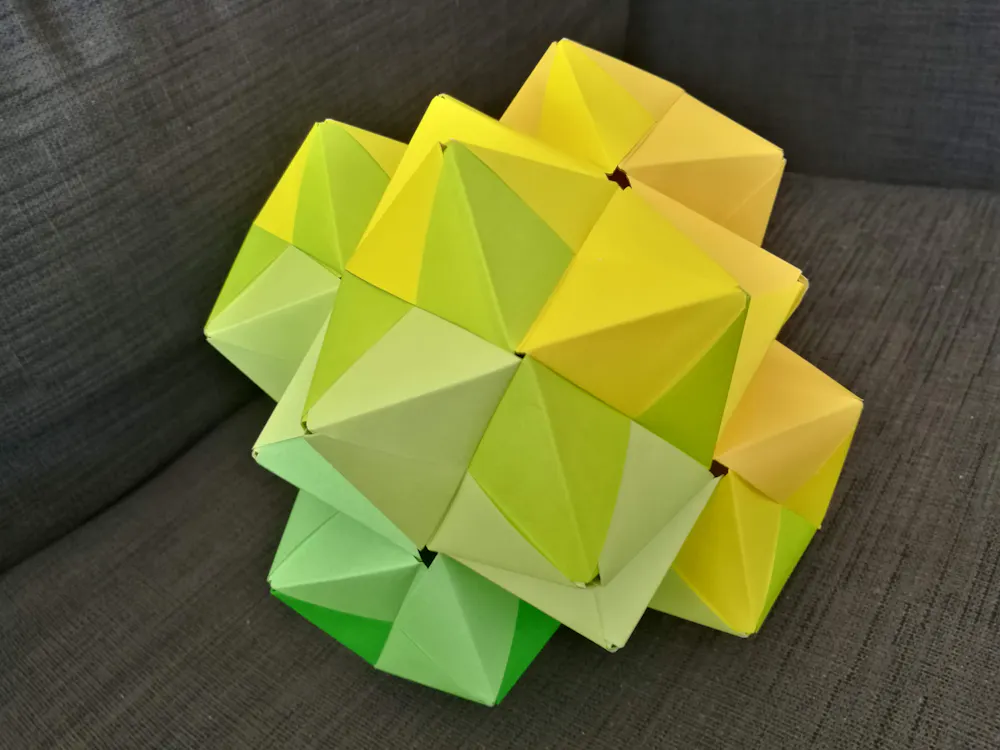 Sonobe units can be put together to build wondrous shapes.
Julia Collins, Author provided
Sonobe units can be put together to build wondrous shapes.
Julia Collins, Author provided
Into the mathematical rabbit hole
Once you’ve mastered the basic structure of each 3D shape, you may find yourself (as others have done[9]) pondering deeper mathematical questions.
Can you arrange the sonobe units so two units of the same colour never touch, if you only have three colours?
Are larger symmetric shapes possible? (Answer: yes!)
Are there relationships between the different 3D shapes? (For example, the icosahedron is basically built of triangles, but can you spot the pentagons lurking within? Or the triangles in the dodecahedron?)
One seemingly innocent question can easily lead to a mathematical rabbit hole.
Questions about colouring will lead you to the mathematics of graphs and networks (and big questions that remained unsolved for many centuries[10]).
Questions about larger models will lead you to the Archimedean solids[11] and the Johnson solids[12]. These 3D shapes have a lot of symmetry, though not as much as the Platonic solids.
Then, for a truly mind-bending journey, you might land on the concept of higher-dimensional symmetric shapes[13].
Or perhaps your questions will lead you in the opposite direction.
Instead of using origami to explore new ideas in mathematics, some researchers have used mathematical frameworks to explore new ideas in origami.
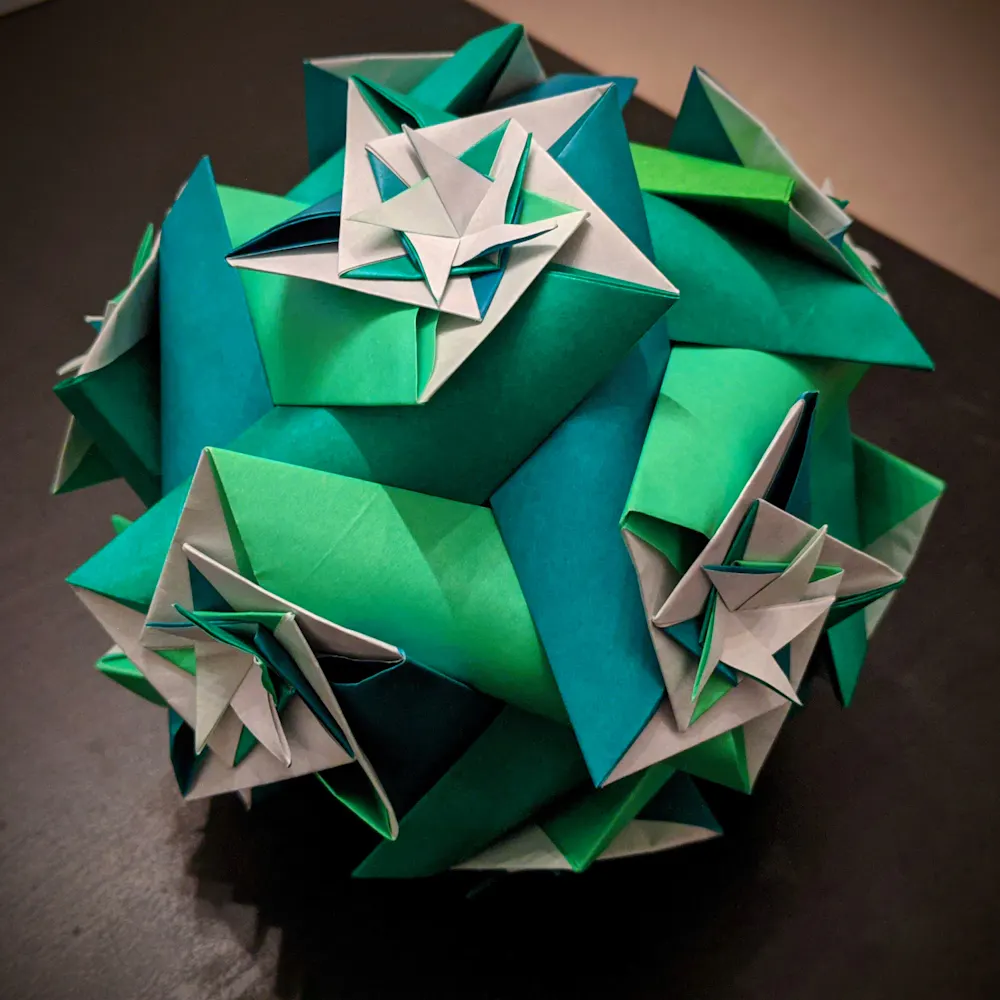 Origami can take you into the mathematical rabbit hole.
Julia Collins, Author provided
Origami can take you into the mathematical rabbit hole.
Julia Collins, Author provided
Solving old problems in new ways
Perhaps the most famous mathematical origami artist is the US-based former NASA physicist Robert Lang[14], who designs computer programs that generate crease patterns for fantastically complicated models.
His models include segmented tarantulas and ants, stags with twisted antlers and soaring, feathered birds.
Credit: Great Big Story/YouTube.Robert Lang and others have also created crease patterns for use in new engineering contexts such as folding telescope lenses[15], air bags[16] and solar panels[17].
Read more: Curved origami offers a creative route to making robots and other mechanical devices[18]
My final example of the power of origami goes back to the cubic equation I mentioned at the outset:
x³ – 3 x² – x + 3 = 0
Cubic equations relate to some “impossible” mathematical problems, such as trisecting an angle[19] (splitting an arbitrary angle into three equal angles). Or doubling a cube[20] (which is finding a cube with double the volume of a given cube).
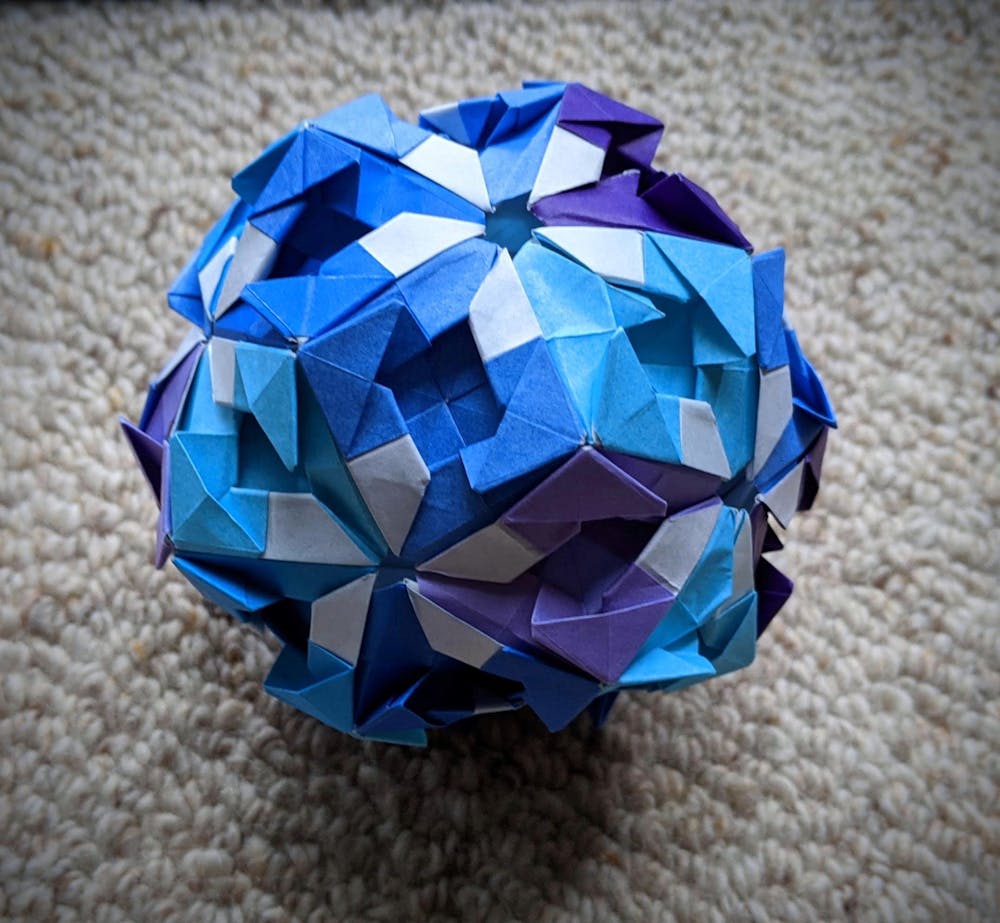 Any piece of origami will contain mathematical ideas and skills.
Julia Collins, Author provided
Any piece of origami will contain mathematical ideas and skills.
Julia Collins, Author provided
Famously, these problems cannot be solved using the classical methods of a straightedge (ruler without the markings) and compass.
In 1980, however, Japanese mathematician Hisashi Abe showed how to solve all these problems using origami[21].
I am excited to see where mathematics and origami will intersect in future. Grab some paper today, make a few models and start your own journey of mathematical exploration.
You can read other articles in this series here[22].
References
- ^ series (theconversation.com)
- ^ paper crane (origami.me)
- ^ Why bother calculating pi to 62.8 trillion digits? It's both useless and fascinating (theconversation.com)
- ^ Maths Craft Australia (www.mathscraftaus.org)
- ^ Platonic solids (en.wikipedia.org)
- ^ sonobe unit (momath.org)
- ^ on my website (static1.squarespace.com)
- ^ on my website (static1.squarespace.com)
- ^ others have done (www.polypompholyx.com)
- ^ unsolved for many centuries (en.wikipedia.org)
- ^ Archimedean solids (en.wikipedia.org)
- ^ Johnson solids (en.wikipedia.org)
- ^ higher-dimensional symmetric shapes (en.wikipedia.org)
- ^ Robert Lang (langorigami.com)
- ^ folding telescope lenses (langorigami.com)
- ^ air bags (royalsocietypublishing.org)
- ^ solar panels (www.nasa.gov)
- ^ Curved origami offers a creative route to making robots and other mechanical devices (theconversation.com)
- ^ trisecting an angle (mathworld.wolfram.com)
- ^ doubling a cube (en.wikipedia.org)
- ^ solve all these problems using origami (plus.maths.org)
- ^ here (theconversation.com)