families of children with cancer say the pandemic has helped them feel seen, while putting them in peril
- Written by: Jenny Davies, PhD researcher, Curtin University
For billions of people across the world, life as we knew it stopped in 2020.
Families and friends were separated. Masks mandated. Hand washing essential. Every trip outside became risky.
As news of deaths, variants and long-term effects of COVID trickled in daily, we were forced to adjust to a new normal marked by constant anxiety and fear, which has only worsened with the recent surge in Omicron cases in Australia.
But for a particular group of Australians, this lifestyle is all too familiar.
As both the mother of a childhood cancer survivor and a Curtin University PhD student exploring families’ experiences of childhood cancer, I embarked on a study to understand the pandemic’s effects on kids going through cancer treatment, and their families.
In mid-2020 I interviewed 34 parents of children with cancer across Australia about their experiences during the pandemic.
The answer I received was a resounding: “welcome to our world”. The pandemic lifestyle we are all adjusting to is the life families of children with cancer have already been living.
The parents in our study, published in December[1] with a team of Curtin University researchers, painted a picture of both benefits and devastating costs.
Even a cold can lead to hospitalisation
Every year, almost 1,000 Australian kids[2] are diagnosed with cancer.
With advances in treatment, survival rates have increased and 84% of children[3] now survive to five years after diagnosis. But this comes at the cost of long, gruelling and complex treatments involving a combination of chemotherapy, surgery and radiotherapy.
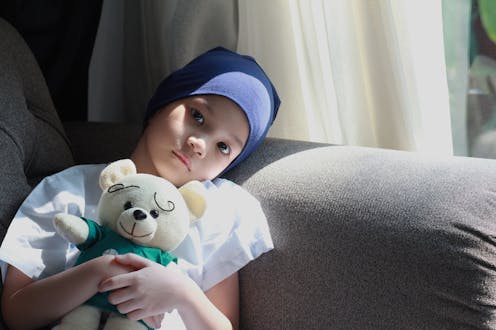
Chemotherapy leaves children profoundly vulnerable to infection. Even a simple cold can leave a child in hospital struggling for their life.
For the families in this study, wearing masks, washing hands, isolating and missing social events was already a way of life during treatment. Some even placed hand sanitiser outside their front door.
COVID silver linings
For this reason, many of the parents welcomed the increased infection control which came with COVID.
“When COVID happened, [people] started taking care […] social distancing, wiping everything, covering their mouths,” said one father. Another added: “it’s actually positively impacted us […] she wasn’t getting colds and flus she’d normally get”.
Previous research has found parents of children with cancer often struggle trying to care for siblings and keep up an income[4] while being in hospital with the child with cancer. The shift to online work and school helped reduce some of this burden.
“One of the good things is that COVID allows me to work remotely […] it’s a big weight off my shoulders […] allows for income to keep coming in,” commented one dad, adding “if it had happened in 2019 it would have been a different approach.”
Read more: We need better treatments for childhood cancer, with fewer side effects[5]
For both the child with cancer, and their siblings, it’s a lonely road. These kids are forced to miss out on having a normal childhood, missing birthday parties, school and time spent with friends. This is an isolating experience, leaving kids feeling like the “odd one out”, and leaving parents feeling profoundly guilty for the impact on their children.
But parents in our study noticed a silver lining to COVID: their kids no longer felt like the only one missing out. “Either way she didn’t miss out on anything, because everybody missed out,” said one parent.
A lonely road
Despite some silver linings of COVID for the families in our study, they also told a story of devastating isolation and fear.
Because of restrictions which allowed only one parent with a child in hospital, several of the parents in our study recalled being alone when they were told of their child’s diagnosis.
“The very first moment we discovered their diagnosis, I was sitting alone, and my husband was in the ED waiting room. I then stayed with my child and it meant we were left to process this news solo and not together […] the last thing I wanted was to sit with my own thoughts.”
As treatment progressed, hospital visitor restrictions kept families apart for months: “I couldn’t see my partner for three months […] five minutes at the door of the hospital […] a little kiss and good night, that was horrible.”
One mother described the gruelling experience as restrictions kept friends and family from visiting hospital: “For the whole year I was on my own […] it was the loneliest year”.
Travel restrictions also meant overseas parents and relatives couldn’t visit to provide support. One parent said: “we definitely felt like we were in the trenches, just the three of us”.
Read more: Immunocompromised people make up nearly half of COVID-19 breakthrough hospitalizations – an extra vaccine dose may help[6]
Even though our study was conducted before the recent wave of Omicron cases, it can still teach us some valuable lessons going forward.
Despite the hardships of COVID, the virus has allowed us to develop new ways of connecting online, and increased flexibility for those unable to be there in person.
As we renegotiate what life with COVID looks like, we can use these lessons to protect and support the most vulnerable among us.
References
- ^ published in December (academic.oup.com)
- ^ 1,000 Australian kids (www.ccia.org.au)
- ^ 84% of children (www.aihw.gov.au)
- ^ keep up an income (onlinelibrary.wiley.com)
- ^ We need better treatments for childhood cancer, with fewer side effects (theconversation.com)
- ^ Immunocompromised people make up nearly half of COVID-19 breakthrough hospitalizations – an extra vaccine dose may help (theconversation.com)