the hidden grey army quietly advancing species discovery in Australia
- Written by: Rachael Fowler, Post doctoral research fellow plant evolution, The University of Melbourne
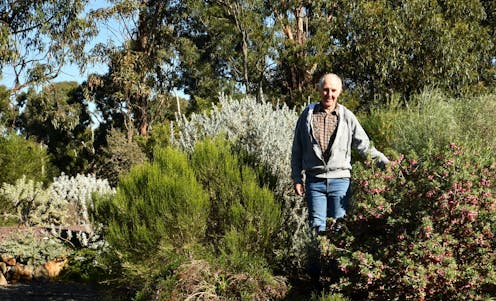
Each year, many new species of Australian plants, animals and fungi are discovered and described[1]. It’s detailed, time-consuming work, and much of it could not be done without the contribution of older Australians.
I’m an evolutionary botanist and I use DNA sequencing to better understand relationships between plant species – a field known as phylogenetics. My job involves collecting plant specimens in the furthest corners of Australia.
Time and again I’m helped by older, generally retired Australians with a passion for the plants I’m working on. In their own time and with their own resources, they take it upon themselves to explore and document a particular geographic area or group of plants.
Many have a professional scientific background, although not necessarily in the field they now contribute to. For these dedicated men and women, passion is their driver and time their secret weapon.
Without these older Australians, my research wouldn’t be where it is today. So let me introduce you to a few of them.
Bevan Buirchell, Ron Dadd and Russell Wait
From opposite sides of the country – Bevan and Ron in Western Australia and Russell in Victoria – these three collectors discover, sample and grow extensive collections of emu bush (Eremophila).
More than 200 species of emu bush have been described, and many are rare, threatened or endangered.
Emu bush is a culturally important plant for many Indigenous Australians, and recent research[2] has revealed the genus contains many new chemical compounds of interest for medicinal use.
Each year, the trio spends weeks four-wheel driving in arid and remote parts of Australia where emu bush is thought to be found.
When the men come across something interesting, they record scientific details and collect a cutting for propagation in their own or each other’s gardens.
Between them, Bevan, Ron and Russell have collections of almost every described species of emu bush, and new species awaiting formal description. So far, Bevan has described 16 new species or subspecies.
In this way, their gardens are like living museums of species diversity. They’re a great resource for the inclusion of species in phylogenetic research.
Read more: The ancient, intimate relationship between trees and fungi, from fairy toadstools to technicolour mushrooms[3]
Don Franklin
In the tablelands of Far North Queensland, retired ecologist Don Franklin spends his time expanding his knowledge of eucalypts.
A colleague put me in touch with Don when I was planning fieldwork to collect eucalypt species for my latest research project. Don was happy to help, assisting me with planning my collection route to ensure I sampled not just every species possible, but all the interesting variants he knows from different regions.
This on the ground experience is invaluable for my work, and impossible to gain from published literature alone.
Don is writing a comprehensive field study for eucalypt species spanning about 80,000 square kilometres. Over the past five years he’s travelled every road in the area, marking species distributions, morphological variants and regions of hybrid zones.
Don was my guide and assistant for a few weeks of field work, and my understanding of this group of plants benefited immeasurably.
Read more: Get to know blackwood better: a magnificent timber and a tough, towering wattle that can survive landslides[4]
Margaret Brookes
Margaret is a retired horticulturalist. For the past decade she’s volunteered at the National Herbarium of Victoria and the University of Melbourne Herbarium, where she helps curate the collections.
Over this period, Margaret’s work has included mounting thousands of new specimens submitted by researchers like me, and processing the backlog of old collections. Margaret has also transcribed historical field notes for plant collectors in decades and even centuries past.
Margaret’s work makes these plant collections accessible to researchers and the general public all over the world[5].
Continual advances in genetic sequencing technology mean we can increasingly access DNA from older and older dried specimens. In this way, the work done by Margaret and other herbarium volunteers becomes even more essential in discovering and classifying new species.
Read more: From Joseph Banks to big data, herbaria bring centuries-old science into the digital age[6]
Combining forces with senior-citizen scientists
As an early career researcher I am bound by two to three year funding contracts. In that short time, samples must be collected and genetically sequenced, then analysed and the results interpreted.
And to come up with plausible hypotheses to understand species’ relationships, my expertise must be broad. I’ve got to be good in the lab, proficient at analysis and across the latest literature.
To produce high-quality work in such tight time frames, I rely on the hidden “grey army” of older people such as those described above.
And while I can only speak from personal experience, I daresay many fields of natural science also benefit from a dedicated older generation quietly contributing to the body of scientific knowledge.
We must recognise the invaluable contributions made by older volunteer researchers. And if we’re to have any chance of better understanding the estimated 70%[7] of Australia’s biodiversity unknown to science, their continued involvement is imperative.
For those interested in volunteering or citizen science projects, try contacting your nearest herbaria. You could also check out the Atlas of Living Australia’s DigiVol volunteer portal[8] or the Australian Citizen Science Association[9].
Read more: About 500,000 Australian species are undiscovered – and scientists are on a 25-year mission to finish the job[10]
References
- ^ discovered and described (www.taxonomyaustralia.org.au)
- ^ recent research (onlinelibrary.wiley.com)
- ^ The ancient, intimate relationship between trees and fungi, from fairy toadstools to technicolour mushrooms (theconversation.com)
- ^ Get to know blackwood better: a magnificent timber and a tough, towering wattle that can survive landslides (theconversation.com)
- ^ world (www.ala.org.au)
- ^ From Joseph Banks to big data, herbaria bring centuries-old science into the digital age (theconversation.com)
- ^ estimated 70% (theconversation.com)
- ^ DigiVol volunteer portal (volunteer.ala.org.au)
- ^ Australian Citizen Science Association (citizenscience.org.au)
- ^ About 500,000 Australian species are undiscovered – and scientists are on a 25-year mission to finish the job (theconversation.com)