


Drooling is a common symptom of Parkinson's. Could a workout for the swallowing muscles help?
- Written by: Naomi Cocks, Senior Lecturer, Curtin University

Imagine not wanting to leave your house because of fear you would drool. That’s the choice many people with Parkinson’s disease confront every day.
Parkinson’s disease is the second most common neurodegenerative condition in Australia after dementia. It’s estimated around 70,000 Australians[1] live with it and one of the most vexing symptoms is drooling. People with Parkinson’s don’t produce more saliva. Rather, they don’t swallow their saliva as often or as well.
This debilitating symptom is experienced by up to 74% of people[2] who have Parkinson’s. Consequently, many avoid social situations and become socially isolated.
My team from ParkC[3], Curtin University, and Royal Perth Bentley Group, recently trialled a behavioural treatment called “expiratory muscle strength training” to see if it could help people with Parkinson’s who drool.
Our small study[4], published in the journal Dysphagia, has shown promising results.
Read more: Parkinson's disease: blood changes may occur years before diagnosis[5]

What is expiratory muscle strength training?
Expiratory muscle strength training was first developed for high school band students[6] to increase exhalation strength.
It involves people blowing into a device against resistance. It’s a bit like blowing into a large straw but instead of the breath passing freely through the straw, the air encounters resistance. You find you have to blow harder, which helps strengthen the target muscles.
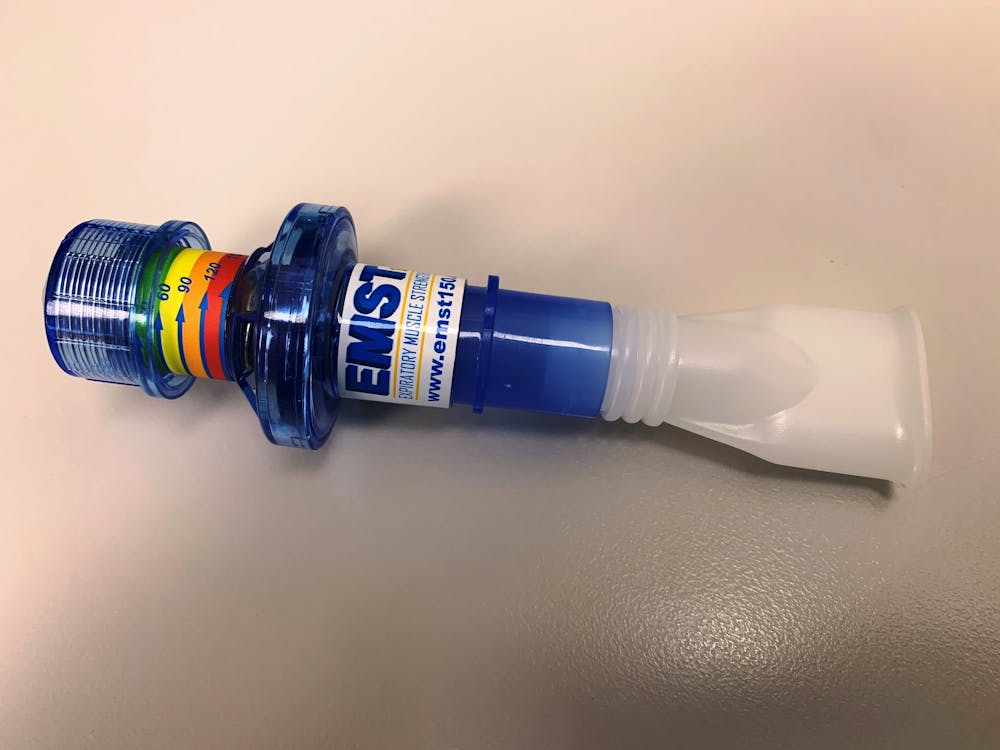 Expiratory muscle strength training involves people blowing into a device against resistance.
Naomi Cocks, Author provided
Expiratory muscle strength training involves people blowing into a device against resistance.
Naomi Cocks, Author provided
Just like a gym workout, people repeat this action multiple times and do this training five times a week.
Since its development, some studies[7] by other researchers have found this training not only increases exhalation strength but also improves cough strength and the swallow. Problems with coughing and swallowing are difficulties often experienced by people with Parkinson’s.
We were interested to know whether this training also resulted in improvements in drooling.
What we did
Our study involved 16 people with Parkinson’s who had self-reported difficulties with drooling.
First, we wanted to make sure measures of their swallowing ability, cough strength, lip strength and self-reported drooling severity stayed stable over the space of one to two weeks.
If they did, we could be more confident any improvements seen after the therapy would be actually due to the therapy and not just instability in these measures.
Typically, participants in our study completed 30 sessions of expiratory muscle strength training over a six week period.
Training consisted of two sessions with a speech pathologist and three sessions at home alone.
After training, we again measured their swallowing ability, cough strength, lip strength and drooling. We found swallowing ability, cough strength and drooling all improved significantly.
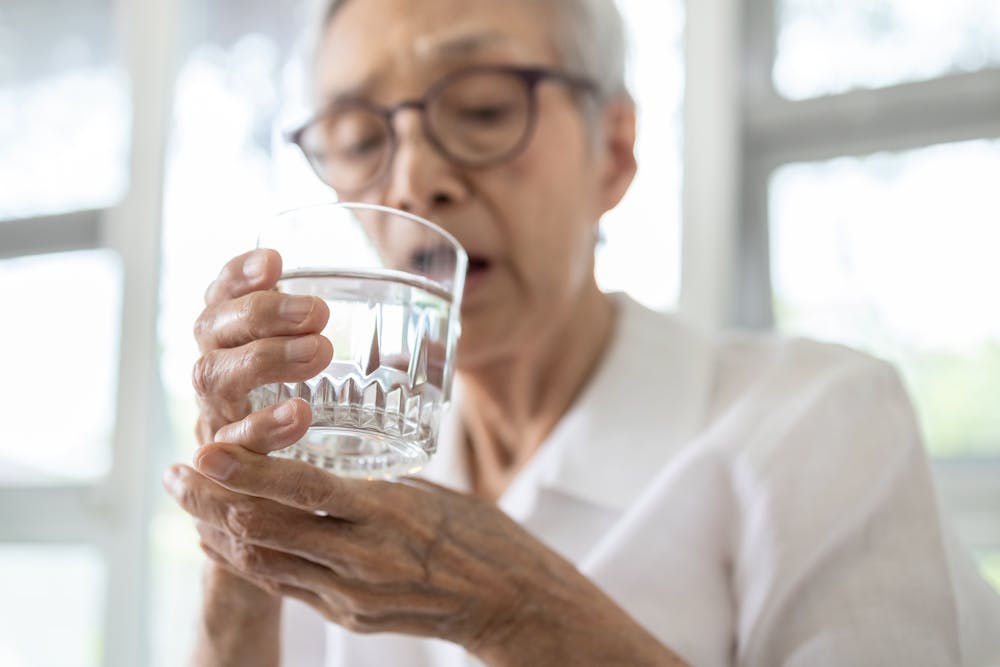 People with Parkinson’s sometimes struggle with swallowing.
Shutterstock
People with Parkinson’s sometimes struggle with swallowing.
Shutterstock
The next step: a bigger study
Our study was small and further research is clearly needed. But our promising preliminary results suggest this treatment may be a more desirable option than the standard approach to reduce drooling for people with Parkinson’s (botox shots, which reduce saliva production but can leave people with a dry mouth and difficulty swallowing).
One of the potential benefits of this treatment is that this single treatment could treat three difficulties common in Parkinson’s – drooling, swallowing and cough strength – all at the same time.
Difficulties swallowing and a weak cough can result in the person being at increased risk of developing pneumonia or choking. So not only could this treatment potentially reduce drooling, but also reduce the risk of serious illness and hospitalisation.
We are now seeking funding in order to explore this treatment’s efficacy with a greater number of participants in a randomised control trial. We hope our research will help people with Parkinson’s feel more comfortable with leaving their homes and, in doing so, improve their quality of life.
Please note: expiratory muscle strength training should not be carried out without consultation with a speech pathologist.
Read more: Parkinson's disease can affect the eyes – here's what we know so far[8]
References
- ^ 70,000 Australians (www.parkinsonsvic.org.au)
- ^ 74% of people (pubmed.ncbi.nlm.nih.gov)
- ^ ParkC (parkc.co)
- ^ study (www.doi.org)
- ^ Parkinson's disease: blood changes may occur years before diagnosis (theconversation.com)
- ^ high school band students (www.sciencedirect.com)
- ^ studies (scholar.google.com)
- ^ Parkinson's disease can affect the eyes – here's what we know so far (theconversation.com)










