New survey shows your relationship status tallies with how well you sleep
- Written by: Madeline Sprajcer, Lecturer in Psychology, CQUniversity Australia

A new survey[1] of Australian adults has found your relationship status can impact how well you sleep.
We know based on previous research[2] that sleeping next to someone can help you sleep better – but this is the first study to look at how the type of relationship you’re in might impact your sleep.
We found that people who live with a regular partner tend to fall asleep faster than people who have occasional or casual partners, or who are single. It’s not all bad news for people who aren’t in an ongoing relationship though – the amount of sleep people got overnight wasn’t related to relationship status.
Read more: How the brain tunes in to unfamiliar voices while you're sleeping – and why it matters[3]
Perchance to dream and stay healthy
It’s generally recommended[4] you should get seven to nine hours of sleep a night. However, about 40% of Australians report[5] inadequate sleep.
Not getting enough sleep, or having poor quality sleep, can lead to a range of health problems – such as poor heart health[6], stomach problems[7], poor mental health[8], and a greater risk of accident or injury[9].
Lots of things can affect how well you sleep – like work worries, family responsibilities and health. Existing research also tells us sleeping next to someone can impact our sleep. Due to a range of psychological and evolutionary factors, such as the need for strong social bonds to feel safe, it seems sleeping next to someone results in better sleep[10], and how well you sleep is linked with your relationship quality[11]. Getting along well with your partner might lead to a better night of sleep – and vice versa!
However, no previous research investigated how relationship status might affect your sleep. We asked nearly 800 Australian adults[12] about their relationship status and to rate their sleep using a shorter version of the Pittsburgh Sleep Quality Index[13], which has been verified as a valid sleep measure.
Casual partners keep us up at night
Our study[15], to be published in the March edition of the Sleep Science[16] journal, finds it takes people who have casual or occasional partners just over ten minutes longer to fall asleep than people who live with a regular partner.
Ten minutes might not sound like a long time – but studies show[17] just four to eight minutes can be the difference between people with insomnia (seen as hyperarousal with physiological measures like increased metabolic rate, higher body temperature, altered heart rate and activity in the brain) and healthy sleepers.
When we break this down by gender in our study, we see women are much more likely to be affected by relationship status than men. Men fall asleep just as quickly when they have a casual partner compared with a regular, live-in partner.
These differences are only seen when we look at what is called “sleep latency” – the amount of time it takes from turning off the light to when you fall asleep. The other main measure – the total amount of sleep overnight – does not change depending on relationship status. People in our study in relationships (regardless of living situation) also report higher post-sex emotional satisfaction, and more frequent orgasms.
So, while you might feel like your sleep is worse because it takes a little longer to get to sleep, we don’t expect this to play out as major changes to daytime fatigue or sleepiness for people who are single or in casual relationships.
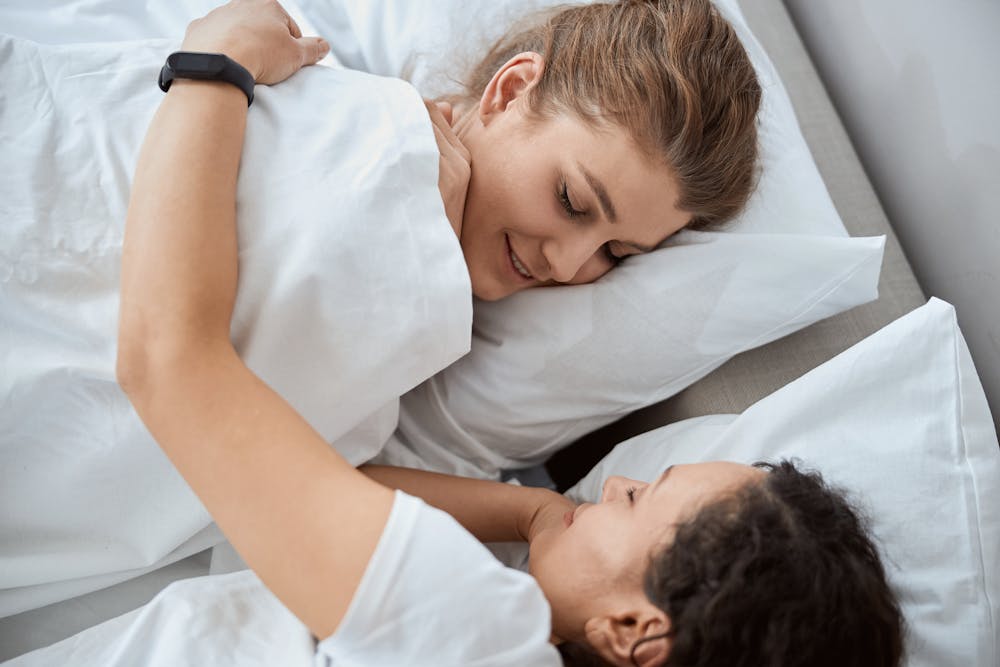 Relationship status seems to have a greater impact on women’s sleep.
Shutterstock[18]
Relationship status seems to have a greater impact on women’s sleep.
Shutterstock[18]
Read more: Why do we wake around 3am and dwell on our fears and shortcomings?[19]
Why is it so?
A few things could explain why relationship status impacts sleep.
People who are in casual (or new) relationships might have greater physiological arousal (racing hearts, breathing faster[20]), which can make it harder to fall asleep[21]. People in new relationships that are still at the casual stage might experience more excitement or anxiety when sleeping next to their new partner – or they might be worrying about the status of their relationship.
On the other hand, being in an ongoing relationship may be associated with feelings of physical and emotional security, which can reduce physiological arousal[22] – and improve sleep. It’s possible we find it easier to sleep next to someone we trust because it is an evolutionary adaptation. That is, we feel safer from predators when sleeping in an environment we perceive to be “secure[23]”.
Read more: Is this love ... or an arrhythmia? Your heart really can skip a beat when you're in love[24]
Now to bed … or beds
If you were to go to the doctor and tell then you’re having trouble sleeping, chances are they would recommend strategies like improving your sleep habits[25] or cognitive behavioural therapy[26] for insomnia. But these strategies don’t consider your relationship status.
Our findings suggest doctors could consider your relationship status as they work out how to help you get a better night’s sleep.
The next step for this research area is to understand how sleep changes when people are in the same bed as their partner or not. People in casual relationships may find falling asleep easier when they sleep alone, whereas people who live with their partners may not – we just don’t know yet. We also need objective data – from wearables or overnight brain activity monitoring – rather than surveys.
References
- ^ new survey (cdn.publisher.gn1.link)
- ^ previous research (psycnet.apa.org)
- ^ How the brain tunes in to unfamiliar voices while you're sleeping – and why it matters (theconversation.com)
- ^ recommended (pubmed.ncbi.nlm.nih.gov)
- ^ report (pubmed.ncbi.nlm.nih.gov)
- ^ poor heart health (pubmed.ncbi.nlm.nih.gov)
- ^ stomach problems (pubmed.ncbi.nlm.nih.gov)
- ^ poor mental health (psycnet.apa.org)
- ^ accident or injury (pubmed.ncbi.nlm.nih.gov)
- ^ results in better sleep (www.frontiersin.org)
- ^ linked with your relationship quality (www.ncbi.nlm.nih.gov)
- ^ asked nearly 800 Australian adults (cdn.publisher.gn1.link)
- ^ Pittsburgh Sleep Quality Index (www.sciencedirect.com)
- ^ Shutterstock (image.shutterstock.com)
- ^ study (cdn.publisher.gn1.link)
- ^ Sleep Science (www.sciencedirect.com)
- ^ studies show (www.ncbi.nlm.nih.gov)
- ^ Shutterstock (image.shutterstock.com)
- ^ Why do we wake around 3am and dwell on our fears and shortcomings? (theconversation.com)
- ^ racing hearts, breathing faster (www.ncbi.nlm.nih.gov)
- ^ harder to fall asleep (pubmed.ncbi.nlm.nih.gov)
- ^ reduce physiological arousal (journals.sagepub.com)
- ^ secure (www.researchgate.net)
- ^ Is this love ... or an arrhythmia? Your heart really can skip a beat when you're in love (theconversation.com)
- ^ sleep habits (www.sleephealthfoundation.org.au)
- ^ cognitive behavioural therapy (www.sleepfoundation.org)