an introduction to the films of Paul Thomas Anderson
- Written by: Ari Mattes, Lecturer in Communications and Media, University of Notre Dame Australia
After successfully shooting the opening sequence of Boogie Nights – an elaborate steadicam shot[1] in which the camera tracks into and around a night club, introducing the title, setting and all of the main characters of the film – young writer-director Paul Thomas Anderson enthusiastically showed it to the ageing star of the film, Burt Reynolds.
Burt Reynolds was reportedly immediately dismissive, noting five other times he’d seen the same thing[2].
Both appear as caricatures of Hollywood types. Anderson, directing his first major feature film comes off as a cocky MTV-generation director at loggerheads with one of the megastars of the 1970s, now ancient history.
Paul Thomas Anderson would go on to become one of the most critically acclaimed directors of the 21st century. His films frequently fare well during the awards season, with works like There Will Be Blood, The Master and Phantom Thread further cementing the credentials of names like Phillip Seymour Hoffman, Joaquin Phoenix and Daniel Day-Lewis.
But are his films all they’re cracked up to be - are they, as New York Times critic Manohla Dargis describes There Will Be Blood, “consummate works of art”[3]? Or are they overblown, pompous, and needlessly concerned with style?
The serious and the farcical
There’s something about the combination of tragedy and comedy in the Reynolds anecdote which seems to epitomise the work of Paul Thomas Anderson at large. His films seem to elicit both serious and farcical readings.
Taken seriously, his films can be a little annoying. They are profoundly heavy-handed (though he’s an interesting enough filmmaker that this isn’t always a negative thing), and at times seem self-important in a trite, arty kind of way.
But they also offer rollicking good times, as funny as the novels of Thomas Pynchon (who Anderson adores), and, viewed from afar, this image of grey-toupeed Burt Reynolds trying to cut down Valley Boy is simply funny.
Despite their evident humour, his films are usually received by critics as straight dramatic studies of larger-than-life characters rather than as black comedies. But this does Anderson’s ingenuity as a filmmaker a disservice. It’s the comedic core of his films that makes them so affective.
And, given Anderson’s skill at bringing funny sequences to life in more obviously comedic films like Boogie Nights, Punch-Drunk Love and, now, the sweet-natured Licorice Pizza, it’s perhaps unsurprising his films work as comedies in serious clothing.

Absurdity and melodrama
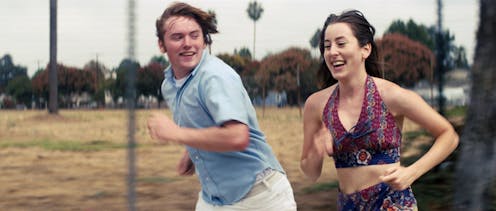
His latest Oscar-nominated film, Licorice Pizza, seems to take a 180⁰ turn in terms of his previous work – it’s a nostalgic teen comedy-romance set in the San Fernando Valley in the 1970s – but, if we look beyond the genre, we see the same kinds of tropes emerging.
There’s the batshit egotistical and immature male lead (in this case totally forgivable because he’s a teenager) brilliantly realised by Cooper Hoffman. There’s the careworn, eccentric female lead, equally brilliantly realised by newcomer to the screen, Alana Haim.
There’s the oddly sprawling narrative, wildly uneven in the picaresque tradition, beginning in media res before pulling back, taking tonally unexpected turns. The very setting of Licorice Pizza and Boogie Nights, the streets of the San Fernando Valley, where Thomas Anderson grew up, seems to determine the logic of the narratives of all his films – winding, flat at times, with one often ending up in the same position from which one began.
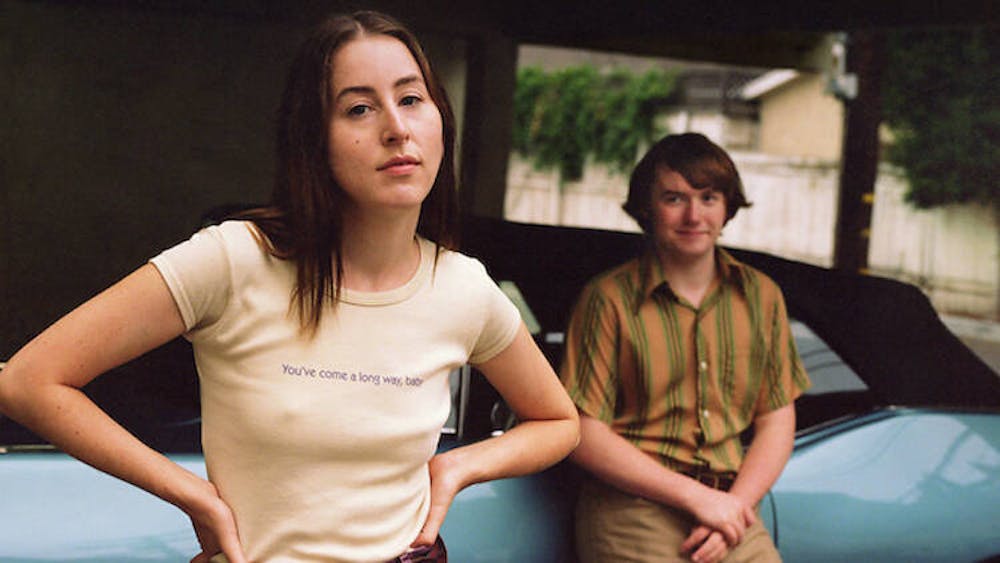 Licorice Pizza is a coming-of-age comedy-drama film written and directed by Paul Thomas Anderson.
IMDB
Licorice Pizza is a coming-of-age comedy-drama film written and directed by Paul Thomas Anderson.
IMDB
Whether a Paul Thomas Anderson film is taken as serious or farcical is, perhaps, just a matter of one’s perspective. Viewed morally, characters do nasty things to each other and we feel outrage, compassion, sadness.
But suspend our morality and things start to take on a deliriously entertaining and madcap sparkle, with films like The Master and Phantom Thread playing like nihilistic screwball, cracked comedies. Daniel Day-Lewis’ marquee scenes in There Will Be Blood (delivered in actorly brogue) are fundamentally ridiculous, which is what makes them so eminently easy to parody.
Big-scale dramatic actors like Day-Lewis and Joaquin Phoenix – the kind of actors who are frequently nominated for Oscars, and who have been endlessly praised for their chops – suddenly appear delusionally serious.
Vision and voice
Not that his films are inconsistent in style – Thomas Anderson is very much an auteur in the classical mould, and there are multiple consonances between his films in both style and theme.
He writes his own scripts, and there is an idiosyncratic rhythm and focus to these. They are inconsistent, and don’t (appear to) follow any of the screenwriting rules that make so many film school graduates’ three-act structure scripts dull.
There’s the feeling of haphazard potential about his stories that makes them more thrilling than conventional Hollywood narratives, even as failure seems to be a usual outcome for his outlandish, blinkered and egotistical characters.
But this never seems to be failure for failure’s sake, or failure at the service of some kind of moral message – everything in Paul Thomas Anderson’s films is in the service of the film as a work, as a coherent whole, and it is this relentless adherence to his own ego/vision as writer-director that makes his films so compelling – and, at times, so pat.
In a period in Hollywood in which auteur cinema seems to have been superseded by either self-conscious, clever genre cinema, or didactic, moralising works that attempt to explicitly shape the viewer’s mind according to assumed social norms, there’s something refreshing about films that don’t claim to be anything other than the vision of one person.
References
- ^ steadicam shot (www.masterclass.com)
- ^ thing (www.gq.com)
- ^ “consummate works of art” (www.nytimes.com)