What are the rights of children at the parliament protest – and who protects them?
- Written by: Claire Breen, Professor of Law, University of Waikato
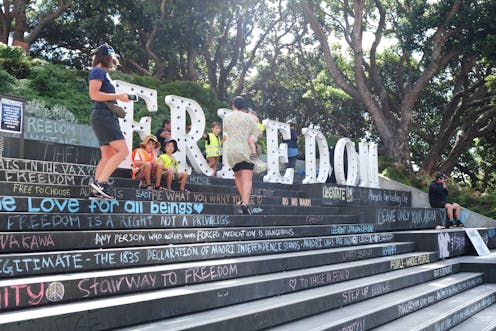
Children have participated in protests against nuclear weapons, wars, the loss of Māori land and customary rights, racism and child poverty. Young people themselves led the School Strike 4 Climate[1] marches.
But the continuing presence of children at the sometimes violent occupation of parliament grounds has concerned many, from police[2] to the prime minister[3] and children’s commissioner[4].
So the question now becomes, should children even be allowed to participate in such events? Those who answer “no” may argue children (especially younger ones) cannot understand the nature of the debate, are being manipulated by adults, and are physically and emotionally vulnerable.
Others might argue young people’s voices should be heard, and that children are capable of grasping the meaning of protest action. And even if young people don’t understand an issue, it could be argued some adults should be prevented from protesting on the same basis.
An alternative view is that children have been, and will continue to be, heavily affected[5] by pandemic restrictions and lockdowns. For that reason, they have a vested interest in being able to exercise their rights to gather and protest peacefully.
But with children potentially caught up in the less peaceful side of the parliament protest, it’s imperative they and their rights are understood and protected.
What does the law say?
Children, like adults, have the rights to freedom of movement, association and peaceful assembly – rights that underpin the right to (peaceful) protest. These rights are protected by the Universal Declaration of Human Rights and the ensuing framework of human rights treaties, including the UN Convention on the Rights of the Child[6].
Whether they are exercised by adults or children, these rights aren’t absolute and can be limited. According to the international legal framework of human rights, however, such limitations must be based in law and in the interests of a democratic society. Restrictions can be imposed for reasons such as public safety, public order, or the protection of public health.
Read more: The Wellington protest is testing police independence and public tolerance – are there lessons from Canada’s crackdown?[7]
But there are other balancing acts when it comes to children’s rights, including their right to protest. The Convention on the Rights of the Child says the best interests of the child, and their right to have their opinions heard, should guide decision-making where children are involved.
In Aotearoa New Zealand, the New Zealand Bill of Rights Act 1990[8] guarantees the rights to freedom of expression, association and peaceful assembly, subject to the same reasonable[9] limits that exist in international law.
Who is responsible for child protesters?
Young protesters are at greater risk from harm than adults because they are physically smaller and therefore generally more vulnerable.
So the issue of who is responsible for the safety of children within the protest at parliament raises a number of complicated questions[10] for the government, police, parents – and, of course, the young people themselves.
There are no clear answers in this type of situation.
The Convention on the Rights of the Child recognises, among other things, that parents have the primary responsibility for the upbringing and development of their children, and that children must be protected from violence.
Read more: To protect children during Aotearoa's Omicron outbreak, we need to consider their families, not just schools[11]
New Zealand’s Care of Children Act 2004[12] states that the welfare and best interests of a child must be the first and paramount consideration. Children must be protected from all forms of violence, and the primary responsibility for their care lies with their parents.
The Oranga Tamariki Act 1989[13] promotes the well-being and protection from harm of children and young people, and Oranga Tamariki itself has said it was working with police and other partners[14] to address any child protection concerns at the Wellington protest.
Challenges for police and the law
Against this legal framework, the challenge (especially for the police) is how to manage a sometimes unruly crowd that contains significant numbers of children.
This has undoubtedly already influenced the police’s response, and the fate of the protest in general hinges to some extent on guarding the children’s best interests and well-being and ensuring they are protected from harm.
Read more: The occupation of NZ’s parliament grounds is a tactical challenge for police, but mass arrests are not an option[15]
Failure to do this could mean the children at parliament grounds could be injured, and their rights to protest and to be protected from violence undermined.
Beyond these immediate concerns, though, the presence of children at parliament grounds should remind us again of the impact the pandemic in general has had on the hopes and dreams[16] of young people.
These protests will eventually end, but ensuring the voices of children and young people are heard must be part of efforts to mitigate the consequences of the pandemic in the months and years to come.
References
- ^ School Strike 4 Climate (www.rnz.co.nz)
- ^ police (www.nzherald.co.nz)
- ^ prime minister (www.stuff.co.nz)
- ^ children’s commissioner (www.nzherald.co.nz)
- ^ heavily affected (www.bbc.com)
- ^ UN Convention on the Rights of the Child (www.ohchr.org)
- ^ The Wellington protest is testing police independence and public tolerance – are there lessons from Canada’s crackdown? (theconversation.com)
- ^ New Zealand Bill of Rights Act 1990 (www.legislation.govt.nz)
- ^ reasonable (www.legislation.govt.nz)
- ^ complicated questions (www.stuff.co.nz)
- ^ To protect children during Aotearoa's Omicron outbreak, we need to consider their families, not just schools (theconversation.com)
- ^ Care of Children Act 2004 (www.legislation.govt.nz)
- ^ Oranga Tamariki Act 1989 (www.legislation.govt.nz)
- ^ working with police and other partners (www.stuff.co.nz)
- ^ The occupation of NZ’s parliament grounds is a tactical challenge for police, but mass arrests are not an option (theconversation.com)
- ^ hopes and dreams (ojs.victoria.ac.nz)