Like many disasters in Australia, Aboriginal people are over-represented and under-resourced in the NSW floods
- Written by: Bhiamie Williamson, Research Associate & PhD Candidate, Australian National University
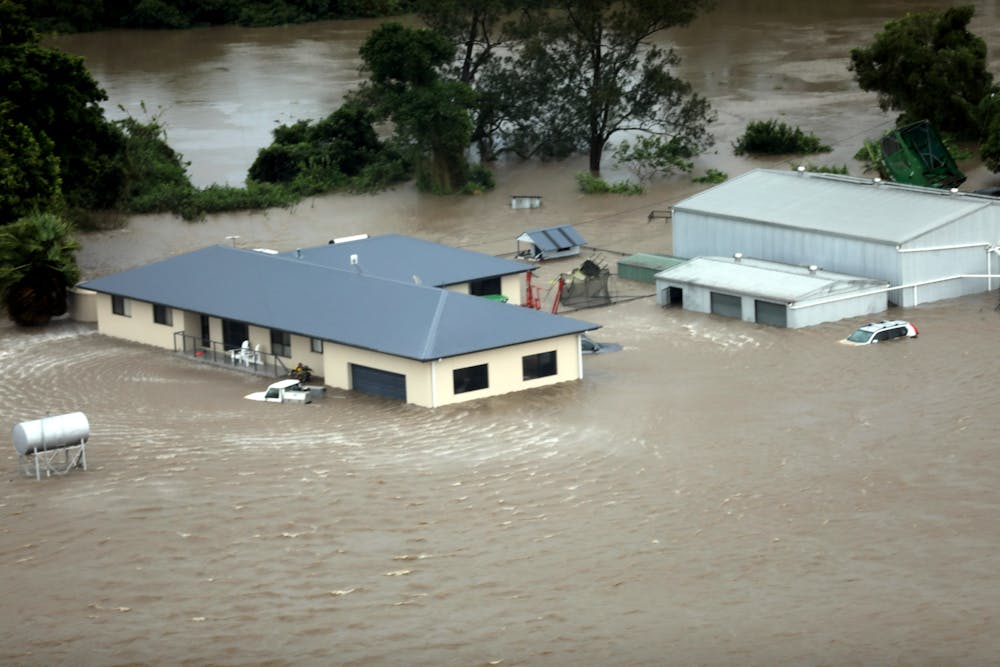
The flooding crisis that has engulfed much of Australia’s east coast is yet more evidence of the catastrophic impacts of climate change. While all people are forced to confront similar challenges such as forced evacuations, loss of property and damage to businesses, Aboriginal people are once again over-represented in the number of people impacted by disaster.
Northern NSW is home to many Aboriginal people living in large townships such as Lismore, Ballina, Casino and Kempsey. It is also home to a vast array of discrete Aboriginal communities such as Cabbage Tree Island, Box Ridge, Gundurimba, Wardell, Maclean (Hill Crest), and more.
A quick glance at the regions that have been officially declared a natural disaster zone in NSW[1] reveals that approximately 36,509 Aboriginal and Torres Strait Islander people have been directly impacted by the floods in NSW, or 4.2%[2] of those affected by floods.
Focusing on regional areas outside of Sydney, the proportion of Aboriginal and Torres Strait Islander people affected by the floods jumps to 6.2%. Compare this with the fact Aboriginal people make up 3.3% of the general population and it becomes clear Aboriginal and Torres Strait Islander people are once more disproportionately affected by disaster.
But these numbers are just one dimension. Aboriginal and Torres Strait Islander people are a youthful population, with more than half being under 24 years old[3]. This means that of the Aboriginal and Torres Strait Islander people affected, most are children and young people.
Read more: 5 big ideas: how Australia can tackle climate change while restoring nature, culture and communities[5]
Stories of survival and strength
With such widespread flooding, emergency services and disaster relief organisations have struggled to keep up, and in the midst of the chaos, Aboriginal communities have found themselves isolated and in some cases forgotten.
At Cabbage Tree Island outside of Ballina, the entire community has been inundated. In the midst of the evacuation, elders and families did not want to evacuate because they had nowhere to go. Bundjalung woman Delia Rhodes shared with ABC PM Radio[6]:
You have Elders and families with children sitting around for hours waiting to get accommodation. It’s very frustrating.
Community members with access to boats took it upon themselves to drop food, baby supplies, and medicine to people who found themselves stranded.
Naomi Moran, General Manager of Indigenous newspaper The Koori Mail shared with NITV[7]:
You know what Blackfullas are like, if it happens to one of us, it happens to all of us. The outpouring of offers to support our communities. You know, taking calls from Sydney mob, from Melbourne mob, saying “how can we help?”
In Dubbo, Bundjalung woman Noelle King is organising donations and relief for families in Lismore and surrounding communities, she said to me:
I have lots of family in Lismore who have lost everything but are so grateful they all made it out to safety in time. I have family in Corakai, on the mission who were isolated with no access to supplies and the same seeing Gundurimba and Cabbo going under […] So I’ve reached out to the community of Dubbo and donations have flowed in of clothes, household items, food and other supplies. We will be organising a truck next week and heading over to help where we can.
Sadly, these stories of Aboriginal communities being left behind with little support, or none at all, are all too common. I have written about similar experiences during the 2019-20 bushfires[8] and the COVID-19 pandemic[9] in Aboriginal communities.
There are also questions about when or even if communities can return to their home communities, as Dyonne Anderson, Principle of Cabbage Tree Island public school shared with The Guardian[10]:
We may not return for many months.
These disasters have exposed the consequences of a lack of planning and preparation in and with Aboriginal communities. They have also shown how entrenched inequality produces further vulnerabilities in times of crisis. The same consequences are now being felt in northern NSW.
Read more: The COVID-19 crisis in western NSW Aboriginal communities is a nightmare realised[11]
How can First Nations communities be better supported during climate change?
Disasters such as this have always been a common feature in Australia, but as more and more emissions are pumped into the atmosphere, the impacts of climate change mean the scale and severity of these disasters will continue to increase. Aboriginal and Torres Strait Islander communities are already bearing the brunt of these disasters. A number of things need to happen now, before climate impacts worsen.
It’s vitally important Aboriginal people throughout flood impacted areas are provided with as much community and government support as they require to return home and recover what has been lost. Aboriginal community members have organised a number of crowdfunding campaigns to support Aboriginal people in flood-affected areas.
Two of note include the Bundjalung community flood relief[12] and Support Aboriginal families of Lismore[13].
It is also time to look beyond individual disasters and develop an integrated response that is led by and centres Indigenous peoples. I suggest this can be done in two ways.
Firstly, we need a national Indigenous disaster resilience framework. My research[14] has uncovered how Indigenous peoples have been made absent in national disaster resilience policies in the past. Without a framework that focuses on our communities, including the distinct impacts of disasters on our peoples, culture and heritage, and the unique legal and governing arrangements within our communities, future policies and responses will continue to fall short.
Second, there is an urgent need to develop and resource an Indigenous climate resilience and adaptation strategy. The recent report by the Intergovernmental Panel on Climate Change, Impacts, Adaptation and Vulnerability[15], recognises the specific challenges for Indigenous peoples in a changing climate. While closer to home Future Earth Australia, a peak expert group based at the Australian Academy of Science, is developing a National Strategy for Just Adaptation[16].
But even these strategies and reports are incapable of capturing and communicating our voices, experiences, and ambitions if they are not Indigenous-led and owned.
What these floods have shown, as the bushfires and COVID-19 have shown before, is the indomitable strength of Aboriginal people.
Perhaps it is fitting the national NAIDOC theme for 2022 is “Get Up! Stand Up! Show Up![17]” - because that is exactly what we continue to do for our people in times of disaster.
References
- ^ declared a natural disaster zone in NSW (www.nsw.gov.au)
- ^ 4.2% (www.abs.gov.au)
- ^ more than half being under 24 years old (quickstats.censusdata.abs.gov.au)
- ^ Australian Defence Force/AAP Image (photos.aap.com.au)
- ^ 5 big ideas: how Australia can tackle climate change while restoring nature, culture and communities (theconversation.com)
- ^ ABC PM Radio (www.abc.net.au)
- ^ NITV (www.sbs.com.au)
- ^ 2019-20 bushfires (theconversation.com)
- ^ COVID-19 pandemic (theconversation.com)
- ^ The Guardian (www.theguardian.com)
- ^ The COVID-19 crisis in western NSW Aboriginal communities is a nightmare realised (theconversation.com)
- ^ Bundjalung community flood relief (www.gofundme.com)
- ^ Support Aboriginal families of Lismore (chuffed.org)
- ^ My research (caepr.cass.anu.edu.au)
- ^ Impacts, Adaptation and Vulnerability (www.ipcc.ch)
- ^ National Strategy for Just Adaptation (www.futureearth.org.au)
- ^ Get Up! Stand Up! Show Up! (www.naidoc.org.au)