The power of tech giants has made them as influential as nations. Here's how they're sanctioning Russia
- Written by: Rob Nicholls, Associate professor in regulation and governance, UNSW Sydney
The world’s five leading tech companies – Google (now Alphabet), Apple, Facebook (now Meta), Amazon and Microsoft – have taken steps to impose significant and (mainly) voluntary sanctions on Russia, in response to its invasion of Ukraine.
But the decisions didn’t come unprompted. Ukraine has lobbied the major tech companies in the same way it sought assistance from the European Union, NATO and the US government.
Facing the largest military action in Europe since the second world war, Ukraine appealed directly to big tech companies as though they were nation states. It’s a reminder that in today’s world, these giants are major players on the geopolitical stage.
So what impact could the tech-related sanctions have?
The Big 5’s response
Google[1]’s response to the crisis has come in two parts. The first has been finance-related. The company has limited the use[2] of Google Pay in Russia for customers or merchants that use a sanctioned bank.
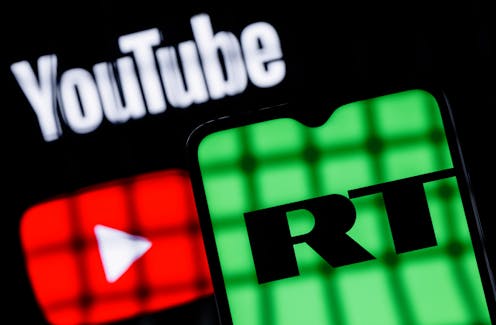
It has also stopped selling[3] online advertising in Russia across its services, and has removed the ability for Russian state media outlets Russia Today (RT) and Sputnik to monetise content on YouTube (which is owned by Google). RT and Sputnik have also been blocked in Europe.
Foxtel has removed RT in Australia, but it’s still available on YouTube, with ads in the livestream. That means RT can earn direct revenue from advertising in Australia, but no advertising revenue from YouTube. Google Search and Maps both remain available in Russia.
Apple[4] has gone several steps further than Google. The company has suspended all product sales in Russia, and Apple Pay and other services have been limited. It has also blocked RT and Sputnik from the Apple App Store everywhere outside of Russia.
Meta[5] has removed access to RT and Sputnik on both Facebook and Instagram (which it owns), and has removed the option for state media to monetise content on any of its platforms. It is also demoting posts that contain links to Russian state-controlled media websites on Facebook.
Amazon has taken the path of supporting cybersecurity efforts in Ukraine and offering logistical support, as announced on Twitter by chief executive Andy Jassy. However, Amazon hasn’t yet taken any action to reduce the revenue it receives from Russia.
Microsoft[6] has also helped on the cybersecurity front. It identified a potential Russian cyber attack in Ukraine on February 24, helping efforts to thwart it. In addition, it has banned all advertisements from RT and Sputnik across its ad network, and blocked access to both channels in the European Union.
(Almost) no chips for Russia
Two of the largest US semiconductor (microchip) manufacturers, Intel and AMD[7], have ceased supplies to Russia. Although the official US sanctions prohibit the export of “dual use” devices with both military and non-military purposes, Intel and AMD have gone a step further and halted all supplies at this stage.
Perhaps more importantly, the major Taiwanese supplier TMSC[8] has stopped supplies. TMSC makes chips for Russian manufacturers such as the Russian Scientific and Technical Centre Module, Baikal Electronics and Marvel Computer Solutions. There are no alternative semiconductor fabrication plants in Russia.
Samsung Electronics, another major chip manufacturer, also announced on Saturday that it would suspend shipments. Samsung leads mobile phone supplies in Russia and, prior to the suspension on Saturday, would have stood to benefit from Apple’s decision to stop sales in the country.
But not all tech companies have given in to political pressure. South Korean chip fabricator SK Hynix has not yet decided to limit supplies (as of when this article was written).
It seems the South Korean government[9] wants to continue supplying semiconductors to Russia, as it has sought exemptions from the US in respect to actions that could negatively impact its semiconductor industry.
Other consequences
Apart from the more directly imposed restrictions, Some Meta and Google services were also blocked after users subverted them for political messaging. For example, social media users across the globe began using Google reviews of restaurants[10] in Moscow and St Petersburg to send information to Russian citizens.
As a result, new reviews in Russia and Ukraine have now been restricted[11] by Google. That is, Google has acted to avoid delivering potential disinformation from either side.
And both Meta[12] and Google[13] have restricted some of their location-based services in Ukraine to limit potential military use.
What’s the immediate impact?
The actions of Meta and Google, and any loss of ad revenue they previously afforded, will have an immediate but relatively small impact on the Russian state – much smaller than the impact from direct financial sanctions[14].
And not being able to use Google Pay or Apple Pay is still not as inconvenient for Russian citizens as being unable to use ATMs[15] – many of which have run out of notes.
On the other hand, the loss of access to Apple hardware could have a much more lasting impact on Russian consumers.
The overall effect of the various sanctions will be a slowing down of the Russian economy – especially the digital economy which is reliant on semiconductors. However, this too will have a small immediate impact.
Read more: Russian sanctions are biting harder than it could have imagined, and it'll get worse[16]
Corporate decisions
There was no legal or regulatory obligation for chip manufacturers and tech companies to limit the export of goods and services to Russia. Instead, the move seems to have been prompted by two key incidents.
First was the very public and direct appeal by Ukrainian Deputy Prime Minister Mykhailo Fedorov to the tech companies, asking them to take action.
Second was the need to meet stakeholders’ expectations. This can be characterised as “corporate social responsibility”, or as social licence.
Both Apple and Google responded to calls for help from members of the Ukrainian government. Google’s philanthropic arm and its employees are directly contributing US$15 million[17] to relief efforts in Ukraine.
While the US sanctions didn’t demand for the tech companies to stop trading with Russia entirely, the signalling from both the US government and Ukrainian officials provided a persuasive context.
It has raised the spectre of multinational tech companies deciding which “side” to support based on a stakeholder perspective, rather than a legislated one. It seems in the end, stakeholder views are still the chief driver of Big Tech’s response to ethical dilemmas.
Read more: Facebook is tilting the political playing field more than ever, and it's no accident[18]
References
- ^ Google (blog.google)
- ^ limited the use (www.bbc.com)
- ^ stopped selling (www.reuters.com)
- ^ Apple (www.euronews.com)
- ^ Meta (about.fb.com)
- ^ Microsoft (blogs.microsoft.com)
- ^ Intel and AMD (www.tomshardware.com)
- ^ TMSC (www.washingtonpost.com)
- ^ South Korean government (www.reuters.com)
- ^ Google reviews of restaurants (www.cnet.com)
- ^ been restricted (www.businessinsider.com.au)
- ^ Meta (about.fb.com)
- ^ Google (blog.google)
- ^ direct financial sanctions (www.theguardian.com)
- ^ unable to use ATMs (www.cnbc.com)
- ^ Russian sanctions are biting harder than it could have imagined, and it'll get worse (theconversation.com)
- ^ US$15 million (www.thinkwithgoogle.com)
- ^ Facebook is tilting the political playing field more than ever, and it's no accident (theconversation.com)