What's the best way to parallel park your car? Engineers have the answer
- Written by: Benjy Marks, Lecturer in Geomechanics, University of Sydney
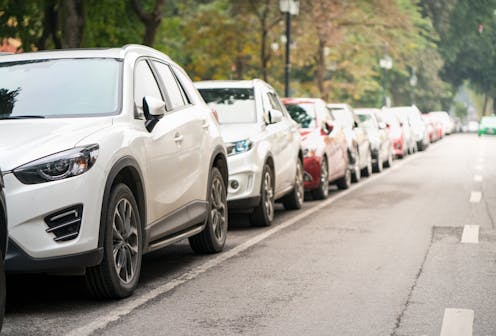
You’re driving slowly along a street, looking for a place to park. You come across a long stretch of parallel parking. But to your frustration, the spaces left by other people’s parking efforts are not quite long enough for you to fit. The search continues.
Drawn from our own frustrating experiences with parking, we decided to answer the question once and for all - what’s the best way to parallel park your car? Our research[1] has found a simple answer.
You should always park at one end of a parking space, leaving as big a space as possible at the other end. It doesn’t matter which end – just remember to leave yourself room to get out. While this might sound obvious, a quick look at the street outside your home will show many drivers think parking in the middle of the space is best – or just don’t give it much thought at all.
Optimising how we park our cars in cities matters, because free parking spaces are, by their nature, a limited resource. We’ve taken to our cars with a vengeance as the world slowly reemerges from lockdowns. Mobility data[2] shows our cities are coming back to life, with our travel behaviours changing in turn.
Even though many of us are still working from home[3], those of us commuting are reluctant to return to public transport[4]. You’ll have already noticed the result based on traffic. The number of cars on the roads of Australian cities has already met or gone past pre-COVID numbers, and so too the parking demand.

How can we all park better?
Everyone is familiar with marked spaces, where painted lines show you where to park. These help manage our frustrations with unreliable parking, but they are bad for density because every space needs to be able to accommodate a large car.
In our research, we focused on unmarked parallel parking, such as that found on most residential streets. That’s because here we can control exactly where we position our cars.
We tested four strategies drivers can follow in these types of parks:
- always park as far back as possible
- park at either end of the space
- park in the middle of the space
- randomly park anywhere in the available space.
We simulated what would happen in the common situation where demand exceeds supply, in which there is always a car waiting to park, with a driver who is prepared to wait until someone else leaves.
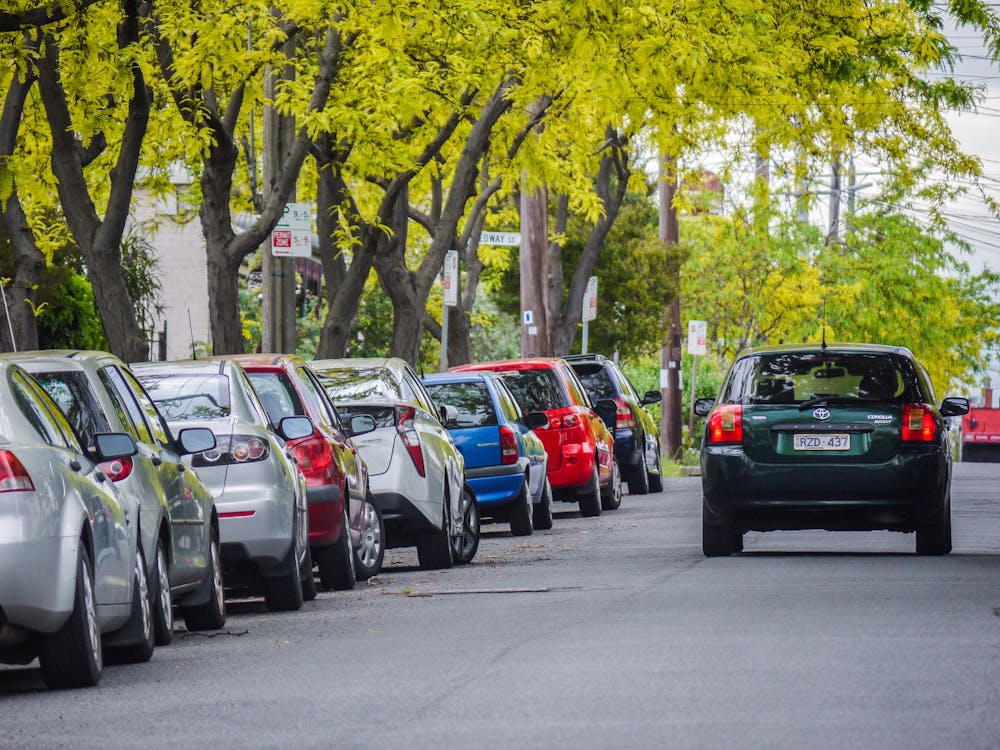 Hunting for a car park can be a frustrating experience.
Shutterstock
Hunting for a car park can be a frustrating experience.
Shutterstock
The worst strategy for maximising car parks? Parking in the middle of the space. You might find this useful if, say, you wanted to discourage people from parking directly outside your house. Parking in the middle of the available space makes it harder to cram more cars in.
We found parking randomly in a space can produce slightly better outcomes. Many drivers use this strategy subconsciously.
But overall, the best strategy for fitting as many cars into scarce street parking is to park at either end of the space. It doesn’t matter which end you park at, and it doesn’t even matter if you choose the same end as your neighbours. Under this scenario, we could fit the most cars onto any street.
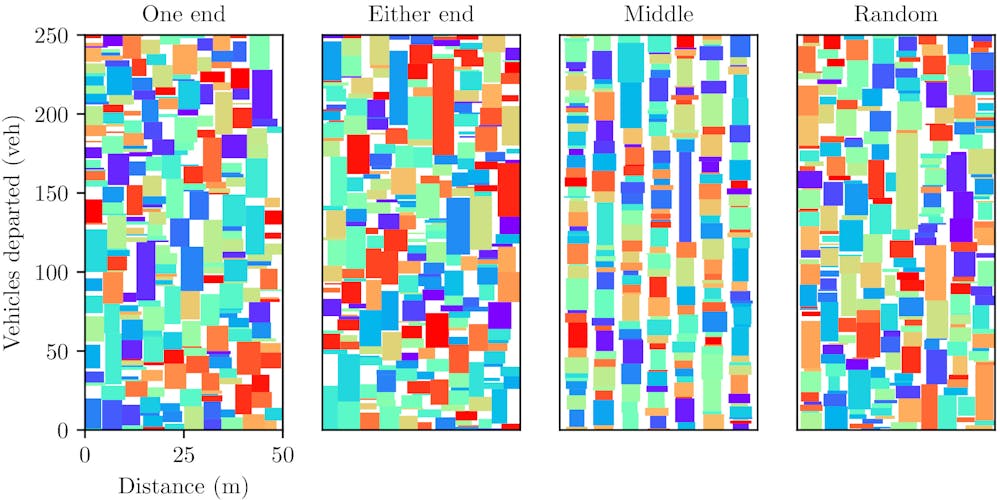 The four parking strategies we tested. Time progresses from bottom to top, with cars leaving and being replaced. Cars are represented by coloured rectangles, with the width of the rectangle the length of the car, and the height of the rectangle how long it was parked for. White represents a gap along the kerb.
Author provided
The four parking strategies we tested. Time progresses from bottom to top, with cars leaving and being replaced. Cars are represented by coloured rectangles, with the width of the rectangle the length of the car, and the height of the rectangle how long it was parked for. White represents a gap along the kerb.
Author provided
We also analysed what happens when there’s only a small distance between driveways or intersections. If you live in a street with shorter kerbs, parking at either end of the spot becomes even more beneficial.
How significant is this technique? In many residential areas, you can almost double the number of cars able to fit on the road by parking at the front or back of the available spaces.
Issues with parking
Parking is a scarce resource that we need to manage carefully to encourage other modes of transport, such as public and active transport. Storing cars on valuable land is also a poor use of real estate[5]. If autonomous cars arrive, we might see a future in which cars drive themselves off to remote car parks and free up all of the highly accessible land currently used for street parking.
If we wanted to reduce the demand for parking, we would have to encourage more people to return to public transport through measures such as lowering fares, or increasing the cost of parking or fuel[6]. We could also build extra car parks next to train stations or bus bays.
But given these measures are unlikely to happen[7] in the near future, we need to make the most of the parking we have.
Until then, the management of on-street parking will remain a vexed issue, particularly in our most congested cities. In Sydney, for instance, local residents and commuters[8] vie with visitors[9] for the right to park in a given street.
As the amount of on-street parking is more or less fixed, we should make the most of the space we’ve got. Next time you come across an unmarked parallel park, try parking at the front or back of the space.
References
- ^ research (findingspress.org)
- ^ Mobility data (covid19.apple.com)
- ^ working from home (www.sciencedirect.com)
- ^ return to public transport (ses.library.usyd.edu.au)
- ^ poor use of real estate (www.jstor.org)
- ^ fuel (theconversation.com)
- ^ unlikely to happen (www.smh.com.au)
- ^ local residents and commuters (www.smh.com.au)
- ^ visitors (www.smh.com.au)