Ultra-processed foods are trashing our health – and the planet
- Written by: Kim Anastasiou, Research Dietitian (CSIRO), PhD Candidate (Deakin University), Deakin University
Our world is facing a huge challenge: we need to create enough high-quality, diverse and nutritious food to feed a growing population – and do so within the boundaries of our planet. This means significantly reducing the environmental impact of the global food system.
There are more than 7,000 edible plant species[1] which could be consumed for food. But today, 90% of global energy intake comes from 15 crop species[2], with more than half of the world’s population relying on just three cereal crops: rice, wheat and maize.
The rise of ultra-processed foods is likely playing a major role in this ongoing change, as our latest research notes[3]. Thus, reducing our consumption and production of these foods offers a unique opportunity to improve both our health and the environmental sustainability of the food system.
Impacts of the food system
Agriculture is a major driver of environmental change. It is responsible for one-third of all greenhouse gas emissions[4] and about 70% of freshwater use[5]. It also uses 38% of global land[6] and is the largest driver of biodiversity loss[7].
While research has highlighted how western diets containing excessive calories[8] and livestock products[9] tend to have large environmental impacts, there are also environmental concerns linked to ultra-processed foods[10].
The impacts of these foods on human health are well described, but the effects on the environment have been given less consideration. This is surprising, considering ultra-processed foods are a dominant component of the food supply[11] in high-income countries (and sales are rapidly rising through low and middle-income countries too).
Our latest research, led by colleagues in Brazil, proposes that increasingly globalised diets high in ultra-processed foods come at the expense of the cultivation, manufacture and consumption of “traditional” foods.
How to spot ultra-processed foods
Ultra-processed foods[12] are a group of foods defined as[13] “formulations of ingredients, mostly of exclusive industrial use, that result from a series of industrial processes”.
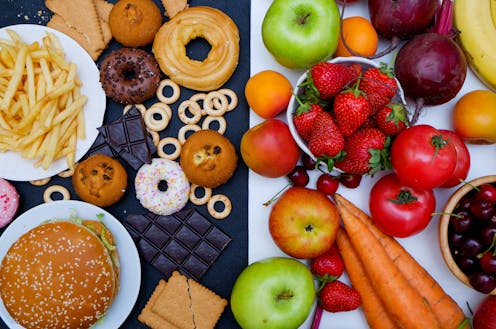
They typically contain cosmetic additives and little or no whole foods. You can think of them as foods you would struggle to create in your own kitchen. Examples include confectionery, soft drinks, chips, pre-prepared meals and restaurant fast-food products.
In contrast with this are “traditional” foods – such as fruits, vegetables, wholegrains, preserved legumes, dairy and meat products – which are minimally processed, or made using traditional processing methods.
While traditional processing, methods such as fermentation, canning and bottling are key to ensuring food safety and global food security[14]. Ultra-processed foods, however, are processed beyond what is necessary for food safety.
Australians have particularly high rates of ultra-processed food consumption. These foods account for 39% of total energy intake among Australian adults[15]. This is more than Belgium, Brazil, Columbia, Indonesia, Italy, Malaysia, Mexico and Spain[16] – but less than the United States[17], where they account for 57.9% of adults’ dietary energy.
According to an analysis of the 2011-12 Australian Health Survey[18] (the most recent national data available on this), the ultra-processed foods that contributed the most dietary energy for Australians aged two and above included ready-made meals, fast food, pastries, buns and cakes, breakfast cereals, fruit drinks, iced tea and confectionery.
Read more: The rise of ultra-processed foods and why they're really bad for our health[19]
What are the environmental impacts?
Ultra-processed foods also rely on a small number of crop species, which places burden on the environments in which these ingredients are grown.
Maize, wheat, soy and oil seed crops (such as palm oil) are good examples. These crops are chosen by food manufacturers because they are cheap to produce and high yielding, meaning they can be produced in large volumes.
Also, animal-derived ingredients in ultra-processed foods are sourced from animals which rely on these same crops as feed[20].
The rise of convenient and cheap ultra-processed foods has replaced a wide variety of minimally-processed wholefoods including fruits, vegetables, grains, legumes, meat and dairy. This has reduced both the quality of our diet and food supply diversity.
In Australia, the most frequently used ingredients in the 2019 packaged food and drink supply[21] were sugar (40.7%), wheat flour (15.6%), vegetable oil (12.8%) and milk (11.0%).
Some ingredients used in ultra-processed foods such as cocoa, sugar and some vegetable oils are also strongly associated with biodiversity loss[22].
Read more: It takes 21 litres of water to produce a small chocolate bar. How water-wise is your diet?[23]
What can be done?
The environmental impact of ultra-processed foods is avoidable. Not only are these foods harmful, they are also unnecessary for human nutrition. Diets high in ultra-processed foods are linked with poor health outcomes[24], including heart disease, type-2 diabetes, irritable bowel syndrome, cancer and depression, among others.
To counter this, food production resources across the world could be re-routed into producing healthier, less processed foods[25]. For example, globally, significant quantities of cereals such as wheat, maize and rice are milled into refined flours to produce refined breads, cakes, donuts and other bakery products.
These could be rerouted into producing more nutritious foods such as wholemeal bread or pasta. This would contribute to improving global food security and also provide more buffer against natural disasters[26] and conflicts in major breadbasket areas[27].
Other environmental resources could be saved by avoiding the use of certain ingredients altogether. For instance, demand for palm oil (a common ingredient in ultra-processed foods, and associated with deforestation in Southeast Asia) could be significantly reduced through consumers shifting their preferences towards healthier foods.
Reducing your consumption of ultra-processed foods is one way by which you can reduce your environmental footprint, while also improving your health.
Read more: We each get 7 square metres of cropland per day. Too much booze and pizza makes us exceed it[28]
References
- ^ more than 7,000 edible plant species (www.kew.org)
- ^ from 15 crop species (www.fao.org)
- ^ notes (doi.org)
- ^ greenhouse gas emissions (www.researchgate.net)
- ^ freshwater use (www.iwmi.cgiar.org)
- ^ uses 38% of global land (www.wfp.org)
- ^ biodiversity loss (www.chathamhouse.org)
- ^ excessive calories (pubmed.ncbi.nlm.nih.gov)
- ^ livestock products (www.researchgate.net)
- ^ ultra-processed foods (theconversation.com)
- ^ dominant component of the food supply (www.researchgate.net)
- ^ Ultra-processed foods (theconversation.com)
- ^ defined as (pubmed.ncbi.nlm.nih.gov)
- ^ food safety and global food security (www.fao.org)
- ^ 39% of total energy intake among Australian adults (www.nature.com)
- ^ Belgium, Brazil, Columbia, Indonesia, Italy, Malaysia, Mexico and Spain (pubmed.ncbi.nlm.nih.gov)
- ^ the United States (www.sciencedirect.com)
- ^ an analysis of the 2011-12 Australian Health Survey (www.researchgate.net)
- ^ The rise of ultra-processed foods and why they're really bad for our health (theconversation.com)
- ^ these same crops as feed (www.researchgate.net)
- ^ 2019 packaged food and drink supply (www.researchgate.net)
- ^ strongly associated with biodiversity loss (www.mdpi.com)
- ^ It takes 21 litres of water to produce a small chocolate bar. How water-wise is your diet? (theconversation.com)
- ^ linked with poor health outcomes (www.researchgate.net)
- ^ processed foods (theconversation.com)
- ^ natural disasters (theconversation.com)
- ^ conflicts in major breadbasket areas (theconversation.com)
- ^ We each get 7 square metres of cropland per day. Too much booze and pizza makes us exceed it (theconversation.com)
Read more https://theconversation.com/ultra-processed-foods-are-trashing-our-health-and-the-planet-180115