Flexibility makes us happier, with 3 clear trends emerging in post-pandemic hybrid work
- Written by: John L Hopkins, Associate professor, Swinburne University of Technology
The first national study of working arrangements in Australia since government work-from-home directions were lifted shows post-pandemic office life is going to be dramatically different to what existed before.
Our survey of 1,421 knowledge workers – essentially anyone doing computer-based work able to be done remotely at least some of the time – was conducted in the week of 21-25 March 2022.
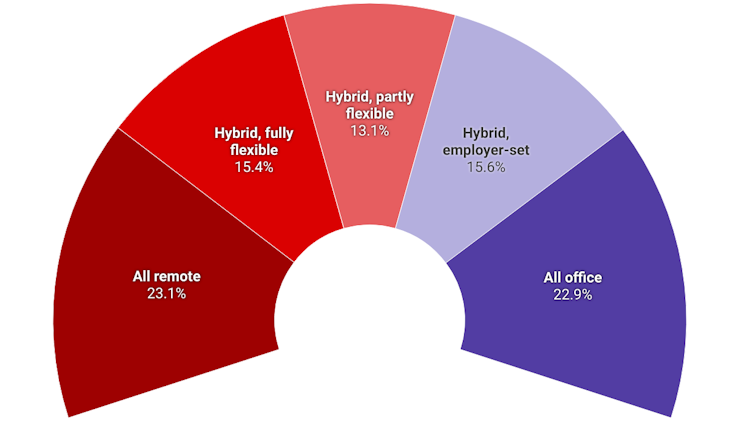
It shows fewer than a quarter of workers (about 23%) returning to commuting five days a week, with about the same percentage working remotely full-time.
About 44% were doing “hybrid work”, splitting their week between days in the office and working remotely. These workers were split fairly evenly between three emerging models of hybrid work.
Who we asked, and what we found
Our survey asked participants a total of 46 questions, covering their current work arrangements, ideal work arrangements, health and well-being, workplace culture, skills changes and communication technologies, along with demographic information (age, sex, income etc).
The survey sample was nationally representative of state and age populations, though slightly skewed towards male participants (58% male vs 42% female).
The following chart shows working arrangements at the time of the survey.
Back to the office?
Working arrangements for knowledge workers March 21-25 2022
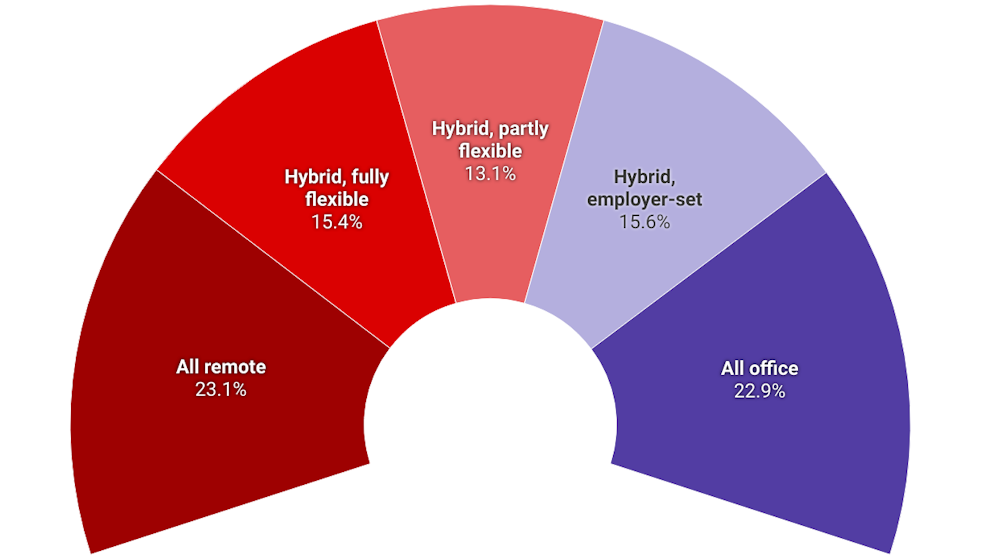
The “other” category includes hybrid variations such as a mixing fixed and flexible days (for example, having one fixed day in the office and two days of the worker’s choice) as well as unspecified arrangements.
Including this category, our results show a majority (54%) following a hybrid work model, with 23% still working remotely full-time and 22.9% back in the office full-time.
By comparison, just 28% of Australian knowledge workers[2] had the chance to work remotely for any part of the week prior to the pandemic.
3 main types of home and office arrangements
Our main motivation for this study was to better understand how new work arrangements are being designed and implemented in what the Productivity Commission has described as the second wave of work experimentation[3] – following the first wave of working from home enforced by COVID-19.
Our survey shows no clear “winner” between the three broad approaches to hybrid work:
-
Days in office fixed, with workers expected to attend the office for a specific number of set days (e.g. Tuesdays, Wednesdays and Thursdays). This applied to 29% of hybrid workers (and 15.6% of all respondents).
-
Fixed office frequency, but workers have the flexibility to choose which days (i.e. any three days a week). This applied to 24.3% of hybrid workers (and 13.1% of all respondents).
-
Flexibility to choose where they work and when. This was the case for 28.5% of hybrid workers (and 15.4% of all survey respondents).
Happier with autonomy
From the individual perspective, our survey strongly indicates those with the greatest flexibility were happiest.
We asked participants to indicate how happy they are with their current work arrangements on a five-point scale from “very unhappy” to “very happy”.
About 94% of those with the greatest flexibility said they were happy or very happy with this arrangement. This compares with 88.5% of those working remotely full-time, and 70.6% for those going into the office full-time.
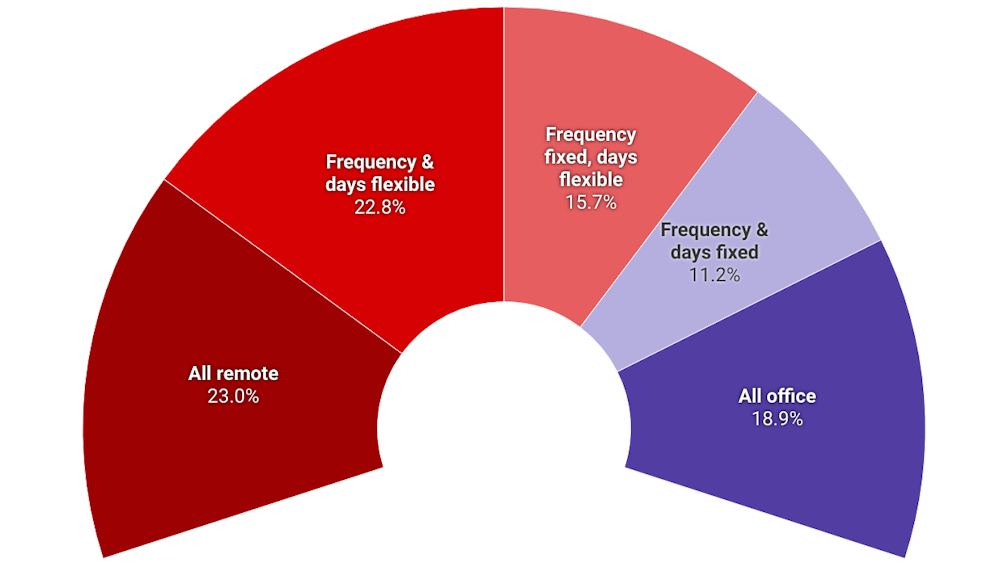
When asked to choose their ideal work arrangements, the most popular choices were having control over the location where they work and when (23.0%), followed by working remotely full-time (22.8%).
Ideal working arrangements
 Survey of 1,421 Australian knowledge workers. Other = 8.4% John Hopkins, Anne Bardoel[4]
Better health and well-being
In good news for employee health, one third (30.2%) of workers said they now have a better work-life balance than they did two years ago, compared with less than one in ten (8.7%) who think it has worsened.
Over a quarter (27.4%) said the key benefit from having a better work-life balance was having more time to invest in their health and wellness.
As the Productivity Commission has noted, while the first wave of forced experiment broke down resistance towards flexible work practices, this wave of voluntary experimentation involves “negotiating, trialling and adjusting” to see what best works for individuals and organisations.
Read more: Even Google agrees there's no going back to the old office life[5]
It is still very early days in the evolution of hybrid work, and organisations will no doubt have to experiment and test out a number of different arrangements before they find the ones that produce the best long-term results for them and their employees.
References
- ^ John Hopkins, Anne Bardoel (www.fwc.gov.au)
- ^ just 28% of Australian knowledge workers (www.fwc.gov.au)
- ^ second wave of work experimentation (www.pc.gov.au)
- ^ John Hopkins, Anne Bardoel (www.fwc.gov.au)
- ^ Even Google agrees there's no going back to the old office life (theconversation.com)