With COVID cases still in the thousands, why are some so keen to ditch the things that kept New Zealand safe?
- Written by: Dougal Sutherland, Clinical Psychologist, Te Herenga Waka — Victoria University of Wellington
Prime Minister Jacinda Ardern has announced New Zealand will remain at the red traffic light setting, but other public health mandates[1] created to control COVID-19 will still be lifted, contributing to the sense that there’s light at the end of the tunnel after two years.
But many New Zealanders are already going further and dropping some of the measures that have kept the country safe.
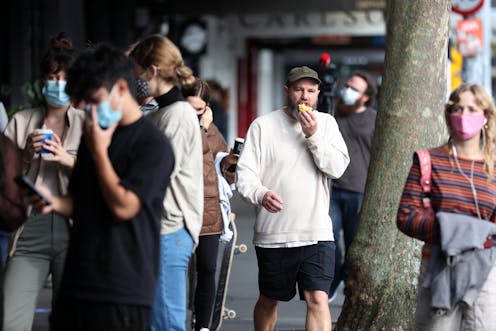
Anecdotally, an increasing number of people are not wearing masks or keeping their distance from strangers, and large gatherings are becoming more common.
So what is driving this push back to “normal” despite the rising death toll and high infection rate? There are a number of psychological factors that help explain this change in our collective behaviour.
Optimism and sense of threat
“It won’t happen to me” and “it’s only a mild flu” are two statements that have been bandied about, especially in the face of Omicron[2].
The first of these implies an optimism bias – the belief that bad things won’t happen to you[3].
While there are some obvious benefits to thinking this way – optimistic people tend to have a more positive mood – it may also lead you to dispense with health-related behaviours such as a wearing masks.
The view that Omicron is only a “mild flu” also suggests that for some, their sense of threat from COVID-19 has reduced and, as their feeling of threat reduces, so too does their use of protective measures against contracting the illness.
This optimism bias and a sense of reduced threat may also be complemented by competing values within different groups.
Read more: Should public health measures like masking continue beyond the pandemic? Data on viral infections shows their benefits[5]
Young adults typically place a high value on socialising, so combining this with a belief you won’t get sick, or at least not much, could easily lead to a disregard of physical distancing measures as we’ve seen recently at Canterbury and Otago universities[6].
Furthermore, research published in 2020 indicated younger people tended not to wash their hands[7] as much as older people, possibly because they perceive themselves as less at risk. If their perception of risk drops even further, so too could this behaviour.
Social modelling and misinformation
What we see around us is also influencing our own behaviour.
A basic tenet of social psychology is that we model our behaviours on the basis of what we see around us[8]. This social modelling theory helps explain why we’re less likely to scan in or show a vaccine pass if those around us aren’t doing it.
The recent anti-mandate protests at parliament may have emboldened some, who were perhaps ambivalent anyway, to ditch mask wearing after witnessing large groups of people doing the same.
The anti-mandate protests also highlighted the role of misinformation in shaping people’s health related behaviours.
Early studies of COVID-19 combined with previous research about other pandemics has shown that when people are given accurate information about a public health problem they are more likely to engage in health-related behaviours such as hand-washing and mask-wearing[9].
Conversely, inaccurate information about an illness (that it’s not severe, for example) reduces people’s engagement in behaviours that may reduce its spread.
COVID fatigue and looking forward to the future
The past two years under the grip of COVID-19 have undoubtedly been exhausting for most. There have been widespread reports of the general public being more tired and irritable[10] during this time.
Understandably, people’s anger and irritation has, at times, been directed at the government’s response — for example, questioning the need for repeated lockdowns. This can gradually erode trust in the government and, in turn, increase scepticism of public health messages, with a resulting reduction in compliance with those messages[11].
As we appear to be approaching the end of the Omicron wave and potentially the worst of COVID-19, many may begin to feel more positive about the future.
People’s emotional state is a key driver of their perception of risk, perhaps more so than hard data about COVID-19[13]. Our mood helps steer where we pay attention, so feeling more positive about the future may lead us to pay more attention to stories and information that emphasise the importance of getting back our normal lives and all the joy they used to bring.
Flooding ourselves with this type of information can then translate into acting like we used to – for example, socialising with others unfettered by masks or hand-washing.
How do we go the distance?
But we’re not out of the COVID woods yet and New Zealanders need to keep doing things that will reduce the transmission of the virus.
Looking back over the past two years, New Zealanders have generally been hihgly engaged in behaviours designed to protect their collective health. But as our compliance wanes a little, a few subtle nudges may help us get to the finish line in good health.
Read more: Could Britain be sued for reopening and putting the world at risk from new COVID variants?[14]
Firstly, when people have a strong negative reaction to germs they are more likely to wear a mask[15]. Having illustrations of how COVID is spread – for example, a graphic illustration of someone sneezing and the spread of droplets – may help gross people out enough to put on a mask.
If we’re more likely to do things we think other people are doing, then providing accurate information about high levels of vaccine uptake and mask wearing may provide a model for us to do the same.
Finally, recognising and catering for different values, like having controlled social events for university students, may help meet the needs of different groups without them having to compromise their health behaviours.
It has been a long two years for everyone, but understanding what is driving some to abandon public health measures despite the continued spread of the virus could help improve measures and encourage the “team of five million” to hold the line.
References
- ^ public health mandates (www.newshub.co.nz)
- ^ face of Omicron (www.rnz.co.nz)
- ^ won’t happen to you (www.nature.com)
- ^ Kai Schwoerer/Getty Images (www.gettyimages.com.au)
- ^ Should public health measures like masking continue beyond the pandemic? Data on viral infections shows their benefits (theconversation.com)
- ^ Canterbury and Otago universities (www.newshub.co.nz)
- ^ wash their hands (jamanetwork.com)
- ^ see around us (www.simplypsychology.org)
- ^ hand-washing and mask-wearing (www.nature.com)
- ^ more tired and irritable (www.rnz.co.nz)
- ^ those messages (www.sciencedirect.com)
- ^ Adam Bradley/Getty Images (www.gettyimages.com.au)
- ^ data about COVID-19 (www.nature.com)
- ^ Could Britain be sued for reopening and putting the world at risk from new COVID variants? (theconversation.com)
- ^ to wear a mask (journals.plos.org)