Google AI
The Times Australia
The Times World News

.

What would it take to get Australians to buy electric cars? Canberra provides a guide

  • Written by Yogi Vidyattama, Associate Professor, National Centre for Social and Economic Modelling, University of Canberra
What would it take to get Australians to buy electric cars? Canberra provides a guide

Only 5,532[1] of the 101,233 new cars sold in Australia last month were all-electric.

While that number is an improvement on previous months, it is tiny[2] compared to the 25% to 85% of new cars sold that are all-electric in European nations such as Germany, the Netherlands, Denmark and Norway.

A lot has been written about why that is[3], but less about what an individual state or territory can do to improve it, in the absence of help from the federal government.

Our team at the National Centre for Social and Economic Modelling, University of Canberra[4] has examined what the Australian Capital Territory[5] (ACT) is doing, and what effect this is having on electric vehicle take-up by price and type of household.

The ACT offers three incentives[6]

  • a full exemption from stamp duty on purchase

  • two years free registration

  • a zero-interest loan of up to A$15,000 for eligible households[7]

We used Australian Bureau of Statistics census and household expenditure data as well as microsimulations based on a survey of vehicle preferences to examine behaviour before and after the changes.

We simulated the decision to buy electric based on a total cost of ownership, which included the value of the vehicle as well as operational costs including petrol, service and repair.

Incentives matter

Our modelling found that with a stamp duty exemption, at an electric vehicle price of A$50,000, around 9%[8] of new vehicles sold would be electric in five years.

The proportion climbs to 11% with zero-interest loan and free registration added.

But even after five years, the proportion of total cars on ACT roads that were electric would be small: just 1.6% with just the stamp duty exemption, and 2.0% with the other measures as well.

This result is much higher than the latest-known proportion of electric vehicles in the ACT, which in 2019 was 0.1%. Nationally, only 23,000[9] (0.011%) of the 20.1 million vehicles registered are electric.

Prices matter

At a much-lower electric vehicle price of $25,000, an extraordinary 23%[10] of new vehicles sold after five years would be electric, provided they were stamp duty exempt.

If there was also a zero-interest loan of $15,000, the proportion would increase to 27%, and with two years free registration as well, to $30%.

As a proportion of the entire car fleet in the ACT, the figures would be 4.1%, 4.8% and 5.3% respectively, depending on those price, loan and registration factors. That would mean much larger demand than at present, but still small enough to mean the infrastructure for maintaining conventional vehicles would be needed for some time.

Income matters

We found that high income households are far more likely to replace their cars within five years and far more likely to switch electric even without incentives – and that for them, the incentives didn’t make much difference.
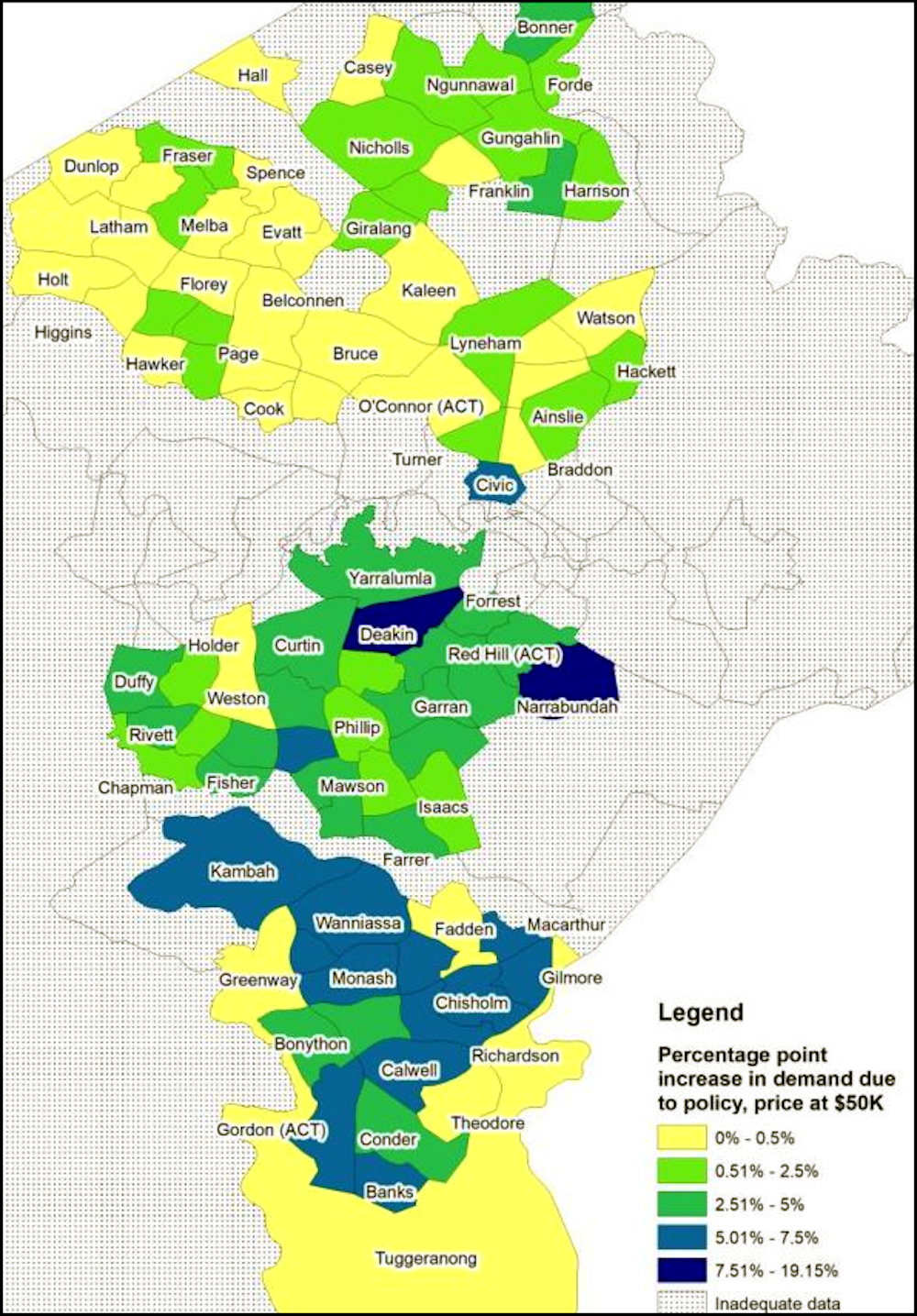
NATSEM, Impact simulation of ACT EV policy[11] The incentives had their biggest impact, not among the highest earning three-fifths of households, or among the bottom fifth, but in the second-bottom fifth. For that group, the interest-free loan was found to be more important than the free registration, whereas for higher income households it was the other way around. In terms of geography, the highest take up is set to be in Canberra’s inner north and south where incomes are high. Nevertheless, our modelling also suggests a high take up in the south of Canberra. Petrol matters And the take-up rate depends on the price of petrol. The price used in our modelling was the 2018-19 price of around $1.45 per litre for unleaded and diesel. Our modelling suggests that the recent increase in price to around $2 a litre would lift the purchase of electric vehicles by 0.5 percentage points, while an increase to $3 would increase take-up by around 2.5 percentage points. Different states are experimenting with different incentives. Victoria, NSW and Queensland are offering $3,000 rebates[12] on the purchase price, along with a registration discounts in Victoria offset by a road user charge. Read more: The embarrassingly easy, tax-free way for Australia to cut the cost of electric cars[13] What applies to the ACT might not apply elsewhere, especially as average incomes in Canberra are higher than in other cities. But our modelling provides a guide as to how incentive-based policies can work. Policies that increase the electric vehicle take-up in lower income households are likely to have the greatest effect, and also likely to benefit these households by freeing them from the need to pay for fuel. References^ 5,532 (www.carexpert.com.au)^ tiny (en.wikipedia.org)^ why that is (theconversation.com)^ National Centre for Social and Economic Modelling, University of Canberra (www.governanceinstitute.edu.au)^ Australian Capital Territory (www.environment.act.gov.au)^ three incentives (www.environment.act.gov.au)^ eligible households (www.climatechoices.act.gov.au)^ 9% (cdn.theconversation.com)^ 23,000 (www.abs.gov.au)^ 23% (cdn.theconversation.com)^ NATSEM, Impact simulation of ACT EV policy (cdn.theconversation.com)^ rebates (evcentral.com.au)^ The embarrassingly easy, tax-free way for Australia to cut the cost of electric cars (theconversation.com)

Read more https://theconversation.com/what-would-it-take-to-get-australians-to-buy-electric-cars-canberra-provides-a-guide-178778

Times Magazine

TRUCKIES UNDER THE PUMP AS FUEL PRICES BECOME TWO THIRDS OF OPERATING COSTS FOR SOME BUSINESS OWNERS

As Australia’s fuel crisis continues, truck drivers across the nation are being hit hard despite t...

iPhone: What are the latest features in iOS 26.5 Beta 1?

Apple has quietly released the first developer beta of iOS 26.5, and while it may not be the hea...

The Voltx Topband V1200 Portable Power Station Review

When we received a Voltx Topband V1200 portable power station for review, a staff member at The Time...

Is E10 fuel bad for my car? And could it save me money?

Fuel has become a precious, and increasingly expensive, commodity. The ongoing Middle East co...

Efficient Water Carts for Dust Control

Managing dust effectively is a critical challenge across numerous industries in Australia. From sp...

How new rules could stop AI scrapers destroying the internet

Australians are among the most anxious in the world[1] about artificial intelligence (AI). This...

The Times Features

THE MTick® ARRIVES IN AUSTRALIA

GenM – The Menopause Partner for Brands and Home of the MTick®, - has brought its life  changing, ...

Brisbane celebrates 25 years of Roma Street Parkland

One of Brisbane’s gardening jewels will mark its 25th anniversary on April 6, commemorating the ...

You’re hungry. There’s a McDonald’s ahead. Should you g…

What are the unhealthy options? It’s a familiar moment. You’re driving, working late, travelli...

Hearing Australia first in the world to provide innovat…

Australians with hearing loss will benefit from a new generation hearing aid fitting prescription...

Running Run Army this month? Here's how to prep for rac…

With Run Army Brisbane this Sunday and Townsville to follow on 19 April, GO2 Health’s Kate Boucher...

As the Iran war disrupts supplies, will it affect acces…

As the conflict in the Middle East disrupts fuel, shipping and food supplies, many are starting ...

Finding the Right Disability Housing in Perth: A Practi…

Where you live shapes everything. It shapes the relationships you build, the community you belong ...

Housing construction costs are already rising, increasi…

For Australia’s building industry, higher fuel costs since the start of the Middle East war have...

Shou Sugi Ban: The Ancient Japanese Timber Technique Tr…

There is something quietly extraordinary about a building material that has been refined over cent...