Google AI
The Times Australia
The Times World News

.

The top 3 skills needed to do a PhD are skills employers want too

  • Written by Lilia Mantai, Senior Lecturer and Academic Lead, University of Sydney
The top 3 skills needed to do a PhD are skills employers want too

More and more people are applying to do a PhD. What many don’t know is it takes serious skills to do one – and, more importantly, complete it.

We analysed the selection criteria for PhD candidates on a platform that advertises PhD programs. Our analysis[1] of thousands of these ads revealed exactly what types of skills different countries and disciplines require.

Why do a PhD in the first place?

People pursue a PhD[2] for many reasons. They might want to stand out from the crowd in the job market, learn how to do research, gain a deeper expertise in an area of interest, or pursue an academic career.

Sadly, too many PhD students never finish. The PhD turns out to be too hard, not well supported, mentally taxing, financially draining, etc. Dropping the PhD often means significant financial loss[3] for institutions and individuals, not to mention the psychological costs of other consequences such as low self-esteem, anxiety and loneliness[4].

Read more: 1 in 5 PhD students could drop out. Here are some tips for how to keep going[5]

Our society and economy can only benefit from a better-educated workforce, so it is in the national interest to manage PhD intakes and be clear about expectations. The expansion of doctoral education[6] led to a more competitive selection process, but the criteria are opaque.

To clarify PhD expectations, we turned to a European research job platform[7] supported by EURAXESS (a pan-European initiative by the European Commission) where PhD programs are advertised as jobs. Required skills are listed in the selection criteria. We analysed 13,562 PhD ads[8] for the types of skills different countries and disciplines require.

We made three specific findings.

1. Top 3 skills needed for a PhD

It turns out that it takes many so-called transferable skills to do a PhD. These are skills that can be translated and applied to any professional context. The top three required skills are:

  • communication – academic writing, presentation skills, speaking to policy and non-expert audiences

  • research – disciplinary expertise, data analysis, project management

  • interpersonal – leadership, networking, teamwork, conflict resolution.

Trending skill categories are digital (information processing and visualisation) and cognitive (abstract, critical and creative thinking and problem-solving).
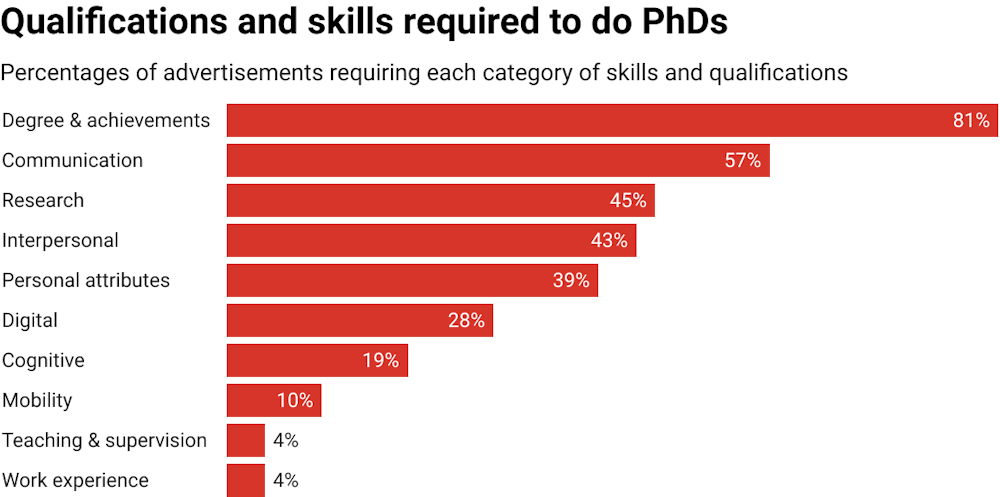
Bar chart showing percentages of each category of skills/qualifications required by PhD ads
Chart: The Conversation. Data: Mantai & Marrone, 2022, Author provided Previous research[9] shows transferable skills are requested for post-PhD careers, including both academic and non-academic jobs. Our research shows such skills are already required to do a PhD. Those keen to do a PhD are well advised to provide strong evidence of such skills when applying. 2. Skill demands vary by country and discipline Skill demands significantly differ by country and discipline. For example, 62% of medical science ads mention interpersonal skills. This is twice as often as in biological science ads. Digital and cognitive skills score much higher in the Netherlands than in other countries. Our research article[10] reports on 2016-2019 data and the top five represented countries (Netherlands, Germany, France, Spain and the UK) and the top five represented disciplines (biological sciences, physics, chemistry, engineering and medical sciences). However, you can use this tool for granular detail[11] on 52 countries – including non-European countries like Australia, New Zealand, the US, etc. – and 37 disciplines included in the data sample. For continuously updated data, please visit https://www.resgap.com/[12]. 3. PhD expectations are rising We see a rise in PhD expectations over time (2016-2019) as more skills are listed year on year. The publish or perish culture[13] prevails and rising demands on academics have led to calls for more engaged research, collaborations with industry, and research commercialisation[14]. PhD students get accustomed early to competitiveness and high expectations. Read more: Is it a good time to be getting a PhD? We asked those who've done it[15] Research-based learning needs to start early These insights have implications for pre-PhD education and pathways. Undergraduate and postgraduate degrees can further promote PhD readiness by embedding authentic hands-on research with academic or corporate partners, either as part of the curriculum or as extracurricular activities. Many postgraduate degrees offer authentic research project work opportunities but are shorter. Those entering the PhD without a postgraduate degree miss out on developing essential research skills. Authentic research experiences need to happen early on in higher education. Organisations like the Council on Undergraduate Research (CUR[16]), the Australasian Council for Undergraduate Research (ACUR[17]) and the British Conference of Undergraduate Research (BCUR[18]) are designed to support institutions and individuals to do this effectively. They showcase great models of undergraduate research. To get a good idea of what undergraduate research looks like, start with this comprehensive paper [19] and catch up on undergraduate research news from Australasia[20]. We know research-based learning develops employability skills[21] such as critical thinking, resilience and independence. Embed career development in PhD programs Doctoral training needs to take note, too, if it is to further build on the skill set that PhD applicants bring with them. The good news is doctoral education has transformed in recent decades. It’s catching up to the call for better-skilled graduates for a range of careers. The training focus has shifted towards generating practice-based and problem-solving knowledge, and engaged research[22] with other sectors. Read more: It's time to reduce the number of PhD students, or rethink how doctoral programs work[23] Some institutions now offer skill and career training. Generally, though, this sort of training is left to the graduates themselves. Many current PhD candidates will attest that the highly regulated and tight PhD schedule leaves little room for voluntary activities to make them more employable. Most PhD candidates also know more than half of them will not score a long-term academic job. Institutions would serve them better by formally embedding tailored career development opportunities in PhD programs that prepare for academic and non-academic jobs[24]. It’s not only PhD graduates’ professional and personal well-being that will benefit but also the national economy. References^ analysis (datastudio.google.com)^ People pursue a PhD (theconversation.com)^ significant financial loss (theconversation.com)^ low self-esteem, anxiety and loneliness (theconversation.com)^ 1 in 5 PhD students could drop out. Here are some tips for how to keep going (theconversation.com)^ expansion of doctoral education (theconversation.com)^ European research job platform (euraxess.ec.europa.eu)^ analysed 13,562 PhD ads (www.tandfonline.com)^ Previous research (openresearch-repository.anu.edu.au)^ research article (www.tandfonline.com)^ use this tool for granular detail (datastudio.google.com)^ https://www.resgap.com/ (www.resgap.com)^ publish or perish culture (theconversation.com)^ commercialisation (theconversation.com)^ Is it a good time to be getting a PhD? We asked those who've done it (theconversation.com)^ CUR (www.cur.org)^ ACUR (www.acur.org.au)^ BCUR (bcur.org.uk)^ this comprehensive paper (philpapers.org)^ undergraduate research news from Australasia (www.acur.org.au)^ research-based learning develops employability skills (www.researchgate.net)^ engaged research (theconversation.com)^ It's time to reduce the number of PhD students, or rethink how doctoral programs work (theconversation.com)^ prepare for academic and non-academic jobs (theconversation.com)

Read more https://theconversation.com/the-top-3-skills-needed-to-do-a-phd-are-skills-employers-want-too-175923


Times Magazine

Growing EV popularity is leading to queues at fast chargers. Could a kerbside charger network help?

The war on Iran has made crystal clear how shaky our reliance on fossil fuels is. It’s no surpri...

TRUCKIES UNDER THE PUMP AS FUEL PRICES BECOME TWO THIRDS OF OPERATING COSTS FOR SOME BUSINESS OWNERS

As Australia’s fuel crisis continues, truck drivers across the nation are being hit hard despite t...

iPhone: What are the latest features in iOS 26.5 Beta 1?

Apple has quietly released the first developer beta of iOS 26.5, and while it may not be the hea...

The Voltx Topband V1200 Portable Power Station Review

When we received a Voltx Topband V1200 portable power station for review, a staff member at The Time...

Is E10 fuel bad for my car? And could it save me money?

Fuel has become a precious, and increasingly expensive, commodity. The ongoing Middle East co...

Efficient Water Carts for Dust Control

Managing dust effectively is a critical challenge across numerous industries in Australia. From sp...

The Times Features

THE MTick® ARRIVES IN AUSTRALIA

GenM – The Menopause Partner for Brands and Home of the MTick®, - has brought its life  changing, ...

Brisbane celebrates 25 years of Roma Street Parkland

One of Brisbane’s gardening jewels will mark its 25th anniversary on April 6, commemorating the ...

You’re hungry. There’s a McDonald’s ahead. Should you g…

What are the unhealthy options? It’s a familiar moment. You’re driving, working late, travelli...

Hearing Australia first in the world to provide innovat…

Australians with hearing loss will benefit from a new generation hearing aid fitting prescription...

Running Run Army this month? Here's how to prep for rac…

With Run Army Brisbane this Sunday and Townsville to follow on 19 April, GO2 Health’s Kate Boucher...

As the Iran war disrupts supplies, will it affect acces…

As the conflict in the Middle East disrupts fuel, shipping and food supplies, many are starting ...

Finding the Right Disability Housing in Perth: A Practi…

Where you live shapes everything. It shapes the relationships you build, the community you belong ...

Housing construction costs are already rising, increasi…

For Australia’s building industry, higher fuel costs since the start of the Middle East war have...

Shou Sugi Ban: The Ancient Japanese Timber Technique Tr…

There is something quietly extraordinary about a building material that has been refined over cent...