The Zealandia Switch drove rapid global ice retreat 18,000 years ago. Has it switched to a new level?
- Written by: Andrew Lorrey, Principal Scientist & Programme Leader of Southern Hemisphere Climates and Environments, National Institute of Water and Atmospheric Research
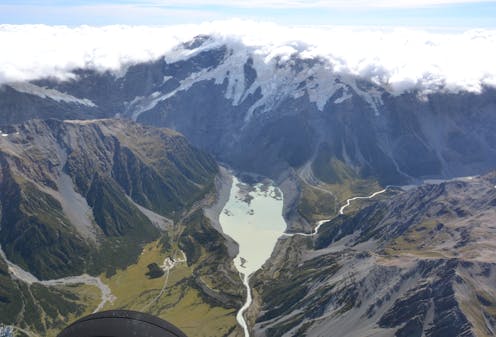
Earlier this month, we wrapped up the latest annual end-of-summer snowline survey over New Zealand’s South Island (Te Waipounamu), providing a birdseye view of how glaciers fared during the past year.
This collection of aerial photos adds to a near half-century perspective of irrefutable and dramatic climate change impacts[1] on New Zealand’s frozen landscapes.
To put it bluntly, New Zealand’s glaciers look emaciated. Another Tasman Sea marine heat wave punctuated the hottest year on record nationally[2] at the close of 2021, bathing the Southern Alps in warmth. That pattern continued into the Southern Hemisphere summer of 2022.
As New Zealand’s glaciers continue to feel the heat and shrink, bedrock that has not seen daylight for ages becomes exposed. Basins filled with meltwater[3] begin to multiply across the landscape. In many cases, a ring of dirt and rock around some of New Zealand’s largest lakes marks where ice once reached.
Our current research is exploring these exposed rocky ridges to retrace New Zealand’s climate history.
Scientists are building a picture of how and when glaciers retreated over millennia. @bexparsonsking @niwa_NZ.Fingerprints of change in the landscape
The ridge-like mounds of rocks retreating glaciers leave behind are called moraines[4]. Directly in front of some of the largest Southern Alps glaciers, fresh moraines circumscribe turquoise-tinted lakes, with ice calving into them. This scene doesn’t leave room for denial of the rapid retreat of ice from the alpine landscape.

Downstream, more extensive moraines are wrapped like ribbons around massive lake basins that lie along the edge of the Southern Alps. Some of these landforms stretch for miles, and they illustrate ice was much more extensive in the past.
We know the processes that formed those moraines must have been similar to what we observe today. But how old are they? What happened to the massive ice that was once there, and why did it retreat?
Read more: How climate change made the melting of New Zealand's glaciers 10 times more likely[6]
A new mechanism that explains a rapid shift at the end of the last ice age – called the Zealandia Switch – is founded on New Zealand moraine evidence. This new hypothesis is challenging a long-held view about why glaciers changed in the recent and distant past.
While the Zealandia Switch focuses on global ice retreat for prehistoric times, we think it may also explain what is happening right now with our glaciers.
 Left: The map shows the Lake Ohau and Lake Pukaki moraines, with their ages expressed in thousands of years before present. Right: Lake Pukaki (A) and Lake Ohau (B) moraines indicate ice rapidly retreated 18,000 years ago.
Map: David Barrell, GNS Science; Photos: Aaron Putnam & George Denton, University of Maine, CC BY-SA[7]
Left: The map shows the Lake Ohau and Lake Pukaki moraines, with their ages expressed in thousands of years before present. Right: Lake Pukaki (A) and Lake Ohau (B) moraines indicate ice rapidly retreated 18,000 years ago.
Map: David Barrell, GNS Science; Photos: Aaron Putnam & George Denton, University of Maine, CC BY-SA[7]
Clues from a nearly sunken continent
Glacial geologists use rare chemical isotopes[8] trapped in rocks to trace the history of Earth’s surface with a technique called cosmogenic surface exposure dating.
This method measures how long rocks found on the surface today have been exposed to cosmic rays[9]. Boulders that have been carried inside flowing ice have zero exposure history.
When they are dropped onto a moraine and exposed to cosmic rays from outer space, their “cosmic clock” starts and the rare isotopes begin to accumulate inside minerals in the rock.
Once exposure dates for moraine boulders are established, they are linked to detailed maps that outline ice advance and retreat sequences. The major moraines around central Southern Alps lakes – Pukaki, Tekapo and Ōhau – now have hundreds of results showing rapid change happened about 18,000 years ago[10].
Read more: Climate explained: what is an ice age and how often do they happen?[11]
Offshore in the Tasman Sea, microfossils from sediment cores indicate ocean currents and boundaries shifted at exactly the same time[12]. Climate modelling can explain the simultaneous land and sea changes through a major switch of Southern Hemisphere westerly winds over the nearly-submerged Zealandia continent[13] – hence the Zealandia Switch hypothesis.
When the Zealandia Switch turns on and spins up the southern westerlies, it helps to promote water vapour export from the tropics and atmospheric circulation patterns that drive warming in both hemispheres. If the Zealandia Switch hypothesis is upheld, then the story about Quaternary ice age origins and their impacts on global climate, plant ecosystems and ancient fauna will need to be rewritten.
The Zealandia Switch and ice loss
Fast forward 18,000 years and the southern winds of change are on the move again. Subtropical waters are being pumped into the Tasman Sea, driving more frequent marine heatwaves[14]. New Zealand’s temperatures are soaring.
Atmospheric rivers loaded with tropical moisture are penetrating Antarctic latitudes and bringing record temperatures with them[15]. The current situation has hallmarks of the Zealandia Switch playing an enhanced role – but this time, Earth is in an interglacial rather than an ice age state.
The latest Southern Alps glacier research shows austral warm season temperatures and a rising snowline trend are tightly coupled[16]. The rising snowline trend is also accelerating at an alarming pace.
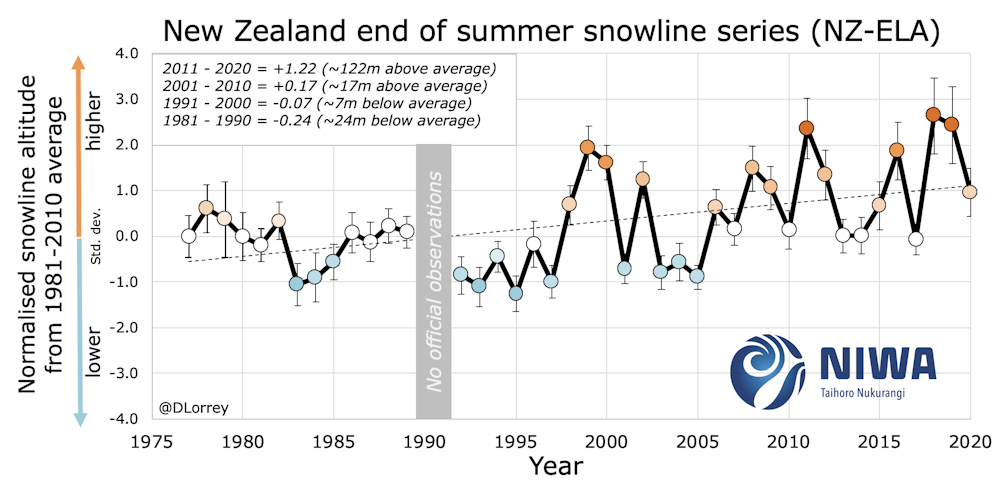 New Zealand’s summer snowline (also known as the New Zealand Equilibrium Line Altitude) has continued to rise in recent years. It is expected to be at least 200m above the 1981-2010 average elevation by next decade.
Andrew Lorrey, CC BY-SA[17]
New Zealand’s summer snowline (also known as the New Zealand Equilibrium Line Altitude) has continued to rise in recent years. It is expected to be at least 200m above the 1981-2010 average elevation by next decade.
Andrew Lorrey, CC BY-SA[17]
A series of extremely hot years with exceptionally high snowlines that are driving this pattern have been linked to anthropogenic greenhouse gas emissions[18]. Similar conclusions have been drawn for the recent acceleration of global ice loss[19].
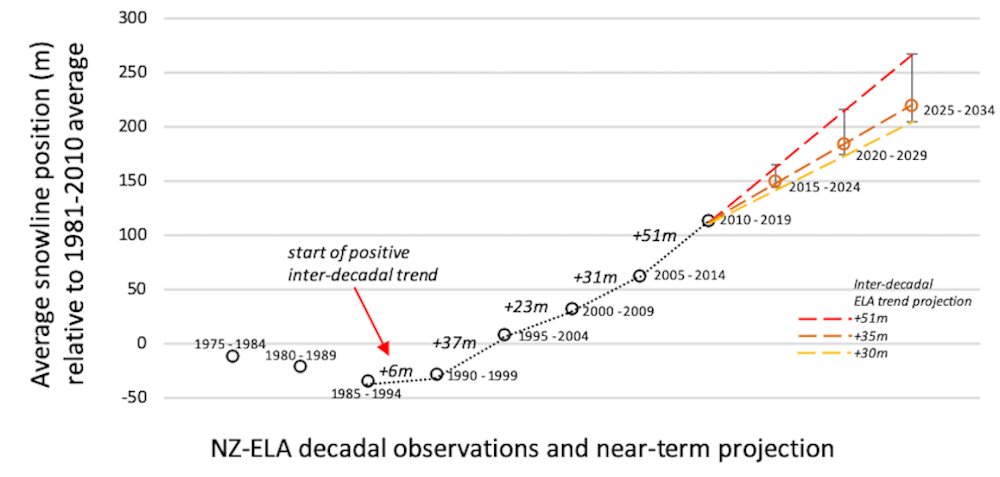 The rise of the snowline is accelerating in the Southern Alps. By 2035, many glaciers monitored by NIWA are expected to be approaching extinction.
Reproduced from Lorrey et al. (2022), CC BY-SA[20]
The rise of the snowline is accelerating in the Southern Alps. By 2035, many glaciers monitored by NIWA are expected to be approaching extinction.
Reproduced from Lorrey et al. (2022), CC BY-SA[20]
These connections raise the possibility that human activities have flicked the Zealandia Switch to a higher level of the “ON” position, and it may remain stuck there for the foreseeable future. If what unfolds is anything similar to when the Zealandia Switch curtailed the ice age during the Last Glacial Termination[21], we can expect big, fast and global climate re-organisation impacts.
The changes ahead may also bring the beginning of the end – a final termination – for many glaciers north and south.
References
- ^ climate change impacts (theconversation.com)
- ^ the hottest year on record nationally (storymaps.arcgis.com)
- ^ Basins filled with meltwater (doi.org)
- ^ moraines (nsidc.org)
- ^ CC BY-SA (creativecommons.org)
- ^ How climate change made the melting of New Zealand's glaciers 10 times more likely (theconversation.com)
- ^ CC BY-SA (creativecommons.org)
- ^ isotopes (www.energy.gov)
- ^ exposed to cosmic rays (www.antarcticglaciers.org)
- ^ rapid change happened about 18,000 years ago (doi.org)
- ^ Climate explained: what is an ice age and how often do they happen? (theconversation.com)
- ^ shifted at exactly the same time (agupubs.onlinelibrary.wiley.com)
- ^ Zealandia continent (www.geosociety.org)
- ^ driving more frequent marine heatwaves (deepsouthchallenge.co.nz)
- ^ record temperatures with them (www.theguardian.com)
- ^ The latest Southern Alps glacier research shows austral warm season temperatures and a rising snowline trend are tightly coupled (www.cambridge.org)
- ^ CC BY-SA (creativecommons.org)
- ^ anthropogenic greenhouse gas emissions (doi.org)
- ^ acceleration of global ice loss (doi.org)
- ^ CC BY-SA (creativecommons.org)
- ^ Last Glacial Termination (doi.org)