The Eta Aquariids meteor shower is set to light up the skies. Here's how to get the best seat in the house
- Written by: Jonti Horner, Professor (Astrophysics), University of Southern Queensland
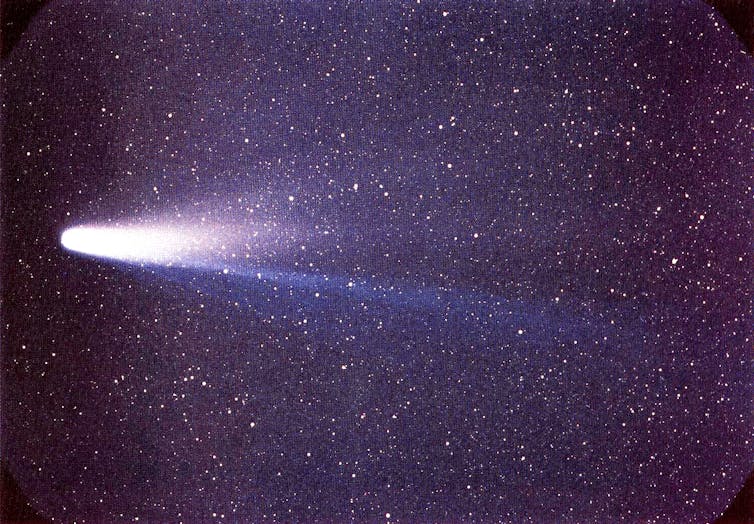
There’s something wonderful about sitting under the night sky, watching a meteor shower play out overhead. However, observers in the southern hemisphere usually get the short end of the stick, with most of the best showers[1] strongly favouring those north of the equator.
Every May, however, southern observers get a special treat – the Eta Aquariid meteor shower. This year conditions promise to be perfect, making it the ideal opportunity for some autumnal meteor observation.
The forecast peak for this year’s Eta Aquariids falls on the morning of Saturday, May 7. The Moon is well out of the way, so meteors won’t be lost in its glare.
But what if skies are cloudy? Well, if you miss the morning of the peak, don’t panic! The Eta Aquariids are famed for their broad peak, and meteor rates typically stay high for about a week around the peak (May 4–11). So if Saturday morning is cloudy, try looking again on Sunday, or even Monday.
To get the best view, you’ll want to get up in the early hours of the morning and be well away from any bright city lights. Give your eyes time to adjust to the darkness. Take a chair or recliner to get comfortable, relax and gaze skywards.
You won’t even need a telescope! To best observe meteor showers, you’ll want to watch as wide an area of sky as possible. Using a telescope or binoculars would make the spectacle almost impossible to observe.
Dust and debris from a famous comet
As the Earth orbits the Sun, it continually runs into dust and debris from comets and asteroids. Every April and May, the Earth spends about six weeks traversing a river of dust left behind by the famous Comet 1P/Halley[2].
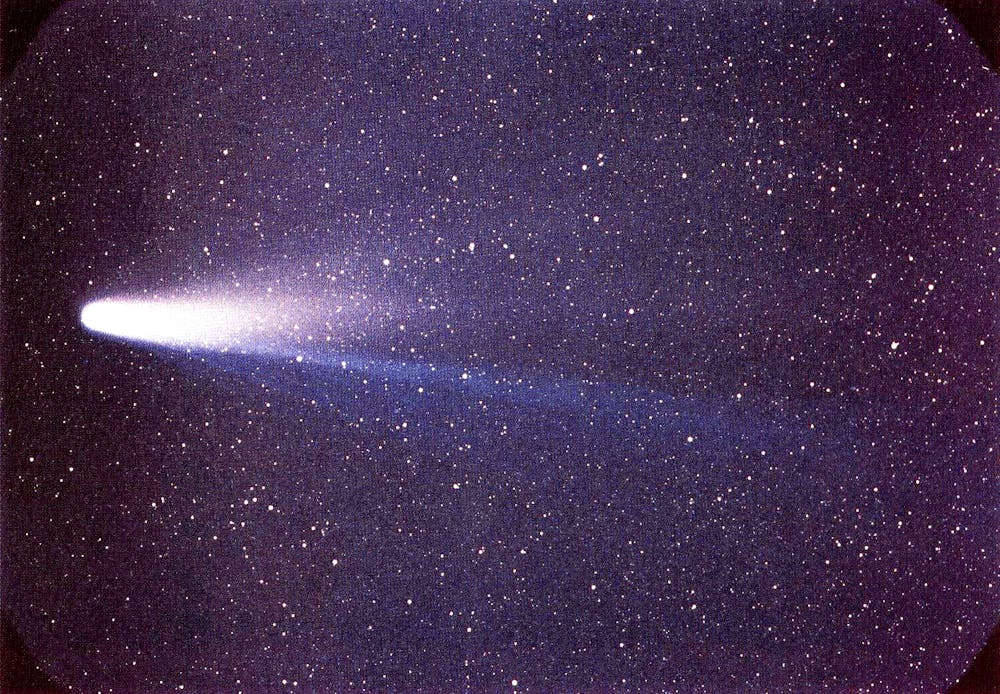
Every 76 years or so, Comet Halley swings close to the Sun. Its icy surface heats up until the ices boil off into space in a process called “sublimation[3]”. This shrouds the comet in a gaseous coma, which is blown away from the Sun to generate the comet’s tail.
The gas escaping Halley’s surface carries dust grains, which gradually spread around the comet’s orbit. Some move ahead of the comet, while others lag behind.
Over thousands of years, the space around Halley’s orbit has become thick with dust grains. The comet is essentially moving through a dirty snowstorm of its own making! And each year, the Earth runs through that broad river of dust – giving birth to the Eta Aquariid meteor shower.
Interestingly, the Earth runs into Halley’s debris again in October, producing the famous Orionid meteor shower[4]. But we get a better show in May each year with the Eta Aquariids, as this is when we move closer to the centre of the dust stream.
Read more: Thousands of satellites are polluting Australian skies, and threatening ancient Indigenous astronomy practices[5]
Where should I look?
When dust left behind by a comet smashes into Earth’s atmosphere, it becomes a spectacular fiery streak of light high in the sky. This usually happens about 80km above the ground[6], although the largest bits of debris can penetrate pretty deep into the atmosphere before burning up entirely.
The dust grains in a meteor shower all move around the Sun at essentially the same speed and in the same direction. This means the grains are also travelling in the same direction as they hit the Earth.
But as they move towards an observer on the ground, that observer’s perspective will make their paths diverge, and they will seem to be radiating out from a single point in the sky. That point is known as a shower’s “radiant”.
 The Orionid meteors are a great example of how meteors in a shower seem to radiate from a single point in the sky. Phil Hart
Meteors showers are named for the constellation in which their radiant lies. So the Eta Aquariids have a radiant near the star Eta Aquarii – the tenth-brightest star in Aquarius[7].
To see the Eta Aquariids, you’ll need to wait until the radiant rises – before that, the body of the Earth gets in the way. We’re lucky here in the southern hemisphere, as the Eta Aquariid radiant rises in the east at around 1:30 to 2am, local time.
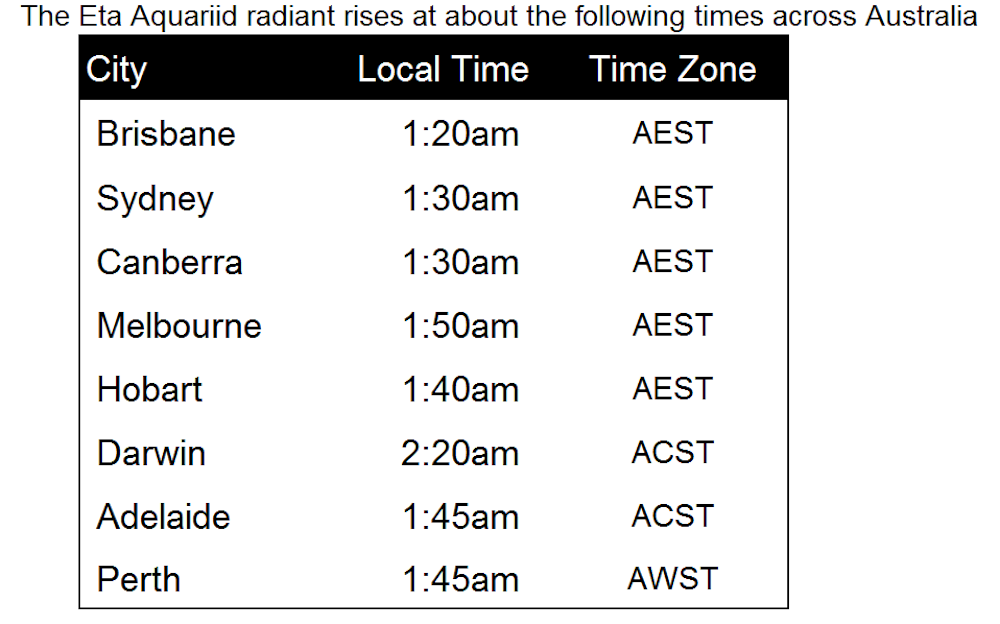 The Eta Aquariids radiant will rise between 1.20am and 2.20am for cities across Australia. Museums Victoria
While the Eta Aquariid meteors can be seen anywhere in the sky, the ideal place to see the best number of meteors is about 45 degrees to the left or right of the radiant itself.
Fortunately, this year we have another spectacular sight in the morning sky. Four planets – Saturn, Mars, Jupiter and Venus – will all be in a line. To see the best meteor show, look about 45 degrees to the left or right of this line of planets.
 The line of planets and the Eta Aquariid radiant as they will appear at around 4am on May 7 from Sydney (rising in the east). The sky will look mostly the same from Brisbane, Canberra and Perth at 4am (local time), Melbourne, Hobart and Adelaide at 4:30am (local time) and Darwin at 5am (local time). Museums Victoria/Stellarium
To see how the planets and radiant will rise from your location, visit the Stellarium planetarium website[8], set your location and move the date and time forward to the morning of May 7. If you turn on the “constellations” and “constellations art” (at the bottom of the screen), you can watch Aquarius and the planets rising from the comfort of your computer.
How many meteors should I expect to see?
The Eta Aquariids are the second best shower of the year for people in Australia. They can put on a spectacular show - but don’t expect to see meteors falling like snowflakes.
When the radiant first rises above the horizon, at around 1.30am, meteors from the shower will be few and far between. If you see five or six Eta Aquariids in that first hour, you should probably count yourself lucky.
That said, these early meteors could be really spectacular. Known as “Earth grazers”, they often seem to streak from near one horizon all the way across the sky. Earth grazers are the result of meteors hitting our atmosphere at a very shallow angle, almost edge on. They’re rare, but incredible to witness!
As the night goes on, and the radiant climbs higher into the sky, the number of meteors should increase. In the hour before dawn, you could easily see 20 to 30 meteors per hour.
Oh, and a word of warning: meteors are like buses – if you’re expecting 30 per hour, you can easily wait ten minutes and see nothing, before three come along at once. Make sure you dress warm so you can stay under the stars for at least half an hour, if not more!
Read more: Hunting galaxies far far away – here's how anyone can explore the universe[9]
References
- ^ most of the best showers (spaceaustralia.com)
- ^ Comet 1P/Halley (en.wikipedia.org)
- ^ sublimation (astronomy.swin.edu.au)
- ^ Orionid meteor shower (theconversation.com)
- ^ Thousands of satellites are polluting Australian skies, and threatening ancient Indigenous astronomy practices (theconversation.com)
- ^ usually happens about 80km above the ground (theconversation.com)
- ^ the tenth-brightest star in Aquarius (theskylive.com)
- ^ website (stellarium-web.org)
- ^ Hunting galaxies far far away – here's how anyone can explore the universe (theconversation.com)